Visual symbols are everywhere —numbers, letters, signs, logos, emblems, tattoos, flags, emoji’s, words, objects, insignias, colors, and more. They silently speak meaningful ideas, elicit powerful emotions, enhance understanding, and jog our memories. The Egyptians developed hieroglyphs to represent sounds, ideas, and history. Petroglyphs are ancient narratives written with characters chiseled into stone. Still photos tell stories. Emoji’s punctuate text messages and express feelings. Icons dot our iPhones and computer screens. Brand names speak status, and flags declare national identities.
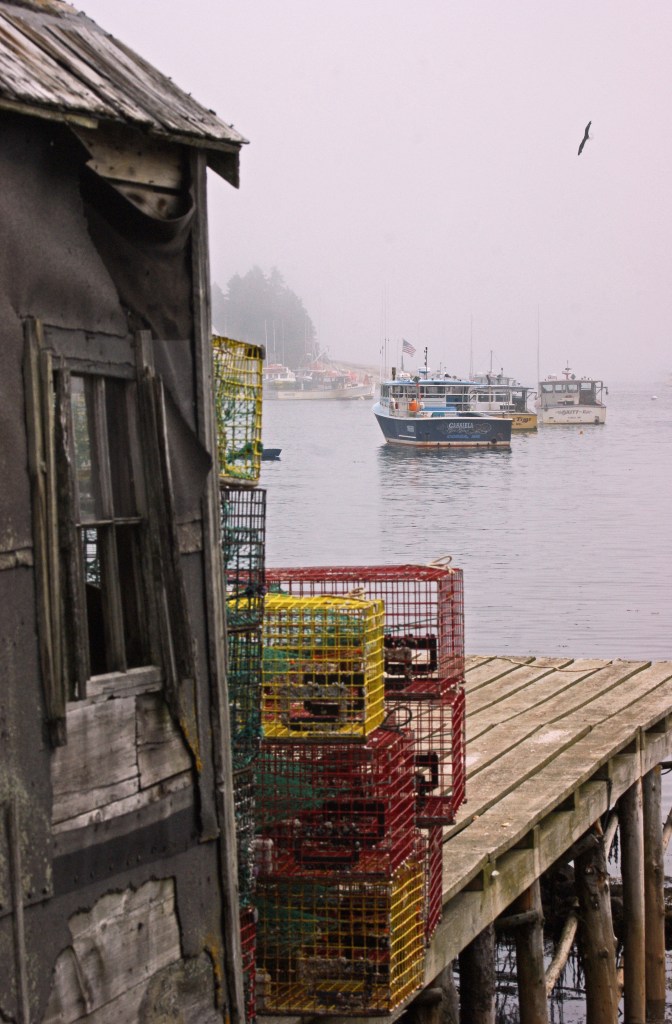
Today’s photo contains multiple visual reminders of a hard but cherished way of life. Colorful, wire lobster traps stacked beside a dilapidated shack on a wharf stretching into a harbor where lifting fog reveals well cared for, technically advanced fishing boats symbolize an industry loosely, yet lovingly, holding onto some of the old ways. Even though Downeast fishing continues to evolve and adapt as it has throughout many generations of fishing families, boats are still identified by fond relationships, special interests, senses of humor, or stark reality. Boats named “Calypso”and “Brown Eyed Girl” fish off the shores of Corea, and apparently one called “Nauti by Nature” fishes from Prospect Harbor. And occasionally the “labels” change because a spouse has.
The lone eagle circling the harbor in the fog is a symbol of courage and strength; its mug shot inhabits the back of the US dollar bill. For some Native Americans the eagle has a spiritual meaning, a kind of connection between human spirits and other spirits. Many religious communities have emblems with special meanings. Islam has its crescent moon and star; Hinduism has the Om, and Judaism the six pointed Star of David. Christianity has the Cross which oddly represents both death and victory. For a Christian the cross is not just a place of torture, punishmment, brutality, humility, shame, and a travesty of justice. Seeing it atop many church spires lifts one’s eyes to the heavens and one’s heart to the ultimate hope of humanity. It symbolizes Jesus’ loving sacrifice for human redemption and the conquering power over all evil and the evil one. It also reminds us that true love is willing to self sacrifice for the good of others.
The Scriptures overflow with symbolic language. Jesus illustrated his parables with seeds, soil, harvest, bread, water, sheep, sheep pens, fishnets, lamps, sand and rocks. The Book of Revelation is saturated with visions of humanity’s future. Rainbows represent God’s covenant with Noah. Jeremiah’s broken clay jars, flowering almond branches, and boiling pots convey truths about God’s dealings with Israel. A bronze serpent raised up by Moses in the Sinai wilderness centuries before Christ is prophetic of Jesus’ crucifixion and how sincere belief is the means of redemption and victory over death. Jesus linked those events in John 3 :14-15: “As Moses lifted up the serpent in the wilderness, even so must the Son of Man be lifted up, that whoever believes in Him should not perish but have eternal life.”
Jesus would fulfill that prophecy but illustrated it in a very moving way on the very night he was betrayed while celebrating the Jewish Passover with his disciples. Just a few hours before his humiliation and crucifixion, this group remembered their history with God, their miraculous Exodus from Egypt, and how the believing, obedient Israelites who put the blood of a sacrificial lamb on their door lintel were saved from the death which callous, unbelievers suffered. Jesus broke a loaf of bread which they all would share, lifted up the chalice from which they all would drink, and spoke sacred words which echo throughout history into present day Christian worship services.
He took the bread “and when he had given thanks, he broke it, and said, “This is my body, which is for you. Do this in remembrance of me.” In the same way also he took the cup, after supper, saying, “This cup is the new covenant in my blood. Do this, as often as you drink it, in remembrance of me” (1 Corinthians 11:23-24). Matthew’s Gospel reports these words: “for this is my blood of the covenant, which is poured out for many for the forgiveness of sins” (Matthew26:26-29).
The following day he would be crucified, lifted up on a Roman cross as the sacrificial lamb to atone for humanity’s sins as was prophesied by John the Baptizer when he saw Jesus: “Behold, the Lamb of God, who takes away the sin of the world! (John 1:29)
That atonement is a wonderful promise which can’t be topped, but actually, there is “frosting on the cake.” The Apostle Paul reminded his readers about the importance of observing communion: “as often as you eat this bread and drink the cup, you proclaim the Lord’s death until he comes” (I Corinthians 11:24). As these early believers remembered Christ’s sacrifice on the cross and celebrated him and this great salvation, they knew they were worshipping a risen Lord who would return one day and usher them into the eternal land promised them, a land foreshadowed centuries before as a band of Israelites saved by the blood of sacrificed lambs advanced into the Promised Land. That promise was fulfilled because they believed.
Those who believe in the atoning work of the Lamb of God for them personally are likewise headed for the Promised Land, an eternity blessed by God.

