Lighting the Way

“Two Lights”, Penobscot Bay, Mark Island, Stonington, Maine

Of the reportedly 65 lighthouses along the Maine Coast, 57 are active, 55 of which are managed by the Coast Guard. As shining sentinels guarding harbor entrances and standing on rocky shoals, these beacons guide fishermen and sailors safely home through the darkness hiding Maine’s hazardous waters and cliff lined shores.

The Genesis story of creation states quite simply that God created light: “God made the two great lights… and the stars. And God set them in the expanse of the heavens to give light on the earth, to rule over the day and over the night, and to separate the light from the darkness. And God saw that it was good. (Genesis 1:16-18)

That same narrative also reveals that God merely spoke and light appeared. Today, His voice enlightens our darkened, broken world and disperses spiritual darkness just as His words took away the darkness of the physical world. King David sang, “You are my lamp, O Lord, You turn my darkness into light.” “Your word is a lamp to my feet and a light to my path.” I have stored up Your word in my heart, that I might not sin against You” (2 Samuel 22:29) (Psalm 119:105) ( Psalm 119:11) And in his letter to Timothy, the Apostle Paul claimed that “All Scripture is inspired by God and is useful to teach us what is true and to make us realize what is wrong in our lives. It corrects us when we are wrong and teaches us to do what is right. (2 Timothy 3:15-16)

God’s message for humanity is so crucial, so loving, but so misunderstood that He personified it. He gave us Jesus. (John 3:16) His Word became more than oral or recorded or transcribed words. “For God, who said, “Let light shine out of darkness,” has shone in our hearts to give the light of the knowledge of the glory of God in the face of Jesus Christ. (2 Corinthian 4:6) Jesus, as the expressed image of God, became the living Word of God to give us redemption and hope. “In him was life, and the life was the light of men. (Colossians 1:15) (John 1:14) (Philippians 2:7) (John 1:4-5)

Through the life and redemptive activity of Christ, God’s voice speaks clearly and loudly. There is no mistaking that humanity is in extreme need of forgiveness and spiritual restoration and that God offers amazing grace to those who will believe. He delivers “ us from the domain of darkness and transferred us to the kingdom of his beloved Son…” (Colossians 1:13)

Jesus, “the Light of the World” came to shine through life’s hazards and pitfalls. He guides our souls to the safety of God’s Kingdom through the confusing darkness which invades humanity’s minds and spirits .“If you follow me, you won’t have to walk in darkness because you will have the light that leads to life, “ Jesus said. (John 8:12) 

Don’t Miss it!

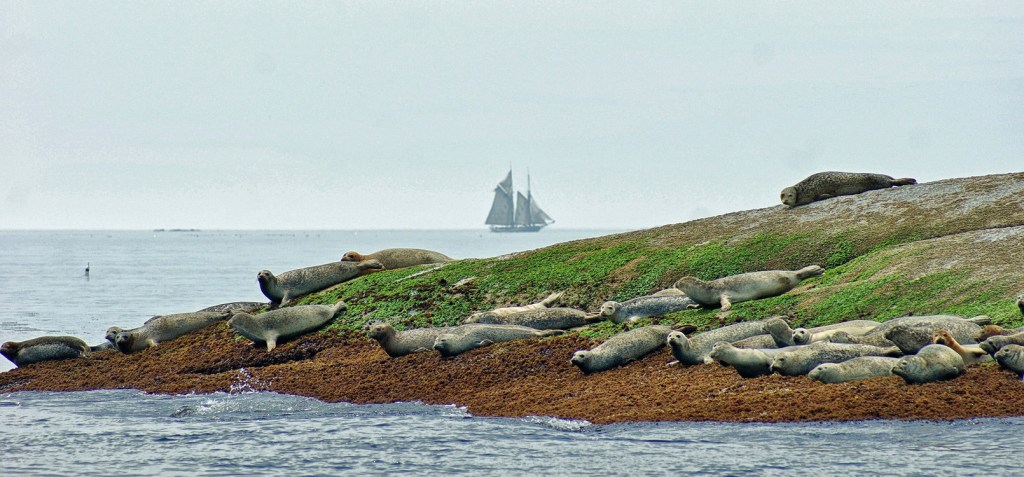
Seal Rookery, Penobscot Bay, Maine

Unwavering from its course, the distant ship is missing the wonder of this seal rookery and is a reminder of the gentleman in the anonymously written poem “Opportunities Missed”: There was a very cautious man/Who never laughed or played/He never risked, he never tried/ He never sang or prayed. // And when he one day passed away/His insurance was denied/For since he never really lived/They claimed he never died!

Hopefully, we are making the most of our opportunities, have few regrets, and are enjoying life. However, we all play the “what if” game. We wonder how different life might have been if we had just altered course a little, if we had chosen a different path, if circumstances had been different, if we had been more focused, mature, and discerning, if we had set better standards and goals, or if we had been more decisive and less fearful. We wonder how or why life has weaved itself together the way it has and whether we are living to our full potential in our current season of life!

Scripture is replete with accounts of men and women at some crossroads in life. Some chose wisely, but others chose poorly and missed out on a blessing. A whole civilization lost its life in the great flood because it mocked and did not heed God’s warnings; a generation of Israelites died in the wilderness because they did not trust God’s leading; the people of Sodom and Gomorrah ignored God and were destroyed; Jonah spent three days in the belly of a big fish because he refused to be God’s man; Solomon’s willful waywardness resulted in a divided Kingdom. These Old Testament examples remind us that it is easy to be self involved, to miss meaning and purpose, to sail by what God intends for us!

Jesus told many parables about missed opportunities. The Levite and the Priest in the story of the good Samaritan lost out on the blessing of helping others; five bridesmaid had no oil for their lamps and therefore missed the wedding feast; a man who hid his talent eventually had it taken away because he had done nothing with it. Perhaps the most striking and troublesome parable is about a group of people who totally missed their reason for being and, in the end, missed eternity with Him. ( Matthew 24:31-46)

We evaluate and therefore react to opportunities differently. Jesus was crucified between two thieves who had the same chance to know him. One questioned Christ’s authenticity. The other recognized Jesus’ power to save and requested that Jesus remember him when he came into his Kingdom. The thing about opportunities is that they are not just about the present but are about how the future will work out.

That is the reason to not sail by Jesus.

Our perceptions of him may differ, but if Scripture is correct, thoughtlessly ignoring him will be life’s greatest missed opportunity.

Don’t Miss it!

Seal Rookery, Penobscot Bay, Maine

Unwavering from its course, the distant ship is missing the wonder of this seal rookery and is a reminder of the gentleman in the anonymously written poem “Opportunities Missed”: There was a very cautious man/Who never laughed or played/He never risked, he never tried/ He never sang or prayed. // And when he one day passed away/His insurance was denied/For since he never really lived/They claimed he never died!

Hopefully, we are making the most of our opportunities, have few regrets, and are enjoying life. However, we all play the “what if” game. We wonder how different life might have been if we had just altered course a little, if we had chosen a different path, if circumstances had been different, if we had been more focused, mature, and discerning, if we had set better standards and goals, or if we had been more decisive and less fearful. We wonder how or why life has weaved itself together the way it has and whether we are living to our full potential in our current season of life!

Scripture is replete with accounts of men and women at some crossroads in life. Some chose wisely, but others chose poorly and missed out on a blessing. A whole civilization lost its life in the great flood because it mocked and did not heed God’s warnings; a generation of Israelites died in the wilderness because they did not trust God’s leading; the people of Sodom and Gomorrah ignored God and were destroyed; Jonah spent three days in the belly of a big fish because he refused to be God’s man; Solomon’s willful waywardness resulted in a divided Kingdom. These Old Testament examples remind us that it is easy to be self involved, to miss meaning and purpose, to sail by what God intends for us!

Jesus told many parables about missed opportunities. The Levite and the Priest in the story of the good Samaritan lost out on the blessing of helping others; five bridesmaid had no oil for their lamps and therefore missed the wedding feast; a man who hid his talent eventually had it taken away because he had done nothing with it. Perhaps the most striking and troublesome parable is about a group of people who totally missed their reason for being and, in the end, missed eternity with Him. ( Matthew 24:31-46)

We evaluate and therefore react to opportunities differently. Jesus was crucified between two thieves who had the same chance to know him. One questioned Christ’s authenticity. The other recognized Jesus’ power to save and requested that Jesus remember him when he came into his Kingdom. The thing about opportunities is that they are not just about the present but are about how the future will work out.

That is the reason to not sail by Jesus.

Our perceptions of him may differ, but if Scripture is correct, thoughtlessly ignoring him will be life’s greatest missed opportunity.

Don’t Miss it!

Seal Rookery, Penobscot Bay, Maine

Unwavering from its course, the distant ship is missing the wonder of this seal rookery and is a reminder of the gentleman in the anonymously written poem “Opportunities Missed”: There was a very cautious man/Who never laughed or played/He never risked, he never tried/ He never sang or prayed. // And when he one day passed away/His insurance was denied/For since he never really lived/They claimed he never died!

Hopefully, we are making the most of our opportunities, have few regrets, and are enjoying life. However, we all play the “what if” game. We wonder how different life might have been if we had just altered course a little, if we had chosen a different path, if circumstances had been different, if we had been more focused, mature, and discerning, if we had set better standards and goals, or if we had been more decisive and less fearful. We wonder how or why life has weaved itself together the way it has and whether we are living to our full potential in our current season of life!

Scripture is replete with accounts of men and women at some crossroads in life. Some chose wisely, but others chose poorly and missed out on a blessing. A whole civilization lost its life in the great flood because it mocked and did not heed God’s warnings; a generation of Israelites died in the wilderness because they did not trust God’s leading; the people of Sodom and Gomorrah ignored God and were destroyed; Jonah spent three days in the belly of a big fish because he refused to be God’s man; Solomon’s willful waywardness resulted in a divided Kingdom. These Old Testament examples remind us that it is easy to be self involved, to miss meaning and purpose, to sail by what God intends for us!

Jesus told many parables about missed opportunities. The Levite and the Priest in the story of the good Samaritan lost out on the blessing of helping others; five bridesmaid had no oil for their lamps and therefore missed the wedding feast; a man who hid his talent eventually had it taken away because he had done nothing with it. Perhaps the most striking and troublesome parable is about a group of people who totally missed their reason for being and, in the end, missed eternity with Him. ( Matthew 24:31-46)

We evaluate and therefore react to opportunities differently. Jesus was crucified between two thieves who had the same chance to know him. One questioned Christ’s authenticity. The other recognized Jesus’ power to save and requested that Jesus remember him when he came into his Kingdom. The thing about opportunities is that they are not just about the present but are about how the future will work out.

That is the reason to not sail by Jesus.

Our perceptions of him may differ, but if Scripture is correct, thoughtlessly ignoring him will be life’s greatest missed opportunity.

Of Beggars and Horses….

White Horse, Sorrento, Maine

“If wishes were horses beggars would ride”, an old Scottish proverb, expresses a desire for the ideal but assumes the harsh reality that not everything is possible. We long for Eden, for Paradise Lost, for a perfect world where there would be no reason for beggars. However, we know that there will always be poverty, mental illness, economic and social inequality, injustice, war and evil behavior. We are incapable of achieving a flawless state because men’s heart are broken and their minds are weak. Regardless of how long we spin our wheels and no matter how high our IQ’s are, we have neither foreknowledge nor incorruptible characters. So, we are given to incomplete or illogical thoughts which lead to flawed actions and unintended consequences.

 Cynical? No! Experience tells us that we cannot have full confidence in people and worldly ideologies. Science constantly reconstructs the meaning of collected data; its “truths” are changing, moving targets. Although intellectually stimulating, statistical analyses or observational conclusions drawn about our material universe don’t hold answers for moral dilemmas. Secularism which emphasizes human potential and value and goodness fails to resolve human problems because we are egocentric creatures. When relativism is elevated and absolutism is debunked and when sin and accountability are downplayed with a weird kind of tolerance which lacks any moral backing and makes our personal desires permissible, human ideas become folly. People fail us; ideologies betray us.

The ancients knew that faith in Sovereign God was the answer for a healthy and strong society. The Psalmist, a great warrior, repeatedly warned against trusting in men or princes or horses or chariots or military might for security and salvation. God was the source of his salvation.(Psalm 118:6-9), (Psalm 146:1-9), (Psalm 20:7-8) The prophets Isaiah and Hosea held the belief that human intentions and behaviors can not save” “Don’t put your trust in mere humans. They are as frail as breath. What good are they?” (Isaiah 2:22)You have eaten the fruit of lies— trusting in your military might, believing that great armies could make your nation safe (Hosea 10:12-13 (NLT2) The New Testament warns us that “… the wisdom of this world is folly with God. For it is written, ‘He catches the wise in their craftiness,’ and again, ‘The Lord knows the thoughts of the wise, that they are futile…’ (1 Corinthians 3:19-21)

Some would say that faith is like a beggar’s wishes because there is no certitude, and that here are no logical grounds for eternal hope. But the author of Hebrews stated it like this: “Now faith is the assurance of things hoped for, the conviction of things not seen.” (Hebrews 11:1) That statement is universally applicable. We do not have full “proof” about every thing we believe, yet we all have some system of belief that includes or excludes God, that believes in future nothingness or some eternal existence. The Judeo-Christian confidence in God arises from creation evidences, from the irrefutable, historical revelations of Scripture about who we are, who we were meant to be, what we can be, and how to grow toward achieving those goals through a power greater than ourselves because of the resurrection and redemptive work of Jesus for us. The Christian community is “built on the foundation of the apostles and prophets, Christ Jesus himself being the cornerstone,” (Ephesians 2:20)

A nation of people honoring God’s authority would be as close to attaining Eden as is possible because its highest ethic would be love: love of God and of neighbor. God showed us what that means through the sacrificial, unconditional, enduring love at the cross of Jesus Christ, who died that we might know peace with God and our neighbors. Although there have been glimmers of such societies, Eden is an impossibility because we choose to be greedy, selfish, power hungry, and seek pleasure and security and meaning not in God but by opposing Him.

As long as mankind knows more than God, dethrones and refuses to worship God, and ignores His redemption powers to forgive and to transform and to restore, we will live in spiritual poverty. But a long look at Scripture, a thoughtful consideration of Jesus, and a decision for faith gives the confidence all spiritual beggars need and long for. Christ makes “hope” a reality!

For you know the grace of our Lord Jesus Christ, that though he was rich, yet for your sake he became poor, so that you by his poverty might become rich.” (2 Corinthians 8:9)

Of Beggars and Horses….

White Horse, Sorrento, Maine

“If wishes were horses beggars would ride”, an old Scottish proverb, expresses a desire for the ideal but assumes the harsh reality that not everything is possible. We long for Eden, for Paradise Lost, for a perfect world where there would be no reason for beggars. However, we know that there will always be poverty, mental illness, economic and social inequality, injustice, war and evil behavior. We are incapable of achieving a flawless state because men’s heart are broken and their minds are weak. Regardless of how long we spin our wheels and no matter how high our IQ’s are, we have neither foreknowledge nor incorruptible characters. So, we are given to incomplete or illogical thoughts which lead to flawed actions and unintended consequences.

 Cynical? No! Experience tells us that we cannot have full confidence in people and worldly ideologies. Science constantly reconstructs the meaning of collected data; its “truths” are changing, moving targets. Although intellectually stimulating, statistical analyses or observational conclusions drawn about our material universe don’t hold answers for moral dilemmas. Secularism which emphasizes human potential and value and goodness fails to resolve human problems because we are egocentric creatures. When relativism is elevated and absolutism is debunked and when sin and accountability are downplayed with a weird kind of tolerance which lacks any moral backing and makes our personal desires permissible, human ideas become folly. People fail us; ideologies betray us.

The ancients knew that faith in Sovereign God was the answer for a healthy and strong society. The Psalmist, a great warrior, repeatedly warned against trusting in men or princes or horses or chariots or military might for security and salvation. God was the source of his salvation.(Psalm 118:6-9), (Psalm 146:1-9), (Psalm 20:7-8) The prophets Isaiah and Hosea held the belief that human intentions and behaviors can not save” “Don’t put your trust in mere humans. They are as frail as breath. What good are they?” (Isaiah 2:22)You have eaten the fruit of lies— trusting in your military might, believing that great armies could make your nation safe (Hosea 10:12-13 (NLT2) The New Testament warns us that “… the wisdom of this world is folly with God. For it is written, ‘He catches the wise in their craftiness,’ and again, ‘The Lord knows the thoughts of the wise, that they are futile…’ (1 Corinthians 3:19-21)

Some would say that faith is like a beggar’s wishes because there is no certitude, and that here are no logical grounds for eternal hope. But the author of Hebrews stated it like this: “Now faith is the assurance of things hoped for, the conviction of things not seen.” (Hebrews 11:1) That statement is universally applicable. We do not have full “proof” about every thing we believe, yet we all have some system of belief that includes or excludes God, that believes in future nothingness or some eternal existence. The Judeo-Christian confidence in God arises from creation evidences, from the irrefutable, historical revelations of Scripture about who we are, who we were meant to be, what we can be, and how to grow toward achieving those goals through a power greater than ourselves because of the resurrection and redemptive work of Jesus for us. The Christian community is “built on the foundation of the apostles and prophets, Christ Jesus himself being the cornerstone,” (Ephesians 2:20)

A nation of people honoring God’s authority would be as close to attaining Eden as is possible because its highest ethic would be love: love of God and of neighbor. God showed us what that means through the sacrificial, unconditional, enduring love at the cross of Jesus Christ, who died that we might know peace with God and our neighbors. Although there have been glimmers of such societies, Eden is an impossibility because we choose to be greedy, selfish, power hungry, and seek pleasure and security and meaning not in God but by opposing Him.

As long as mankind knows more than God, dethrones and refuses to worship God, and ignores His redemption powers to forgive and to transform and to restore, we will live in spiritual poverty. But a long look at Scripture, a thoughtful consideration of Jesus, and a decision for faith gives the confidence all spiritual beggars need and long for. Christ makes “hope” a reality!

For you know the grace of our Lord Jesus Christ, that though he was rich, yet for your sake he became poor, so that you by his poverty might become rich.” (2 Corinthians 8:9)

Ripples

Heron on the Taunton River, Sullivan, Maine

This little heron presents us with a visual metaphor. We often feel helpless and vulnerable in the chaotic, confusing sea of geopolitical messes, pandemic crises, inconceivable violence, and moral decline in our world, but this awkward appearing bird emanating ripples from the center of its personal microcosm as it carefully and quietly searches for its dinner speaks a truth to us.

Our personal impact on the small world around us, even in the more mundane moments, is powerful. Words, attitudes, efforts, and behaviors can diminish or encourage those who seek our approval. Similarly, we remember kindnesses,  affirmations, encouragements, gentle exhortations and commendations, but we also hang onto negativity directed at us. We nurse snide remarks, verbal abuse, being ignored, and gossipy character assassinations. Apologies may be made and forgiveness sought, but words and actions can’t be retrieved and may evolve into resentments.

As approval seekers, we self-evaluate by others’ criteria. Our minds  are bombarded and molded daily by a wide variety of  conflicting and confusing cultural, subliminal messages as well as by overt, intentional persuasions of family, friends, teachers, writers, musicians, social media, news casters, religious leaders, and politicians, all of whom have opinions and points of view!

Popular music frequently mirrors real life stories and insights into “our ripple effect.”  In her song “I’m everything I am/ Because you loved me”,  Celine Dion reinforced the great importance of encouraging, supporting, and loving those about us.  Ray Boltz’s “Thank you for giving” broadens that kind of power to a much wider circle than we might imagine. The setting of his song is heaven where he is walking with his friend. People unknown to his friend approach and thank his friend for how he had influenced their lives as he lived out the graces of the Gospel. “One by one they came/Far as the eyes could see/Each life somehow touched/ By your generosity/Little things that you had done/ Sacrifices made/Unnoticed on the earth/In heaven now proclaimed.” Each came with the same message; “Thank you for giving to the Lord/I am a life that was changed/Thank you for giving to the Lord/I am so glad you gave.”

There is no better motivator for grace than the Gospel. There is no better mirror than Scripture where we can ascertain who we truly are–broken but valuable before Holy God, who in extreme love offers us redemption despite our faults, evil desires, and bad behaviors. Scripture reveals that wisdom for this earthly life begins by revering God, that His principles guide our journeys, that Jesus is the light of the World, and that we should walk as he did and be imitators of God, who gives us His righteousness through faith and empowers us to be gracious and to live a life of love and generosity.

If those ideas become more than theory, if they become a reality, some pretty nice “ripples” will be generated even when one isn’t trying!


Ripples

Heron on the Taunton River, Sullivan, Maine

This little heron presents us with a visual metaphor. We often feel helpless and vulnerable in the chaotic, confusing sea of geopolitical messes, pandemic crises, inconceivable violence, and moral decline in our world, but this awkward appearing bird emanating ripples from the center of its personal microcosm as it carefully and quietly searches for its dinner speaks a truth to us.

Our personal impact on the small world around us, even in the more mundane moments, is powerful. Words, attitudes, efforts, and behaviors can diminish or encourage those who seek our approval. Similarly, we remember kindnesses,  affirmations, encouragements, gentle exhortations and commendations, but we also hang onto negativity directed at us. We nurse snide remarks, verbal abuse, being ignored, and gossipy character assassinations. Apologies may be made and forgiveness sought, but words and actions can’t be retrieved and may evolve into resentments.

As approval seekers, we self-evaluate by others’ criteria. Our minds  are bombarded and molded daily by a wide variety of  conflicting and confusing cultural, subliminal messages as well as by overt, intentional persuasions of family, friends, teachers, writers, musicians, social media, news casters, religious leaders, and politicians, all of whom have opinions and points of view!

Popular music frequently mirrors real life stories and insights into “our ripple effect.”  In her song “I’m everything I am/ Because you loved me”,  Celine Dion reinforced the great importance of encouraging, supporting, and loving those about us.  Ray Boltz’s “Thank you for giving” broadens that kind of power to a much wider circle than we might imagine. The setting of his song is heaven where he is walking with his friend. People unknown to his friend approach and thank his friend for how he had influenced their lives as he lived out the graces of the Gospel. “One by one they came/Far as the eyes could see/Each life somehow touched/ By your generosity/Little things that you had done/ Sacrifices made/Unnoticed on the earth/In heaven now proclaimed.” Each came with the same message; “Thank you for giving to the Lord/I am a life that was changed/Thank you for giving to the Lord/I am so glad you gave.”

There is no better motivator for grace than the Gospel. There is no better mirror than Scripture where we can ascertain who we truly are–broken but valuable before Holy God, who in extreme love offers us redemption despite our faults, evil desires, and bad behaviors. Scripture reveals that wisdom for this earthly life begins by revering God, that His principles guide our journeys, that Jesus is the light of the World, and that we should walk as he did and be imitators of God, who gives us His righteousness through faith and empowers us to be gracious and to live a life of love and generosity.

If those ideas become more than theory, if they become a reality, some pretty nice “ripples” will be generated even when one isn’t trying!


Of Lilacs and Remembrances

Lilacs in a Vibert Vase, Sullivan, Maine

Look, the winter is past, and the rains are over and gone/ The flowers are springing up, the season of singing birds has come, and the cooing of turtledoves fills the air… “Lilacs are exuberantly purple and perfumed, and cherry trees fragrant with blossoms….”(Song of Songs 2:11-12, NLT2; 2:13 MSG)

In late May, beautiful purple and white lilac blossoms renew Maine’s countryside with color and fragrance after having been draped for months in winter starkness and long spring drabness. They bloom everywhere.

Lilacs in dooryards/Holding quiet conversations with an early moon/ Lilacs watching a deserted house/Settling sideways into the grass of an old road/ Lilacs, wind-beaten, staggering under a lopsided shock of bloom/Above a cellar dug into a hill. You are everywhere.”  (excerpt from “Lilacs” by Amy Lowell)

These late May blooms are not only lovely, aromatic forerunners of summer but are also happy reminders of my Mother, who loved lilacs not only for their beauty and fragrance but because her Father did! On Memorial Day, she would place a bouquet on his grave.

Memorial Day began as Decoration Day, a day commemorating Civil War soldiers who had died in the war. Currently, it is designated a national holiday day set aside to remember all veteran women and men, living or dead, with patriotic parades, memorial services of gratitude and commemorations, and flags decorating graves.

And then there are red poppies! Historical reminders, symbols, and perspectives are so important. Wynne McLaughlin reportedly said,  “Maybe history wouldn’t have to repeat itself if we listened once in awhile.”  In 1915, John McCrae, a Canadian Army Lieutenant wrote the poem  “In Flanders Fields” to honor the memory of his fallen comrades who fought the sad, bloody battles of WW1 through the poppy fields of France and to hold future generations responsible for keeping the world free from tyrannyIn Flanders fields the poppies blow/Between the crosses, row on row/ … We are the dead. Short days ago/We lived, felt dawn, saw sunset glow… Take up our quarrel with the foe: To you from failing hands we throw/The torch; be yours to hold it high/If ye break faith with us who die/We shall not sleep, though poppies grow/In Flanders fields.” (Excerpts from In Flanders Fields)

Similarly, Scripture calls us to this wisdom of remembrance. It exhorts us to never lose sight of the character and works and words and presence of  God because He knows what is best for us. Jeremiah recognized our strange reluctance to seek the moral guidelines which bring us peace: “Thus says the Lord: “Stand by the roads, and look, and ask for the ancient paths, where the good way is; and walk in it, and find rest for your souls…” (Jeremiah 6:16) Isaiah urged Israel to “Remember the former things of old; for I am God, and there is no other; I am God, and there is none like me.” (Isaiah 46:9) The Psalmist reminds us “…to forget not all (God’s) benefits” and then lists some: forgiveness, redemption, healing, righteousness and justice; God is merciful, gracious, compassionate, and patient and abounds in love; He is sovereign but gentle with us because He remembers we are dust. (Psalm 103)

If we are to remember God, then we must seek knowledge of Him. Creation speaks to us of God’s nature. (Romans 1:20) The Scriptures tell us who God is (2 Timothy 3:16-17)  Christ showed us the character image of God.. “For in him all the fullness of God was pleased to dwell, and through him to reconcile to himself all things, whether on earth or in heaven, making peace by the blood of his cross.” (Colossians 1:19-20) And through the Communion symbols of broken bread and poured out wine, Christ opened his heart of grace and mercy to his disciples as he drew them close to his cross and called them to a regular remembrance of his redemptive action for all. “Do this in remembrance of me,” he said. (1 Corinthians 11:24-25)

But there is a very happy and blessed contrast to God’s remembrances. God forgets! In His gracious ways, in His detailed knowledge and understanding, and in His compassion for us who live in this fragile, dusty, mortal state, God is gentle and patient and loving  and willing to “forget” our sins. When we come to Him by faith, “as far as the east is from the west, so far does he remove our transgressions from us”. (Psalm 103) He promises to remember them “no more.” (Isaiah 43:25) (Hebrews 10:17) That is the confidence of faith.


Life and Art…

Painting on Monhegan Island, Maine

Does art imitate life or does life imitate art? Apparently, whether life merely influences artistic expression or whether art influences our perception and behaviors were questions debated by Aristotle and Plato!

We all are imitators and influencers. We formulate our own life views from the ideas, behaviors, and artistic expressions of the people and the culture we know and then model it to others. Written words may change the course of one’s life as one acquires a personal world view. Fashions reflect the way we feel about ourselves whether mod, goth, hip, cool, professional, or wealthy and fashionable, but they also contribute to one’s sense of self respect and to performance.  Violence, drug use, and  immorality in tv programs, movies,  theatrical performances,  or video games may have their origins in personal experiences but also affect attitudes and life styles of those who view these activities.

Creativity is a characteristic of God. He spoke into being all that is good in this vast and mysterious cosmos which displays His ” invisible qualities—his eternal power and divine nature.” (Genesis 1)(Romans 1:20)  If we are created in God’s  image, our creativity must be meant to be more than self expression of an emotion, an idea, or a perception. Its derivation is good. So, shouldn’t a poet’s poetry, a photographer’s lighting, a painter’s shades and tones, a musician’s notes and lyrics, a dancer’s steps, and the inking of words point us toward a greater wonder or truth?

Scripture does that. Humanity’s good, bad and ugly behaviors are on display through historical records,  revelations, stories, parables, teachings, and exhortations. It reveals life as it is, who we are, and who God is. It directs us to God through redemptive faith. It teaches a universal moral code which gives definition to right and wrong,  encourages discernment, holds parents responsible for modelling and teaching moral values,  and exhorts us to guard our mind by considering what is good, true, honorable, pure, commendable, and worthy of praise . (Philippians 4:8)    Scripture encourages believers to learn from one another, to consider the faith of the Saints, to imitate the character of God, to walk as Jesus did, to joyfully live out the Gospel with mercy, grace, love, kindness, forgiveness, and an enduring peace filled spirit. Scripture is powerful and changes lives when revered.

In truth, we are “works of art!” Whether our image is one of lost, restless, wandering sheep or molded pottery or children of God or a “tapestry”, we are working through the choices and meaning and purposes of our lives in the context of created beings:

Our lives are but fine weavings, that God and we prepare/ each life becomes a fabric planned/ and fashioned in His care…..We may not always see/just how the weavings intertwine/ but we must follow the Master’s hand and trust His design/ For He can view the pattern/ upon the upper side while we must look from underneath/ and trust in Him to guide….The dark threads are as needed/in the Weaver’s skillful hand/as the threads of gold and silver/ in the pattern He has planned.” (Excerpts from the “Master Weaver”)

“Art” is part of who we are and are becoming. As individual people, we have our own distinctive songs, color palettes, and dance moves, but in whatever way our lives are expressed, our giftedness is a tool for good and should honor the One from whom all good and perfect gifts come.