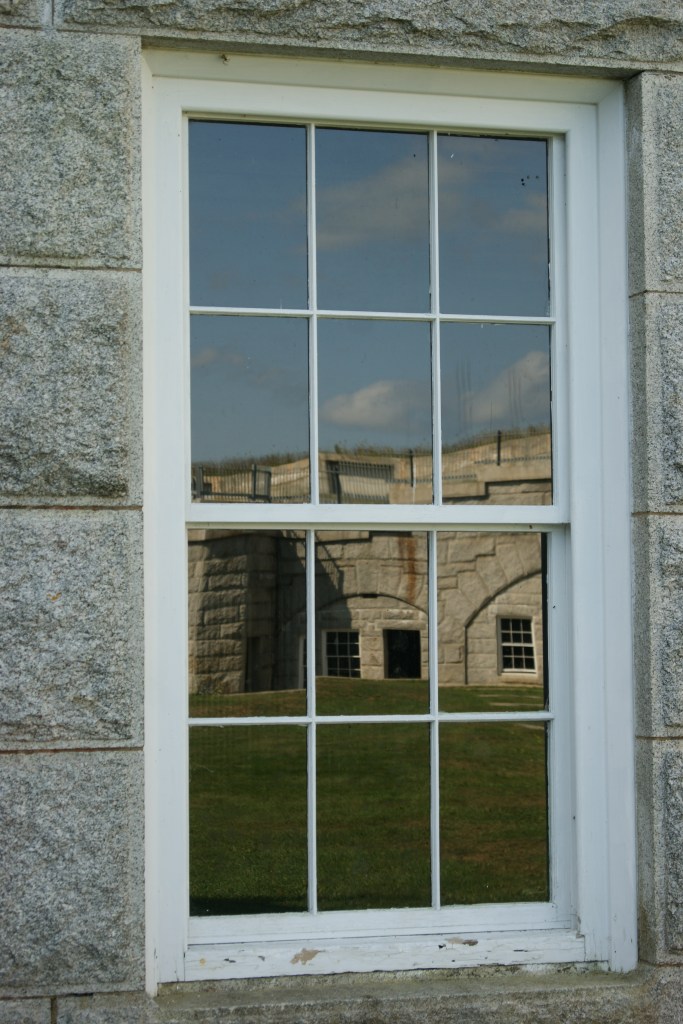
Distorted Reflections

Now we see things imperfectly as in a cloudy mirror, …” (1 Corinthians 13:12)

Fall Reflections, Taunton River, Sullivan, Maine

If you want an impartial assessment of yourself ( and probably you don’t), spend some time under the innocent but brutal scrutiny of a three-year-old. Recently, while I was playing with my granddaughter, she offhandedly revealed that I have big ears, hair in my nose, a big belly and several other observations which I conveniently have forgotten. However, after a quick mirror check, I was disappointed to see that she was quite observant. 

We easily distort reality because we have bruised psyches, lack personal insight, and allow ourselves at least a modicum of magical thinking! Neglect, rejection, bullying, abuse, and bad choices contribute to a negative sense of self worth. Misperceptions such as an exaggerated fixation on a specific or imagined bodily defect may lead to significant psychological and/or social dysfunction such as anorexia. Narcissistic personalities overplay the importance of self, position, and appearance.  And we all have idiosyncrasies and quirks which may be annoying or offensive to others.

In C. S. Lewis’s somewhat amusing but seriously probing book, The Screwtape Letters, a demon named Screwtape writes a series of letters to assist his nephew, Wormwood, who had been given the responsibility of derailing the faith of a new convert to Christianity. Wormwood’s goal was to confuse his “patient’s” mind so that his faith would be rendered superficial, hypocritical, ineffectual, and effectively denied. A bit of Screwtape’s advice was: “You must bring him to a condition in which he can practice self-examination for an hour without discovering any of those facts about himself which are perfectly clear to anyone who has lived in the same house with him or work in the same office”

We laugh! But the point is that we are spiritually prideful. We don’t believe that we are sinful and condemned. However, the reality is that Holy God knows that we are unholy people, and we know we need redemption. Faith begins with the raw honesty that we are all incapable of perfection, and so we need God to rescue us, which He lovingly does through Christ, who paid the penalty for our broken natures.

  Self examination is more painful work than denial and delusion, but we have help keeping our feet to the fire: “…the Holy Scriptures, which are able to make you wise for salvation through faith which is in Christ Jesus.  All Scripture is given by inspiration of God, and is profitable for doctrine, for reproof, for correction, for instruction in righteousness, that the man of God may be complete, thoroughly equipped for every good work. (2 Timothy 3:15-17)

Scripture keeps us honest. It exposes us, warts and all. But when we come to terms with our brokenness , we find healing, completeness, and love. Such was the journey and prayer of the Psalmist. “…Create in me a clean heart, O God; And renew a right spirit within me.” (Psalm 51: 7-10 )

Whose Story?

Last week we remembered D-Day, that historic day which began the joyful reclamation of Europe from tyranny but which was tragically stained by the tremendously sad sacrifices of young men dying to restore liberty. Remembering people and events from our past helps to define us as people and as a country, to understand and evaluate our strengths and weaknesses, to celebrate our successes, and to correct or atone for our errors. It guides us forward to a changed future.

The reflection of Fort Knox in this window reminds us not only of a different war for freedom (Revolutionary) but also of how relevant history is to our current life of freedom. Although until fairly recently, we have accessed historical knowledge through the reflections of oral and written stories and facts, the lens of modern audio-visual technology now allows us to experience history as it happens even though it has happened before our time! And we can relive some of our own experiences! As I was thinking about this blog, my brain kept playing the tune and hearing the lyrics of “Wonderful World” emanating from somewhere out of the din and fog of the past. So, I turned to the internet and started reliving the 70’s!… 

“Don’t know much about history, don’t know much biology. Don’t know much about a science book, don’t know much about the French I took. But I know that I love you, and I know that if you love me too What a wonderful world this would be…”

 Those are simple words sung to a catchy tune! (check it out if you don’t recognize it!) But within that song lies the profound fact that our greatest need is to be loved! This past week, our country experienced protest marches and endured riots stemming from very deep national and personal hurts and mistrusts because we neither understand nor value each other. We either lack the skills or do not have the will to love and to treat each other with the respect any human should extend to another human.

Love is the overarching theme of the Judaeo-Christian narrative which is God’s story about His gracious offer to free mankind from the tyranny of ourselves. It is about the ways He values us and protects us with His love just as He did Israel, to whom was given the promise, “For the LORD your God is going with you! He will fight for you..(Deuteronomy 20:4)”

And He has done that for us; Regardless of skin color or ethnicity or social status or gender, God draws all people who will believe to Himself and to His Kingdom. He lovingly moves throughout this corrupted creation administering mercy and justice in order to redeem everyone of us. He fought the decisive battle for our liberty through the sacrifice of Christ, who took the wrath and just penalty for our sins so that we would be completely forgiven and not face condemnation if we trust. He showed us love through mercy so that we might live lives of mercy and forgiveness. As a result, we can confidently sing with Martin Luther: “A mighty fortress is our God, a bulwark never failing, Our helper He, amid the flood of mortal ills prevailing.” And we can agree that all who live are valued.

His story is about salvage and renewal. We all need it. We are all part of the problem, but He will make us part of the solution if we will let Him!

Just A Glimpse

Andrew Young, a Scottish poet, compared his ongoing but somewhat futile quest for meaning to searching for lady slippers:  “…I peer in every place: Seeking for what I cannot find/ I do as I have often done/ And shall do while I stay beneath the sun.” (Lady-Slipper, Orchid)

We “see”, and we are amazed at our unique world.  But how often does that translate into awe of God? Or even to a glancing thought of Him? Do we ever get a glimmer of why God viewed His creation and said, “It is good”?(Genesis 1:11-12) Generally, we prefer to be analytical and shrug off theological truths about the amazing source of a sunset, the physiology of a cell, the complex and unifying functions of our bodies, the mysterious appearance of a giraffe, or the vast DNA variants found, not just in the Galapagos Islands, but in the whole earth.

St Augustine didn’t give us much credit for making a meaningful connection between our lives and what we observe: “Men go abroad to wonder at the height of mountains, at the huge waves of the sea, at the long courses of the rivers, at the vast compass of the ocean, at the circular motion of the stars; and they pass by themselves without wondering.”

  God majors in creative uniqueness. He parts seas for His people, speaks in thunder and lightning on mountain tops, reveals His purposes through stubborn donkeys, and appears to us as a poor Rabbi, Jesus. (Numbers 22:30) (Colossians 1:15-16) . Sometimes, especially during personal chaos, God unexpectedly speaks to us in a “still small voice”, calming our personal unrest and giving us a glimpse of Him as He did Elijah. (1 Kings 19:12) However, Job’s experience was different. In the midst of his sufferings, self-pity and struggles with God, God inspired him from a whirlwind, “Hear this, O Job; stop and consider the wondrous works of God.” Through creation’s marvels, Job began to understand that he never would be able to explain everything, and he saw God’s transcendence, His sovereign justice and purposes. (Job 37:14; 38:1)

A couple of years ago, a friend walked me through his woods to a secluded place and a hidden patch of stunning, delicate, pink and white Lady’s Slippers. Their captivating loveliness quietly but beautifully announced God’s magnificent imagination. These small flowers clearly declared the huge message that God has imparted glory to His creation.

“Meaning” is there for our viewing and consideration! “The heavens proclaim the glory of God. The skies display his craftsmanship. (Psalm 19:1) Our lady’s slipper not only provides us with a glimpse of God but also a peek at ourselves. We are manifestations of God’s loving creativeness. We are made to shine with the glory of His beautiful character. We have tarnished the glory, but He offers to restore us through redemption n Christ. (Genesis 1:26) (Matthew 5:16) (1 Corinthians 2:7 (John 3:16)

Slack Tide

Sunset at “slack tide” Taunton Bay, Sullivan, Maine

Oddly enough, this canoe facing a setting sun reminds me of two people, my grandmother Viola Bancroft Preble (1886-1973) and Alfred Lord Tennyson (1809-1892). They never met but briefly were contemporaries! My grandmother loved to read his poetry to us when we were children. One might question the appropriateness of reading The Charge of the Light Brigade or Crossing the Bar to seven- or eight-year old’s, but she loved drama and literature, and we loved her and listening to her. And we were not traumatized!

In Crossing the Bar, Tennyson metaphorically envisions his life finishing at a “slack tide”, that moment when the tide is full and when the sea quietly awaits the transition from in-coming to out-going. It is the turning of tides when movement stops before reversal. Such is the twilight moment of “crossing the bar” when mortality transitions to immortality, when the spirit silently leaves its earthly abode and enters the after life.

    Crossing the Bar

Sunset and evening star
   And one clear call for me!
And may there be no moaning of the bar,
   When I put out to sea,

But such a tide as moving seems asleep,
   Too full for sound and foam,
When that which drew from out the boundless deep
   Turns again home.

Twilight and evening bell,
   And after that the dark!
And may there be no sadness of farewell,
   When I embark;

For though from out our bourne of Time and Place
   The flood may bear me far,
I hope to see my Pilot face to face
   When I have crossed the bar.

                          Alfred Lord Tennyson

Tennyson saw no need for drama, for moaning, or for a sad farewell at his death which he approached calmly and unafraid because He had faith in the One who had guided him through life, the One who had risen from the dead and had promised to prepare a place for him, the same One of whom the Psalmist spoke:“For this God is our God for ever and ever: He will be our guide even unto death.” (Psalm 48:14)“You will guide me with your counsel, And afterward receive me to glory.” (Psalm 73:24)  

The confident expectation of those who believe is well stated, “I hope to see my Pilot face to face , When I have crossed the bar.”

Paddle Your Own Canoe

Canoe at Sunshine, Maine

The phrase to “paddle your own canoe” has been around since the mid 1800’s and conjures up ideas of independence, self-reliance, persistence, endurance and the belief that we control our own destiny! Several poems were written and entitled “Paddle Your Own Canoe”. Sarah Bolton’s contained an often partially quoted verse:

Voyager upon life’s sea,
To yourself be true,
And whatever your lot may be,
Paddle your own canoe…..

   I recently watched a season of “Alone”, a reality series about ten people who were simultaneously placed in separate, isolated, wilderness locations with minimal survival gear. The contestants’ goal was to survive the longest and win a half million dollars. They endured starvation, loneliness, severe weather adversity, and isolation! Most had the noble goal of bettering their families’ lives, but deeper reasons were divulged. They drove themselves to their physical and emotional limits in search of answers to questions they had about themselves. They needed proof that that they were caring, strong, capable, and worthy of respect, that they were valuable and good people despite their flaws and personal histories.

Their motives and questions are generic. We are all survivalists who face life differently, yet similarly. We waffle about while seeking purpose in our lives. We suffer and want strength to overcome. We have self doubts and desire affirmation. We want to know the “why’s” and “where” we are to paddle our canoes. Our choices (along with others’ choices) determine the course we take, and often the waters are rough.

Psalm 4 is a song with an answer and a solution for us: “But know that the LORD has set apart the godly for himself; the LORD hears when I call to him….. There are many who say, “Who will show us some good?” Lift up the light of your face upon us, O LORD! You have put more joy in my heart than they have when their grain and wine abound. In peace I will both lie down and sleep; for you alone, O LORD, make me dwell in safety.” (Psalm 4:3-8)

We long for joy, peace, and security. Although some temporary satisfaction is found in transitory material things and worldly pleasures (in “grain and wine”), a repentant life, centered upon and trusting God, will find “joy of heart” and will “lie down and sleep” in peace because He has lifted His light upon us, has shown us “good”, and secured us through the the sacrifice of Christ for us.

The Psalmist gives us the eternal perspective about who and what we need. “The LORD is my shepherd; I shall not want.He makes me lie down in green pastures. He leads me beside still waters. He restores my soul. He leads me in paths of righteousness for his name’s sake. Even though I walk through the valley of the shadow of death, I will fear no evil, for you are with me; your rod and your staff, they comfort me. You prepare a table before me in the presence of my enemies; you anoint my head with oil; my cup overflows. Surely goodness and mercy shall follow me all the days of my life, and I shall dwell in the house of the LORD forever.” (Psalm 23:1-6)

We paddle into safe waters when we paddle our canoes toward immortal God and ultimate answers!

The Way forward

The way forward is often uncertain and rarely takes a straight line. Sometimes, we are fine with the routine, the boring, and small pleasures. Sometimes, we long for the sun to brighten the way ahead! But all the time, there are questions lurking about, shrouded in the deep, foggy crevices of our minds.

We desire answers. We seek knowledge, understanding, and wisdom as we puzzle out how to live life. We want to utilize time well and to discover and achieve our intended destinations.  On one level, we check maps, compasses, travel and hunting guides, mathematical equations, and YouTube for directions. On a different level, we seek out self help books, mentors and life coaches to assist us in navigating emotional and spiritual uncertainties. We question the scientist, the historian, the philosopher, the theologian, “Why”, “What is it all about?”, “How am I to make sense of this?”.

Perhaps these lobstermen have a lesson for us. Although they appear headed straight for disaster, they are confidently advancing to the next lobster pot. They are in familiar territory as they pull their traps in the fog. They know the way. They have been following the tactics taught to them by their fathers before them for many years.

Scripture tells us to seek the ancient paths that lead to healthy living through simple, practical instructions which are personally advantageous as well as beneficial for the common good. These include such exhortations as : don’t be a sluggard, care for your family and neighbor, be at peace with all men as much as is possible, be careful about going into debt,  avoid bad company, respect one’s elders and leaders, be law abiding, and bring justice to the poor, disenfranchised, and suffering.

The integrity of God’s moral law (Exodus 20) has never been topped. His code of ethics flawlessly guides us how to live life for our own good and the good of others. And most importantly, the redemptive words of Christ in the Beatitudes (Matthew 5) point the way to the Kingdom of God. These principles are reliable ancient paths that provide answers to our questions of ethics, purpose, and redemption.

The Psalmist expresses this beautifully: Your word is a lamp to my feet And a light to my path. (Psalm 119:105)

Safety in Troubled Waters

Approaching the Stonington thoroughfare, by Mark Island Light

Life is unpredictable. There is beauty and joy but also darkness and sorrow. Sometimes our reality is external chaos and inner turmoil as we deal with human tragedies and conundrums that leave us discouraged, frustrated, anxious, angry, or fearful.  When we are buffeted and battered by difficult, sad, and trying times, we need encouragement and guidance to navigate through those emotion-filled challenges.

The Apostle Peter tells us that God’s Word is “a lamp shining in a dark place” (1 Peter 1:19). When “fear comes as a storm” or “calamity as a whirlwind”, when distress and anguish overwhelms, the Psalmist assures us that “He makes the storm a calm, So that the waves thereof are still (Psalm 107:29)

Christ embodied that ancient statement as he was sailing in a small boat with his disciples when a terrible storm overtook them. He calmly slept while the waves were breaking over and filling the boat. Awakened by his panicked boat mates, he spoke, “Peace! Be still!” And the wind ceased, and there was a great calm. He said to them, “Why are you so afraid? Have you still no faith?” (Mark 4:37-41)
 
Christ was there for his friends in the midst of their faith building storm. He calmed them along with the tempest. He is here in the midst of our upheavals as well, is not surprised by our troubles, and is worthy of our trust. He clearly demonstrated his power and jurisdiction over all aspects of life by healing physical disease and mental disorders, exerting control over natural laws and events, resisting and overpowering supernatural forces, and conquering death by raising the dead and most importantly by his own resurrection. Even today, lives are permanently and eternally transformed because of his redemptive work. If we trust him, He has power to save and to sustain our souls, and to give calmness and the “peace… that passes understanding” (Philippians 4:7) “Peace I leave with you; my peace I give to you. Not as the world gives do I give to you. Let not your hearts be troubled, neither let them be afraid.” (John 14:27 )

It is that peace which Horatio Spafford experienced and about which he wrote in 1873 after his son died from scarlet fever and his four daughters were lost at sea,

                                 When peace like a river, attendeth my way,
                                 When sorrows like sea billows roll;
                         Whatever my lot, Thou hast taught me to say
                                  It is well, it is well, with my soul.


Solitude and Solace

Monhegan Island, Maine

   Even the extroverts among us need solitude (even in a pandemic) — a time and place free for uninterrupted thought and meditation, for processing life, for resting weary minds and reviving waning spirits, and for re-energizing tired bodies. Calmness and refreshment may be found behind a door which shuts out our universe for a few minutes, or in a comfortable chair, or on a familiar walk along the beach or in the woods, or doing a hobby, or spending just a few hours at camp.

   Although mental relief is essential, it isn’t enough when we need soul comfort. In those moments, we can easily relate to the overwhelmed Psalmist who cried: “…Oh that I had wings like a dove! for then would I fly away and be at rest. Lo, then would I wander far off, and remain in the wilderness…I would hasten my escape from the wind and tempest.” (Psalm 55:6-8)

   The reality is that some things are inescapable! Solitude is insufficient to quell inner “tempests”, to alleviate pain, or to provide answers to difficult situations. The Psalmist discovered that God’s presence provided a deep-down solace found in no other place: You are my hiding-place; You will preserve me from trouble; You will compass me about with songs of deliverance… (Psalm 32:7)

   This great thought of deliverance is beautifully echoed in Christ’s offer to everybody: “Come unto me, all ye that labor and are heavy laden, and I will give you rest. Take my yoke upon you and learn of me; for I am meek and lowly in heart: and ye shall find rest unto your souls. For my yoke is easy, and my burden is light.” (Matthew 11:28-30)

   That offer from God is not made from a distance! The Book of Revelation presents us with an intimate image of Christ standing at our heart’s door, knocking, asking to come in and to have personal fellowship with us. “Behold, I stand at the door and knock. If anyone hears my voice and opens the door, I will come in to him and eat with him, and he with me.” (Revelation 3:20)

Rocky Shores and Firm Foundations

  Looking back from the sea, this lobsterman can visually grasp the firm foundation of our great state. Maine has magnificent rock formations from its mountain ranges and slate and granite quarries to its rockbound coast with rugged, beautiful cliffs and outcroppings that hang jagged and high over the Bold Coast trail in Cutler. Pink granite boulders are piled callously along the eastern shore of Frenchmen’s Bay. Grindstone and Stonington boast large, contoured rocks washed smooth and flat by centuries of tides and through which black larval veins run. Smaller, springy, rounded, large stones populate a stony shore on the Schoodic Peninsula, while curious, brown and green jasper rocks comprise a beach in Machiasport, and barnacled boulders jut and variegate the coastline where children explore. There is strength, sturdiness, and a rugged dependability reflected in those rocky structure that hold us together against the crumbling caused by elements and time.

In Scripture, rocks become a metaphor for God’s dependability, His faithfulness, His reliable presence and stability in life’s storms and turbulence. If one Googles the question, “What is the most frequent command in the Bible”, varying results pop up because the same idea or fact can be expressed in different words. One result is “be happy” and another is “don’t be afraid”. There is an obvious correlation between those thoughts.  We naturally fear many things that sap our happiness, among these are suffering, illness, loneliness, rejection, financial loss, uncertainty, and death. But Scripture is filled with encouraging phrases and words such as “Fear not”, “do not be afraid”, “fret not”, be anxious for nothing, “do not be anxious for your life”, “don’t be anxious for tomorrow”, “peace”, “hope”, “blessed” and “rest”.  Those commands and concepts come from the lips of God and remind us that a relationship with God quells the spirit. It is trust, that drives away fear and anxiety.

The Psalmist repeatedly encourages us to reach out in prayer and praise to the “Rock who is higher than we are”, to the One who is “over all” and who hears us wherever and whatever our circumstances. He wonderfully expressed what God had done for him and the sure footing we can discover when caught in the “miry” pits of life–in depression, obsession, addiction, moral failure, toxic situations, wrongful accusations, and overwhelming despair.

From the end of the earth will I call unto thee, when my heart is overwhelmed: Lead me to the rock that is higher than I.” (Psalm 61:2)

“He brought me up also out of a horrible pit, out of the miry clay; And he set my feet upon a rock, and established my goings.” ( Psalm 40:2)

He alone is my rock and my salvation, my fortress; I shall not be greatly shaken……
For God alone, O my soul, wait in silence, for my hope is from him……
On God rests my salvation and my glory; my mighty rock, my refuge is God.
Trust in him at all times, O people; pour out your heart before him; God is a refuge for us. Selah”  
(Psalm 62:2-8)

That reality of God as our present and future hope is a foundational concept for Christians, who have sung songs of prayer and praise to Him for centuries. We still sing several old hymns that triumphantly echo thoughts of security and strength in God’s saving grace: “My hope is built on nothing less than Jesus blood and righteousness… On Christ the solid rock I stand, all other ground is sinking sand...”(1863) and that majestic hymn “The Church’s One Foundation is Jesus Christ her Lord….” (1866)

.

Surprised by God!

Surprised in Stonington. Maine

  The unusual and the unexpected startle us –like a pig in the living room window!

   Life is filled with the unanticipated. And that is partly why God is so awesome. He is the Master Revealer who surprises us with every good thing! However, our responses to Him are a bit curious because of the restrictions we place on Him. In a society where our material needs are met, we lack a sense of dependence on anyone but ourselves until something happens that reminds us that we have little control over our lives–like a pandemic! And we also neatly quantify and package our knowledge in a scientific model. We like measurable facts, discount what we can’t prove with our senses, and trust our own logic and not the greater thoughts and ways of God. “For my thoughts are not your thoughts, neither are your ways my ways, saith Jehovah.” (Isaiah 55:8 (ASV)

   God transcends our comprehension. So, why wouldn’t we be surprised by omniscience, omnipresence, omnipotence, by a pure integrity and character, by Sovereign authority and an intellect and spiritual nature that surpasses any love or joy or patience or goodness or kindness that we experience as humans? Because we lack complete knowledge and therefore ability to understand, God’s plans and purposes and ways of accomplishing them puzzle us, and we may react with awe or confusion or disbelief.

   When we experience or read about astonishing miracles of Biblical proportions , about a star that puzzled wise men, about angels singing “peace” songs that frightened shepherds, about divine love delivered unexpectedly as a baby born in a barn in a remote part of the world, about a young, itinerant Rabbi who walked on water but died a wrongful, agonizing death on a Roman cross, we may wonder how such highly dramatic ways are necessary or correct or purposeful ways to bring glory to God and restore glory to man. We doubt the reality, the necessity! Certainly we could have devised a more majestic and humane plan!!? But in the Perfect Mind that was the only truly just and workable plan! God’s reasons restore our sinful natures, atone for our sins, and bring salvation to all men, to all nations, not just a select few.

   We are surprised when God makes sense out of such cruelty and something good out of His and our suffering and adversity. But a pandemic can shake out our basic values, increase our gratefulness and appreciation for opportunities, for material things, for physical health, for those we love, and for an awareness of the Almighty.  God not only changed a cruel crucifixion and miserable death into a surprise resurrection, He also promises to “restore our souls”- to bring rest out of weariness, to make sense out of trouble and despair, to give joy within sorrow and peace within turmoil, to produce wholeness where brokenness resides and to give hope when death comes knocking. He makes the crooked straight and removes mountains when we believe.

    We are surprised by love! We are surprised by hope! We are surprised by restoration! We will always be surprised by God’s faithfulness! But should we be? God does not change, His promises are sure. His Word will not fail.