Solitude and Solace

Monhegan Island, Maine

   Even the extroverts among us need solitude (even in a pandemic) — a time and place free for uninterrupted thought and meditation, for processing life, for resting weary minds and reviving waning spirits, and for re-energizing tired bodies. Calmness and refreshment may be found behind a door which shuts out our universe for a few minutes, or in a comfortable chair, or on a familiar walk along the beach or in the woods, or doing a hobby, or spending just a few hours at camp.

   Although mental relief is essential, it isn’t enough when we need soul comfort. In those moments, we can easily relate to the overwhelmed Psalmist who cried: “…Oh that I had wings like a dove! for then would I fly away and be at rest. Lo, then would I wander far off, and remain in the wilderness…I would hasten my escape from the wind and tempest.” (Psalm 55:6-8)

   The reality is that some things are inescapable! Solitude is insufficient to quell inner “tempests”, to alleviate pain, or to provide answers to difficult situations. The Psalmist discovered that God’s presence provided a deep-down solace found in no other place: You are my hiding-place; You will preserve me from trouble; You will compass me about with songs of deliverance… (Psalm 32:7)

   This great thought of deliverance is beautifully echoed in Christ’s offer to everybody: “Come unto me, all ye that labor and are heavy laden, and I will give you rest. Take my yoke upon you and learn of me; for I am meek and lowly in heart: and ye shall find rest unto your souls. For my yoke is easy, and my burden is light.” (Matthew 11:28-30)

   That offer from God is not made from a distance! The Book of Revelation presents us with an intimate image of Christ standing at our heart’s door, knocking, asking to come in and to have personal fellowship with us. “Behold, I stand at the door and knock. If anyone hears my voice and opens the door, I will come in to him and eat with him, and he with me.” (Revelation 3:20)

Rocky Shores and Firm Foundations

  Looking back from the sea, this lobsterman can visually grasp the firm foundation of our great state. Maine has magnificent rock formations from its mountain ranges and slate and granite quarries to its rockbound coast with rugged, beautiful cliffs and outcroppings that hang jagged and high over the Bold Coast trail in Cutler. Pink granite boulders are piled callously along the eastern shore of Frenchmen’s Bay. Grindstone and Stonington boast large, contoured rocks washed smooth and flat by centuries of tides and through which black larval veins run. Smaller, springy, rounded, large stones populate a stony shore on the Schoodic Peninsula, while curious, brown and green jasper rocks comprise a beach in Machiasport, and barnacled boulders jut and variegate the coastline where children explore. There is strength, sturdiness, and a rugged dependability reflected in those rocky structure that hold us together against the crumbling caused by elements and time.

In Scripture, rocks become a metaphor for God’s dependability, His faithfulness, His reliable presence and stability in life’s storms and turbulence. If one Googles the question, “What is the most frequent command in the Bible”, varying results pop up because the same idea or fact can be expressed in different words. One result is “be happy” and another is “don’t be afraid”. There is an obvious correlation between those thoughts.  We naturally fear many things that sap our happiness, among these are suffering, illness, loneliness, rejection, financial loss, uncertainty, and death. But Scripture is filled with encouraging phrases and words such as “Fear not”, “do not be afraid”, “fret not”, be anxious for nothing, “do not be anxious for your life”, “don’t be anxious for tomorrow”, “peace”, “hope”, “blessed” and “rest”.  Those commands and concepts come from the lips of God and remind us that a relationship with God quells the spirit. It is trust, that drives away fear and anxiety.

The Psalmist repeatedly encourages us to reach out in prayer and praise to the “Rock who is higher than we are”, to the One who is “over all” and who hears us wherever and whatever our circumstances. He wonderfully expressed what God had done for him and the sure footing we can discover when caught in the “miry” pits of life–in depression, obsession, addiction, moral failure, toxic situations, wrongful accusations, and overwhelming despair.

From the end of the earth will I call unto thee, when my heart is overwhelmed: Lead me to the rock that is higher than I.” (Psalm 61:2)

“He brought me up also out of a horrible pit, out of the miry clay; And he set my feet upon a rock, and established my goings.” ( Psalm 40:2)

He alone is my rock and my salvation, my fortress; I shall not be greatly shaken……
For God alone, O my soul, wait in silence, for my hope is from him……
On God rests my salvation and my glory; my mighty rock, my refuge is God.
Trust in him at all times, O people; pour out your heart before him; God is a refuge for us. Selah”  
(Psalm 62:2-8)

That reality of God as our present and future hope is a foundational concept for Christians, who have sung songs of prayer and praise to Him for centuries. We still sing several old hymns that triumphantly echo thoughts of security and strength in God’s saving grace: “My hope is built on nothing less than Jesus blood and righteousness… On Christ the solid rock I stand, all other ground is sinking sand...”(1863) and that majestic hymn “The Church’s One Foundation is Jesus Christ her Lord….” (1866)

.

Surprised by God!

Surprised in Stonington. Maine

  The unusual and the unexpected startle us –like a pig in the living room window!

   Life is filled with the unanticipated. And that is partly why God is so awesome. He is the Master Revealer who surprises us with every good thing! However, our responses to Him are a bit curious because of the restrictions we place on Him. In a society where our material needs are met, we lack a sense of dependence on anyone but ourselves until something happens that reminds us that we have little control over our lives–like a pandemic! And we also neatly quantify and package our knowledge in a scientific model. We like measurable facts, discount what we can’t prove with our senses, and trust our own logic and not the greater thoughts and ways of God. “For my thoughts are not your thoughts, neither are your ways my ways, saith Jehovah.” (Isaiah 55:8 (ASV)

   God transcends our comprehension. So, why wouldn’t we be surprised by omniscience, omnipresence, omnipotence, by a pure integrity and character, by Sovereign authority and an intellect and spiritual nature that surpasses any love or joy or patience or goodness or kindness that we experience as humans? Because we lack complete knowledge and therefore ability to understand, God’s plans and purposes and ways of accomplishing them puzzle us, and we may react with awe or confusion or disbelief.

   When we experience or read about astonishing miracles of Biblical proportions , about a star that puzzled wise men, about angels singing “peace” songs that frightened shepherds, about divine love delivered unexpectedly as a baby born in a barn in a remote part of the world, about a young, itinerant Rabbi who walked on water but died a wrongful, agonizing death on a Roman cross, we may wonder how such highly dramatic ways are necessary or correct or purposeful ways to bring glory to God and restore glory to man. We doubt the reality, the necessity! Certainly we could have devised a more majestic and humane plan!!? But in the Perfect Mind that was the only truly just and workable plan! God’s reasons restore our sinful natures, atone for our sins, and bring salvation to all men, to all nations, not just a select few.

   We are surprised when God makes sense out of such cruelty and something good out of His and our suffering and adversity. But a pandemic can shake out our basic values, increase our gratefulness and appreciation for opportunities, for material things, for physical health, for those we love, and for an awareness of the Almighty.  God not only changed a cruel crucifixion and miserable death into a surprise resurrection, He also promises to “restore our souls”- to bring rest out of weariness, to make sense out of trouble and despair, to give joy within sorrow and peace within turmoil, to produce wholeness where brokenness resides and to give hope when death comes knocking. He makes the crooked straight and removes mountains when we believe.

    We are surprised by love! We are surprised by hope! We are surprised by restoration! We will always be surprised by God’s faithfulness! But should we be? God does not change, His promises are sure. His Word will not fail.

And the Winner is…..

We are born contenders! Most of us enjoy some form of individual or group competition. We love to cheer on our favorite teams and challenge each other with family games, pickup basketball, and school sports. We test ourselves in attempts to better our individual swim and running times, to improve our golf game, tennis swing or pool shot or to exceed our last weight lift and number of push-ups. We want to be one step ahead, to excel, and to show our worth and in so doing to build our ego! We like being “top dog”. Most of this is done in the spirit of “good fun” and contributes to fellowship, self-discipline, and character building.

However, rivalry takes a dark turn and morphs into something unsavory and evil when it degenerates into selfishness, envy, jealousy, pride, arrogance, self-righteousness, rebelliousness, greed, anger, lust, and cutthroat behavior. Our innate “willfulness” got us into trouble in “the Garden”, is clearly evident in sand box and playground interactions, and continues life long as we vie with siblings, parents, friends, spouses and cultural and religious values! And like Jacob and Job and Jonah, we all struggle with God! 

We have an inner drive to carve out “my way”, to get what we think will be pleasurable or will satisfy some need or drive that we have. We understand the inner moral conflict between doing what we know is right and good for us and wanting to do what we know is wrong and not so good for us! We are inherently like the Apostle Paul who said that he did what he did not want to do and didn’t do what he wanted to do…. (Romans 7:15) Those struggles of the conscience (that sense of right and wrong or of good and evil or of ethical and unethical behavior which enables us to act morally and responsibly) are all too familiar.

Often, we dismiss our moral failures as “missteps” or as human frailty and ultimately as insignificant because we compare ourselves with what we know about others. Indeed, we may be moral and upright, generous and kind, and as good as or perceptively better than many others. But that is an empty, meaningless comparison! We are not in a celestial competition with each other!

“Sin” is not a nice word. But it does have substantive and eternal meaning when we compare our nature to God’s and not our neighbors’. Breaking the moral law, going against conscience, knowing what is right and not doing it, and falling short of God’s glory are all facets of sinful behavior and are deeply personal in nature.

Who can say that they “…have a conscience void of offence toward God and men…”? (Acts 24:16 (ASV) That high bar proves we need deliverance from ourselves! We fail. We miss the mark, and do not rise to the level of perfect glory that God gave humanity. (Romans 3:23) We cannot cure ourselves. We are all on equal and tenuous ground because our rebellious, broken natures cannot be allowed to ruin the Kingdom of God. That is why we all need redemption. That is why God in great love and mercy took extreme action. That is the reason for Jesus, who took our condemnation and paid the death penalty so that through faith we are cleansed. Hebrews 9:14 (ASV)”

In a great paradox, a terrible and wrongful crucifixion became a cosmic victory! It was finished! Mankind was no longer under condemnation. The Kingdom was open to those who accepted the invitation to believe. And the clarion declaration of victory came three days later at an empty tomb…..

“…Death is swallowed up in victory.  O death, where is thy victory? O death, where is thy sting? but thanks be to God, who gives us the victory through our Lord Jesus Christ.” (1 Corinthians 15:54-57 )

The competition is over! The Victor has been declared! And the joyful Easter cry resounds! “He is Risen.”

“He is risen indeed!”

Have a joyous Easter!

Despair or Hope

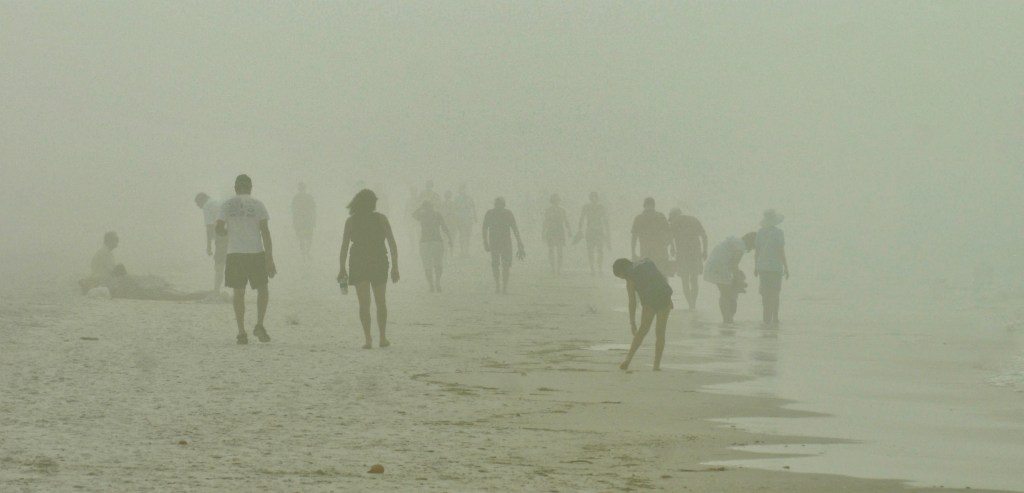
There is something poetic and literary about these beach strollers as they attempt to find enjoyment in this dense fog. While wandering about, coming and going, and disappearing into the mist, they conjure up metaphors and raise questions about the mysteries and brevity of life.

They are reminiscent of the desperate, meandering shadows of Shakespeare’s Macbeth, who cried that “…life is but a walking shadow, a tale told by an idiot, full of sound and fury signifying nothing”.

Or as these fuzzy images drift mindlessly about, they remind one of T.S. Eliot’s J. Alfred Prufrock, who was so isolated by senseless, anxious indecisiveness, silly concerns, and the inanity of society that he worriedly asked himself, “Do I dare to eat a peach? “Do I dare to disturb the universe? In a minute there is time for decisions and revisions which a minute will reverse.”

Could those roaming souls be lost in the foggy hopelessness of meager minded, nihilistic philosophers? Are they left devoid of the redemptive purposes of the Great Creative Mind, who thinks outside of space and time and gives hope?

These ghostly depictions evoke thoughts of our fragile human condition. “Vanity, vanity, all is vanity.” (Ecclesiastes 1:2)  Your life is like the morning fog—it’s here a little while, then it’s gone.” (James 4:8-14) 

So, does life have no substance? Is it chaotic and meaningless?

We know about hopelessness and despair! This world is filled with violence, brutality, inequalities, injustices, avarice, and poverty. So, are we stuck in this culture of rising self and of diminishing reason and civility? Must we end with T.S. Eliot’s words “This is the way the world ends, Not with a bang but a whimper”? (The Hollow Men) Can something good arise from our despair, or should we throw up our hands and curl into the fetal position? George Eliot said, “But what we call our despair is often only the painful eagerness of unfed hope.” (Middlemarch).

 As we approach Easter, we are reminded that Christianity is the story of Hope. Jesus not only gives us confidence to live life as it should be lived, but he also has secured the future. As he stood by a dead man’s tomb and raised him back to life, Jesus proclaimed he was “the Resurrection and the Life” and that believing in him would bring eternal life. (John 11:25) What he did for Lazarus, the dead man, is evidence of what he can do for us all.

A few days after that miracle and after a horrendous crucifixion, Christ himself arose from the dead and left behind an empty tomb, cementing forever his power over death and the hope of life everlasting for those who would trust him.

These people in the photo aren’t pictures of despair but are heralds of hope. They patiently waited for what they believed would happen. And it did. The sun came out! There are mysteries, but the haze will clear. They speak to us of the confident hope of the Christian who believes in the resurrected Christ.

God is “the God of hope who fills us with all joy and peace in believing.” (Romans 15:13) 

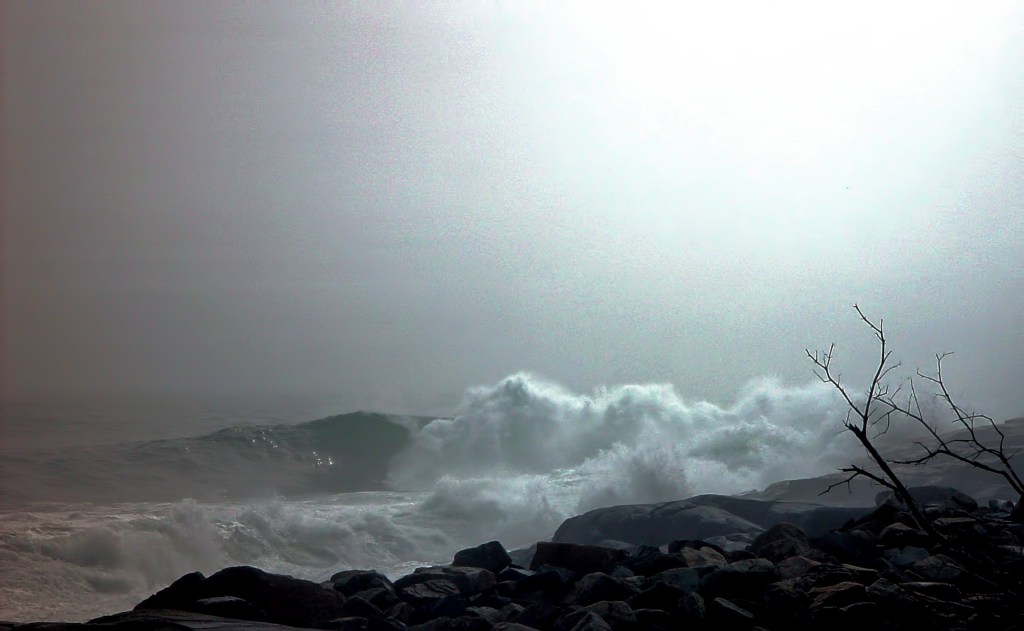
A break in the Storm

Schoodic Point, Acadia National Park, Maine

When I was around ten years old, our small Church had a Junior Choir consisting of seven or eight “kids”. We were quite angelic in our little, white robes as we sang joyfully and with great gusto during Sunday Worship Service. I still remember the refrain of one of those songs:

“The Storms may come but fear not! O Noah, I am nigh! And through the upper window, you’ll see me standing by.”

In the midst of personal storms (and pandemics), believers have an unmitigated confidence, a steadfast hope, in the One who not only rules over life’s storms but enters into our pressing situations where He sheds His light and casts His love upon us.

Isaiah captures both God’s transcendence and His Fatherly love as he introduces us to God and His promise to be present with those who trust Him:

For thus says the One who is high and lifted up, who inhabits eternity, whose name is Holy: “I dwell in the high and holy place, and also with him who is of a contrite and lowly spirit, to revive the spirit of the lowly, and to revive the heart of the contrite.”

(Isaiah 57:15)

Anchored

Each day we awaken within the mist of the unknown. Sometimes we do so with fear and anxiety; but in our culture, we generally feel safe and prepared for our daily routines as we look forward to the small joys that will unfold. We are not concerned about unexpected events. When we leave for work or school or the grocery store, we expect to return home safely, perhaps tired, but well and in one piece.

However, when the winds of adversity rise and the seas turn rough (as they are now), we need stability. We need an anchor. The New Testament book of Hebrews reassures believers that in their time of need not only is God’s present but He is their source of confidence. He holds their future in His Sovereign hands……

“….Therefore, we who have fled to him for refuge can have great confidence as we hold to the hope that lies before us. This hope is a strong and trustworthy anchor for our souls…” (Hebrews 6:18-19)

New Beginnings

Sunrise at Corea Maine

Watching the sun peek over the horizon to gaze upon the awakening day is spirit lifting! Sunrises offer us new beginnings.  Even when we carry old business forward, dawn brings freshness and excitement, a renewed hope, and an anticipation for possibilities, yet to be experienced. Even the weeping Prophet, Jeremiah, found this to be true:


  But this I call to mind, and therefore I have hope:
 The steadfast love of the LORD never ceases; his mercies never come to an end;
 they are new every morning; great is your faithfulness.
“The LORD is my portion,” says my soul, “therefore I will hope in him.”
The LORD is good to those who wait for him, to the soul who seeks him.
 It is good that one should wait quietly for the salvation of the LORD.

Lamentations 3:21-26

Valleys and Mountains

 In his hand are the deep places of the earth; The heights of the mountains are his also . Psalm 95:4

Not everyone agrees with this Psalmist’s sentiments. The origin and the vastness of our universe both hide and declare great mysteries. Whether one accepts creation as secondary to happenstance, or to intelligent design, or as the Biblical narrative describes, the complexity and cohesiveness of our universe and its life are awe inspiring and quite incomprehensible despite all the scientific and technological knowledge available to us.

One of the foremost considerations or deliberations about the mysterious existence of the material universe should be that the cosmos has to have had a beginning. Since it is impossible for nothing to produce something, logic tells us that something or someone outside of time and space had to have initiated it. Scripture says that someone is God and that His power, creativity, magnificence, authority and presence are both above and within His creation.

God is everywhere. That means when we seek Him, He can be found even in the deepest, darkest valleys and the highest, peaks of the journey of our souls….

He has promised His seekers: “I will dwell in them And walk among them.I will be their God,And they shall be My people.” (2 Corinthians 6:16)

Soaring on Eagle’s Wings


Have you never heard? Have you never understood? The LORD is the everlasting God, the Creator of all the earth. He never grows weak or weary. No one can measure the depths of his understanding.
He gives power to the weak and strength to the powerless. Even youths will become weak and tired, and young men will fall in exhaustion.
But those who trust in the LORD will find new strength. They will soar high on wings like eagles. They will run and not grow weary. They will walk and not faint.”

Isaiah 40:28-31