Calmness in the Chaos

Aroostook County Farm, Maine

“Between the dark and the daylight/When the night is beginning to lower/Comes a pause in the day’s occupations/That is known as the Children’s Hour.” (Henry W. Longfellow)

The closure of a stress filled day as ” the night is beginning to lower” is often met with a sense of relief and release. The day is relinquished to its inevitable end, and work is laid aside. Completion! Rest! Relaxation! And for those with families, the day is topped off with sweet moments of being with those deeply loved…until ….we turn on the evening news.

The nightly litany is long and tortures us with the incredible melancholy hanging over our world. Our peace and  joy drain into the abyss of unending, prevailing miseries of suffering people: a terrible pandemic, divisive politics, repression, toppling nations, terrorism, war and poverty, earthquakes, massive droughts, horrible fires and floods, climate change, horrible air quality, brutality, racism, and crumbling values. After twenty minutes of negativity, a restlessness and an angry sense of helplessness rise within us; we become saddened, bewildered, and anxious by the chaotic, unhappy state of humanity. Mental, emotional, spiritual fatigue creeps in over time.

When the Psalmist faced his unstable world (Psalm 46), he was not shaken. “….we will not fear though the earth gives way, though the mountains be moved into the heart of the sea/though its waters roar and foam, though the mountains tremble at its swelling.” He had reason not to fear. He trusted God. “God is our refuge and strength, a very present help in trouble….”

Because we possess  broken, fallen natures which lack integrity, we live in an imperfect, contentious world where greed, selfishness, violence and injustices have injurious sway and result in social and political divisions, unpleasant, unwarranted events, unhealthy relationships, and a progressively immoral, violent culture. We do need “refuge and strength.”

The world may shake apart, but the Psalmist knew that Sovereign God guarantees safe passage. “Be still, and know that I am God. I will be exalted among the nations, I will be exalted in the earth!” “God will help… when morning dawns. The nations rage, the kingdoms totter; he utters his voice, the earth melts.  The LORD of hosts is with us; the God of Jacob is our fortress.” “He makes wars cease to the end of the earth; he breaks the bow and shatters the spear; he burns the chariots with fire.” “The LORD of hosts is with us…” (Psalm 46:1-11)

“Be still.” Become centered in God. The Psalmist found encouragement, reassurance, confidence and rest in God’s character, sovereignty, and promises of redemption. Christ entered history’s overarching story to fulfill the promise of victory over evil. Through him come forgiveness, relief from the condemnation of our inner struggles and actions, reconciliation with God, eternal hope, and the promise of rest and peace for our souls.  Come to me, all who labor and are heavy laden, and I will give you rest. Take my yoke upon you, and learn from me, for I am gentle and lowly in heart, and you will find rest for your souls. For my yoke is easy, and my burden is light.”( Matthew 11:28-30) He taught that the pathway to God comes via repentance and belief and that the road to joy is living out the grace God gives us.  These things I have spoken to you, that my joy may be in you, and that your joy may be full.” “This is my commandment, that you love one another as I have loved you.” (John 15:9-12)

The world will always be chaotic and filled with nightly “bad” news, but the Good News is that God had always been and will always remain true to His immutable nature. He is steadfast in love and enduring in faithfulness and will never desert humanity, who, though fallen, are meant for good.

Trust fully. Wait patiently. Rest confidently. Love as Christ does with grace, forgiveness and sacrifice. Live joyfully with purpose. Know that the ultimate victory has been won even though the battle rages.

For every child of God defeats this evil world, and we achieve this victory through our faith.” (1 John 5:4 (NLT2)

.

A World of Symbols


Ellsworth, Maine

Our world is filled with signs and objects which stand for attributes, concepts, or abstract ideas. Wedding rings remind us of love and commitment; product brands speak to us of style or quality. Emblems identify organization; Oscars and Emmys and academic cords connote excellence. Portraits, statues, and photographs depict historical events and thus help us preserve our cultural, national, and personal memories and heritages. We hold tightly to different religious traditions and rituals and symbols because they represent deep aspects of our beliefs. Some of us find meaning in the “atomic whirl”, others in lotus flowers and banners. Some of us fly prayer flags or burn incense while chanting mantras; others of us have prayer rugs and bow deeply as we pray facing Mecca. Some of us have dream catchers and ceremonial dances. Some of us light Menorahs, wear skull caps and phylacteries and rock when we pray. Others of us have rosary beads and icons. Some of us sing doxologies and share the wine and bread of communion and rejoice over baptisms.

However, we all share the beauty and grandeur of the heavens and the earth. Lying behind the mysteries of our cosmos’ magnificent and immense complexity is a transcendent power, a greatness, and a precise and caring creativity which should at least raise the question of God’s existence. Scripture says creation is definite proof of God’s existence and leaves us no excuse for unbelief. (Romans 1:18) And King David prayed, Yours, O LORD, is the greatness and the power and the glory and the victory and the majesty, for all that is in the heavens and in the earth is yours. Yours is the kingdom, O LORD, and you are exalted as head above all.” (from a prayer of King David in 1 Chronicles 29:9-20)

Inspired by a hilltop view of a church spire and the Avon river running through the countryside, F. S. Pierpoint wrote the hymn For the Beauty of the Earth. Each stanza is followed with the phrase; “Lord of all, to thee we raise this our hymn of grateful praise.

“For the beauty of the earth/For the beauty of the skies,
For the love which from our birth/Over and around us lies,

For the beauty of each hour/Of the day and of the night,
Hill and vale, and tree and flower/Sun and moon and stars of light,

For each perfect gift of thine/To our race so freely given,
Graces human and divine/Flowers of earth and buds of heaven,

For thy Church which evermore/Lifteth holy hands above,
Offering up on every shore/Her pure sacrifice of love,”

The beauty of flowering plants, a bright and clear blue sky, and a new England Church steeple pointed toward the heavens and topped with the symbol of Heaven’s grace to us is a reminder of Sovereign God. Crosses atop many Protestant and Catholic church spires prompt thoughts of incomparable, divine, redemptive love given us in the sacrifice of Christ. They symbolize the possibility of salvation, ultimate victory over death, and eternal hope for all who choose to believe.

“Lord of all, to thee we raise this our hymn of grateful praise.”


An Equal and Beyond Fair Wage!

Raking Blueberries in Whitneyville, Maine

Before technology changed the blueberry industry, almost every kid who grew up in Washington County, Maine earned “back to school” money by spending a few, hot, August days in exhausting, backbreaking blueberry raking along side family, buddies and migrant workers.  However, finding reliable seasonal workers and paying them fair wages have troubled Maine farmers for generations.

While addressing misconceptions about the meaning of the Law, Christ utilized similar labor issues in a parable illustrating the wonderful grace that God extends to all mankind.(Matthew 20:1-16) He spoke of the “master of a house” who needed workers for his vineyard. Arising early, he went to the market place where he hired workers for an agreed upon day’s wage of a denarius. As the day progressed, he needed a larger workforce. Returning to the market place four times, he always found others waiting for a job, even at the 11th hour, the last possible time to obtain work before day’s end.

No reason is given for these workers’ late search for employment. Maybe they had foolishly whiled away the day before realizing their need? Perhaps they had tried other opportunities that didn’t satisfy or pan out? Maybe they had been seeking but did not know where to look and heard about this marketplace last. Whatever the reason, they were desperate. Hope was fading with the daylight. But the “master” was on the outlook for them, discovered them, and offered them an opportunity. They were in such dire straits that they did not even attempt to negotiate a wage. They were at the mercy of the landowner and had to trust his word. He said “… ‘whatever is right, I will give you,’ So they went.” 

At the end of the day, the landowner dropped a philosophic and emotionally loaded bombshell. All workers received the same compensation regardless of the number of hours they had worked. Those who worked for an hour received the same total wage as those who had labored all day! Accentuating that fact, the “master” intentionally paid the last-hirers first! So, when the first-hires came up the pay line last, the “master’s” generosity had made an indelible impression. However, his payment plan did not meet any measure of fairness in their minds. They had labored all day in the scorching heat and believed they should have been more highly valued and deserved greater compensation. They opposed and grumbled at the Master.

In its entirety, this story addresses multiple layers of religious thought and behavior and misconceptions, but the fact that God has always valued faith, not performance, is at its core. Jesus’ audience should have known that no one merits God’s approval. Centuries of failed attempts to be holy by keeping the Old Testament Law had proved that sinless perfection is an impossibility for humans.  Unless placed within the context of faith in God, good works or good conduct mean nothing to Him, nor does ethnicity or religious affiliation. He is no “respecter” of persons. (Galatians 3:28) Belief, not conduct, is the “work” blessed by God.

Even though God demands holiness and turns away from sin, He extends the grace of forgiveness to both Jews and Gentiles (the world). In great mercy, He has fully paid the price of saving mankind from its rebellious and sinful state. He chooses to see mankind in view of Christ’s sacrifice which is an amazing, surprising, generous, unmerited, fully sufficient, perfect, loving, “once for all” payment for our sinful natures.  “God saved you by his grace when you believed. And you can’t take credit for this; it is a gift from God.  Salvation is not a reward for the good things we have done, so none of us can boast about it. (Ephesians 2: 8-9 (NLT2). Redemption is entirely God’s doing.

The world rewards performance. God honors faith with grace and mercy “all across the board.” At the end of the day, it is not about who one is or how good one is but is about in whom one trusts to meet eternal needs. God patiently searches for, willingly accepts, and presents the blessings of His Kingdom to all who will come to serve with Him. (11 Peter 3:8-9)  

Inaudible Shouts…

Peony at the Azela Garden, Northeast Harbor, Maine

“Magnificent!”. “Glorious!” Beautiful!” Those exclamations echoed around the garden as visitors admired the flowering shrubs and peony blossoms.

The adage that “Beauty lies in the eye of the beholder” holds some truth. We have individual aesthetics or preferences and subjectively value the quality of the tangible or intangible. So, is beauty a reality or an illusion? Is beauty is a perception or an intrinsic quality. Is that peony blossom beautiful when I am not the one admiring it? It is. Independent observers expressed their admiration even when I wasn’t looking.

Thus, another question…Why “beauty?” Does it have a purpose beyond drawing our attention?

Answers might vary depending upon the lens through which one views life. Some believe that we are earth dwellers by happenstance, functioning organisms composed of atoms and molecules somehow directed by complex nucleotides of DNA which originally came from some unexplained source by an inexplicable cosmic accident. If so, the implication would be that “beauty” is merely some chemically induced perception, a mediated reaction identically produced in all humans. However, one has to entertain the question of whether there is purpose beyond the biophysiological for the awe and deep emotions evoked through experiencing and appreciating the diversity and wonder of colors, shapes, sights, sounds and tastes of our expanding universe and the creativity of its inhabitants. Could it be that a good Creator has gifted us with “beauty” as a loving act, as a way for us to relate and know Him better, to sense that He cares and wants to bring enjoyment to our earthly stay?

When circumstances were surprising or difficult, my Grandmother frequently quoted the proverb that “there is reason in all things.” Whether she knew it or not, that is theologically sound! Beautiful “things” should lift our spirits in awe and gratitude for the magnificence of God and His goodness to us just as the Psalmist’s lyrics proclaim : “Those who live at the ends of the earth stand in awe of your wonders. From where the sun rises to where it sets, you inspire shouts of joy.” (Psalm 65:8 (NLT2)

With inaudible shouts, this peony inspires quiet exclamations of joy!

The Clearest Day Ever

Watching the rhythm of the sea, Schoodic Point, Maine

The rhythms of the sea with its shifting tides, rising waves, crashing surf, and drifting fog are mesmerizing. And as the fog lifts to expose a view stretching beyond the horizon’s curve into the heavens, both awe and calmness engulf the soul with a sense of belonging within that vastness.

“On a Clear Day You can See Forever” was a ‘60’s musical and later a film in which Barbara Streisand starred. It was a quirky but hope filled play/film about a young lady with low self esteem who learned how to  value herself. A number of popular singers sang the theme song:

“On a clear day, rise and look around you, and you’ll see who you are.
On a clear day, how it will astound you
That the glow of your feelings outshines every star.
You will follow every mountain, sea and shore,
You will see from far and near a world you’ve never seen before.
On a clear day, on a clear day, you can see forever, and ever, and ever more
.”

We Americans spend a great deal of time and money attempting  “to  see who (we) are.” A few of us overinflate our importance, but most of us are clearing up or cleaning up our self perceptions. We explore our insecurities, inadequacies, “mistakes”, and powerlessness. We face self-delusions and misconceptions while gathering confidence that we are valued and gifted individuals despite our heritage, opportunities, or personal backgrounds.

However, wherever we are on that journey of self-discovery and self-affirmation, of self-fulfillment and self-expression, or of self-love, the clearest day will be when we realize that we are supremely valued sinners in need of mercy and grace, that God loves us with a magnitude of love that is beyond our comprehension despite our unholiness, and that He has provided forgiveness, redemption and hope.

Finding that faith is the day “(We) will see from far and near a world (we’ve) never seen before/On a clear day, on a clear day, (we) can see forever, and ever, and ever more.”

(John 3:16,17, John 5:24, Matthew 11:28-30, Galatians 6: 7-8, 1 Timothy 1:15-6, 1 Peter 1:8-13)

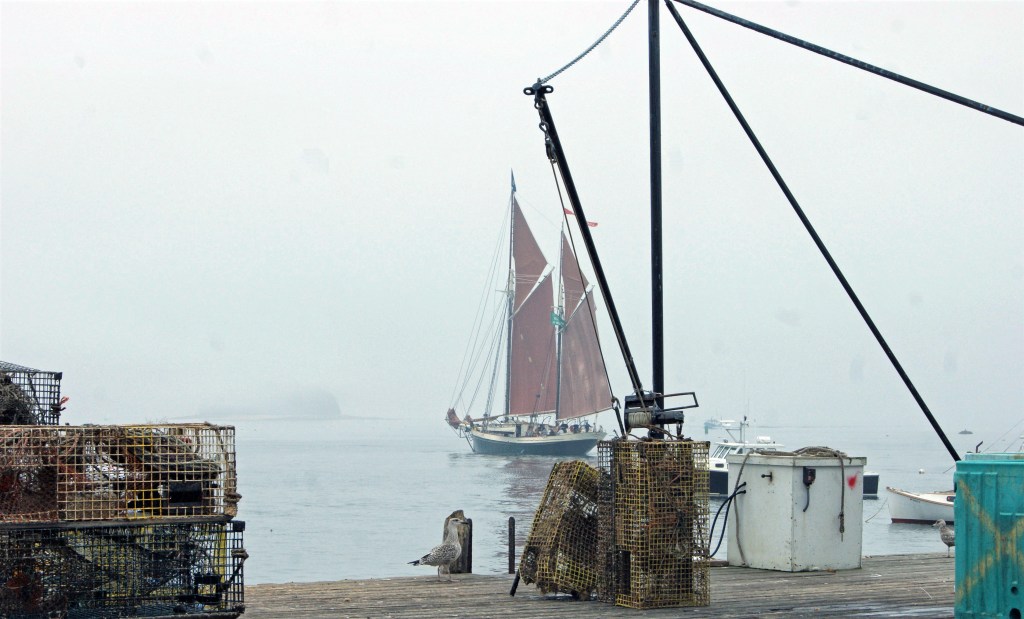
Presumption or Promise?

Foggy Morning in Stonington, Maine

  A quintessential, summer morning sail along the Maine coast includes lobster boats and pots, wharf smells and screeching gulls, lifting fog and salty breeze filling hoisting sails, and a sense of uncertainty and adventure as one heads for open seas.

  In her poem “As if the Sea should part”, Emily Dickinson likened the mystery of infinity and the uncertainty of  eternity to sailing into a series of unending seas…

As if the Sea should part
And show a further Sea —
And that — a further — and the Three
But a presumption be —

Of Periods of Seas —
Unvisited of Shores —
Themselves the Verge of Seas to be-                                                        Eternity-is those-

    Thoughts of eternity can be daunting because death is scary and the afterlife holds uncertainties. We may wonder if “eternity” is a concoction of anxious minds and mere speculation. Fortunately, history presents us with a credible witness who has sailed beyond life’s horizon and returned. Christ’s very existence, his miraculous interactions, teachings, parables, claims and most importantly his bodily resurrection from the dead draw our attention to the reality of the afterlife of which he spoke often. If Jesus is credible, we should listen to his concerns not only for the spiritual well being of mankind in this earthly life but also for a future time. He specifically expressed that to Nicodemus in some of the most quoted words in the Bible: “For God so loved the world, that he gave his only Son, that whoever believes in him should not perish but have eternal life. (John 3:16)

  Standing at Lazarus’ tomb, Jesus reassured his sister, Martha, that he was ” the resurrection and the life” and proclaimed, “Whoever believes in me, though he die, yet shall he live, and everyone who lives and believes in me shall never die. Do you believe this?” (John 11:25-26) Then he miraculously raised Lazarus from the dead, thus giving all those present reason to believe that through faith their spirits could live with God forever!

  Even during his incredibly brutal crucifixion, Jesus lovingly and confidently comforted the dying thief on an adjacent cross that they would be together in paradise that very day after he confessed belief in Jesus. (Luke 23:39-4)

  Christ often both warned and comforted his disciples regarding future events when teaching about the Kingdom of Heaven. He spoke of angels and end times and of ultimate joy but also of eternal separation of the faithful from the faithless and the faithless from God. He illustrated final judgment with a story about dividing sheep from goats. However, on the eve of his crucifixion, he gave encouragement, reassuring them that he had come into the world from “the Father” and was “leaving the world and going to the Father” but would return for them. His final words uplifted them with a proclamation of his eternal presence. “Behold, I am with you always, to the end of the age.” (Matthew 24, John 16) (Matthew 7:19-23), (Matthew 13)(John 16:28)(John 14:2-3(Matthew 28:18-20)

Despite the mysteries ahead, we have reliable information and directions. With confident expectation, we can advance into that unexperienced, hazy territory with hoisted sails of faith in the One familiar with the way. We have promises not presumptions!


Into the Wind

Racing past Mark Island, Winter Harbor, Maine

By trimming the sails, a good sailor skillfully pulls the wind into the canvas, dominates the prevailing, opposing and shifting gusts, and maneuvers his boat forward. He or she knows their boat’s capabilities, reads maps, sets the course, watches the skies, and catches the breeze with skill and strength . Know-how, common sense, intuitiveness, and a certain knack give a proficient sailor an advantage over nature.

 Life is a bit like that! Sometimes, the breezes of good fortune carry us along. Other times, we become caught in headwinds and cross winds that oppose and impede and blast us off course or threaten to do us in. We may be blindsided or overpowered by circumstantial and personal adversity over which we have little or no control. And we frantically scramble to deal with disturbing or devastating consequences of our own missteps of commission or omission. But cursing ill winds accomplishes nothing! Navigating chaos and turmoil requires tenacity, the ability to tweak things, or even make a full course correction. Adversity and misfortune focus us, help us to define or redefine, encourage persistence or realignment of our values and goals, and often force us to ponder deep questions about the meaning of our existence or whether God is at the end of our “time.”

Questioning God’s existence or distrusting His ability and goodness are universal doubts, but persistent doubt is an intellectual and spiritual no-man’s land. “…he that doubts is like the surge of the sea driven by the wind and tossed.” (James 1:6) Is there an answer to the God question? How is one to “trim the sails” so “that we may be no longer children, tossed to and fro and carried about with every wind of doctrine, by the sleight of men, in craftiness, after the wiles of error” ? (Ephesians 4:14)

Christ made the bold, challenging statement that he is “The Truth”, that if one has seen him one has seen God, and that he is the Way to God. (John 14:6-9) So, either God can be found, or Christ was sadly delusional! One of the great promises of Scripture is that those who seek will find. The physical universe, history, the moral Law and Scripture’s revealed principles for living, and the person and teachings of Jesus Christ direct us to God and His loving intentions and ultimate purposes for mankind.

So, steady as she goes, Mate. If asked, God will fill our sails with His offers of forgiveness, redemption, enabling, and the eternal “hope” necessary for stability and direction. He will be our Helmsman, keeping us from being blown off course as we sail toward that final horizon.

Coffee Thoughts…

Settling moon, on Taunton Bay, Sullivan, Maine

Early morning on the river’s shore,

Listening to the flowing, rippling water

Watching the rising sun and settling moon

in an expanding universe

Sipping a cup of coffee….

Peace, solitude,

Then intruding thoughts…Life!

Meaningless or purposeful?

Insignificant or valued?

The search for truth…

History? Science? Philosophy? Religion?

Same goals? Cohesive?

Or clashing, exclusive ideologies

defended with stubborn arrogance and willful blindness?

Evidence… historical, scientific, experiential , revelatory.

Discovery…

O LORD, our Lord, your majestic name fills the earth! Your glory is higher than the heavens.
You have taught children and infants to tell of your strength, silencing your enemies and all who oppose you.   When I look at the night sky and see the work of your fingers— the moon and the stars you set in place—  what are people that you should think about them, mere mortals that you should care for them?
Yet you made them only a little lower than God and crowned them with glory and honor
. (Psalm 8:1-9 (NLT2)

Amazing world…

Awesome Creator…

Loving God!

Amen

Land that I Love

Gathering Clouds over Moosehead Lake and Mount Kineo

Although written during WW1 and revised in 1938 when WW11 was on the horizon and a great testing for America lay ahead, Irving Berlin’s “God Bless America” has always been my favorite patriotic song and musical prayer for America. As a kid, I remember sitting in front of  our floor model radio and listening to Kate Smith’s clear, contralto voice give a heart felt rendering of what became her signature song:

“While the storm clouds gather far across the sea/Let us swear allegiance to a land that’s free/
Let us all be grateful for a land so fair/As we raise our voices in a solemn prayer.”

“God bless America/Land that I love/Stand beside her and guide her/Through the night with a light from above.”

“From the mountains to the prairies/To the oceans white with foam/God bless America, my home sweet home/God bless America, my home sweet home.”

In those difficult days of war and sacrifice, God was and had always been a welcomed part of our Nation’s spoken narrative. At our beginnings, many of our founding fathers were Theists, if not Christians, who recognized God as a player in the blessings bestowed on  America. Our Declaration of Independence mentions God four times. Although some of out recent leaders have expressed that God is an important part of America’s collective mindset, our country is less oriented toward God today than it was in the past. In that context, President Ronald Regan’s thoughts deserve consideration: ” Freedom prospers when religion is vibrant and the rule of law under God is acknowledged.” and ” If we ever forget that we’re one nation under God, then we will be one nation gone under.”

Somehow,  our understanding of “separation of Church and State” has morphed into elevating the role of the state and locking God out of authority. Human reasoning and our search for origins and purpose have narrowed our thinking and diverted us away from the possibilities of God. He has become more of an ironic symbol than a reality. “In God we trust” is imprinted on our highly trusted money. Congress opens with prayer but public prayer is illegal in schools. We pledge allegiance to a nation under God but have no concept of what that means. The slogan “For God and Country” is used by many sincere, good intentioned, and patriotic people. It has been adopted as a moto by families, organizations, universities, and even reportedly by political or military campaigns. According to some sources,  the US Navy Seals confirmed the death of Osama bin Laden with the signal “For God and country, Geronimo, Geronimo, Geronimo.”

However, whether stated or inferred, phrases that invoke God have inherent problems and are open for abuse. They may convey a false sense of moral credence. They can be used to justify an idea or imply a lofty motivation to a goal which may or may not be good. They equate two unequals…the infallible with the fallible, the omniscient with the limited,  the pure and holy with the flawed, the absolute with the relative.

There is a disparity between patriotism and loyalty to God although in certain contexts they might be inclusive. Seeking God’s blessing for our nation is quite distinct from claiming that our national purposes are God’s purposes. Nations have national priorities not God’s. If they seek God, it is for His blessing on what they want to do, not an inquiry into what He would want them to do! They pursue national interests and needs and borders and protection and hopefully the common good of its people. But the historical truth is that the forces for change within a nation are ideologies, politics, power, and greed.

Ultimate power, authority, and blessing come from God, not national leaders or even “the people.” God instructed Israel in a principle that guaranteed His good blessings. It is as definite and reliable and true for us today as are the laws that govern our universe. The Lord explained it to wise, rich, powerful, praying King Solomon while answering his prayer: “… I have heard your prayer …When I shut up the heavens so that there is no rain, or command the locust to devour the land, or send pestilence among my people,  if my people who are called by my name humble themselves, and pray and seek my face and turn from their wicked ways, then I will hear from heaven and will forgive their sin and heal their land. Now my eyes will be open and my ears attentive to the prayer that is made in this place. (2 Chronicles 7:12-15)

May it be so- that if or when the clouds gather and God doesn’t seem to be in the land- that we will be teachable, will have learned the lessons of history, and will seek God’s wisdom so that He will continue to bless America, the land that I love!

Timing is Crucial!


   We know plants bloom or fruit at specific times. Field daises flower, crab apples blossom, and pond lilies emerge on schedule. There are seasons to life, and at some point, we become aware that “time” for us is unpredictable and limited and that there are no extensions or redo’s. Our responses to this truth may be mixed but usually include thoughts about life’s meaning and purpose and perhaps even an urgency and the making of a “bucket list”. In that context,  Diana Bell’s  praise chorus deserves consideration: “In His time, in His time. He makes all things beautiful, in His time/Lord, my life to you I bring, may each song I have to sing/ be to you a lovely thing, in your time.” (Praise chorus by Diana Bell)

   Those are encouraging words, but one certainly questions those ideas if one does not believe in Almighty God. Even people of faith may question them when circumstances are difficult, when they have disappointed themselves, or if they are feeling deflated or perhaps even defeated by the negativity of messy lives, lousy attitudes and offensive behaviors which may be their own or someone else’s! Yet, despite spiritual weaknesses and moral failures, Scripture proclaims that God has good news for us all, “He will bring us out of the quagmire of our folly and set us upon the Rock of steadfast love when “(we) cry out to God Most High, to God who will fulfill his purpose for (us).” (Psalm 57:2) That is the promise of the Gospel. God will redeem people and their circumstances when they sincerely seek Him and His purposes in their lives.

   Christ taught that life’s “quagmires”, all the injustices, meanness, and evil in this world proceed from man’s fallen nature and that mankind desperately needs God’s redemptive intervention. (Matthew 15:19)(John 3:16) So, in “the fullness of time” Christ stepped into the human narrative for that reason. (Galatians 4:4-5) He appropriated the Old Testament Messianic prophecy which said that “The Spirit of the Sovereign LORD” was upon himthat he was “anointed to bring good news to the poor,” that he would ” comfort the brokenhearted,” and that he would proclaim the “release of captives ” and freedom of “prisoners.” Furthermore, his message to Israel was that God would “give a crown of beauty for ashes, a joyous blessing instead of mourning, festive praise instead of despair.(Isaiah 61:1-3) (Luke 4:17-19)

Jesus’ Jewish audience had an historical perspective for Isaiah’s words. Time and again, their idolatrous and self-willed rebellions against God had tested His forbearance, “His steadfast love.” However, when they cried out in repentance and confessed their waywardness, He repeatedly intervened, raising them up from the ashes of their destructive sinfulness and powerfully restoring their mourning nation with forgiveness, joy, opportunity, goodness and renewal. But before doing His special work in their lives. He waited until they cried “out to God Most High” in a sincere desire to have Him ” fulfill his purpose for (them).”

  Somewhat surprisingly, Jesus declared this transforming power was his to assert by personally claiming Isaiah’s Old Testament prophecy which foreshadowed Christ’s earthly life of compassionate help and healing and hope he gave to the hopeless, the physically, materially, socially, and spiritually defeated. Those ancient words also pictured his personal sacrifice and crucifixion-to release the world from spiritual oppression and to lift humanity from darkness into light because it had proven over time that it could not do so without divine help. New Testament correlates are the promises that “…everyone who calls upon the name of the Lord shall be saved.” (Acts 2:21) and that God works all things for good to those who love Him enough to live within His purpose of conforming to the image of Christ, the image for which He created us.(Romans 8:28)

    God will always exert His sovereign influence in the matters of men. Even wise King Solomon needed a life time to discover that God waits to give redemption until people acknowledge their need. Reflecting upon the general purpose of existence and the specific meaning behind his long and priviledged life, he realized the importance of submitting to moral principles set forth by God. Recognizing God presence in His life , he said that God “had made everything beautiful in its time.” (Ecclesiastes 3:11; 12:1)

God creates beauty through faith, through the humility and trust of hearts that are teachable and transformed by mindset shifts from self-dependence to God-dependence, from self centeredness to God centeredness, from our folly filled wisdom to His Truth, from  self-righteousness to Christ’s. The meaningless wastelands we have created and the difficulties and injustices we experience will be changed into something purposeful. The Psalmist reassuringly sang ”The LORD will fulfill his purpose for me; your steadfast love, O LORD, endures forever. (Psalm 138:8) And the Philippian Church was encouraged that God, who had brought salvation to them, would “bring it to completion at the day of Jesus Christ.” (Philippians 1:6) And “In His time,” this broken, fallen, groaning creation will be “set free from bondage to corruption.” (Romans 8:20-24)

“In His time” is how history’s narrative will be written. The conclusion of time will be beautiful for those who have cried out “to God most high.”  And Scripture is clear that “today” is the day that one should consider these things because we are promised no other day. (Hebrews 3:13,4:7))