An Oasis of Words

Middle River, Marshfield, Maine

Words are important and powerful. They may be a sword or a lullaby depending upon the user’s intention or whim. Strung together, words create stories, poems, lyrics and conversations. They can break hearts or cheer souls. Used wisely, they may encourage and refresh needy spirits and nurture good character. Contemptuous or gossipy words diminish and destroy. Truth spoken with love may inspire change or resolution. Misleading or harsh and condemning and deflating words lead to despair.

God’s Words are presented as creative, redemptive, and transformative in the Biblical narrative. Jews accept the Law and the Prophets as sacred and morally instructive, and Christians also believe that the Gospels and Epistles and New Testament books are historically revealed and divinely inspired words which convict, correct, exhort, instruct, and transform by addressing humanity’s thirst for spiritual health and healing through personal faith. (Genesis1) (Romans 3:24; 12:1-2) (1Timothy 3:16) (Hebrews 4:12) (Ephesians 2:8-9; 5:25-26)

Isaiah recorded that God created oases to sustain His people even in arid deserts. “I will plant trees in the barren desert— cedar, acacia, myrtle, olive, cypress, fir, and pine. I am doing this so all who see this miracle will understand what it means— that it is the LORD who has done this, the Holy One of Israel who created it.” (Isaiah 41:19-20 (NLT2) Those havens where life could be sustained, refreshed, and sheltered were metaphors for the spiritual strength and refreshment found in God as one navigates a parched, dreary, colorless, uncertain, and precarious spiritual journey through life.

The Psalmist sang: “Blessed is the man who walks not in the counsel of the wicked, nor stands in the way of sinners, nor sits in the seat of scoffers; but his delight is in the law of the LORD, and on his law he meditates day and night. He is like a tree planted by streams of water that yields its fruit in its season, and its leaf does not wither…” (Psalm 1:1-3)

The Apostle Paul addressed the need for grounded and focused thinking. Worldly advice from pundits and ungodly companions will never quench our deep spiritual longings or protect us from evil or its eternal consequences.. “Don’t let anyone capture you with empty philosophies and high-sounding nonsense that come from human thinking and from the spiritual powers of this world, rather than from Christ.” Colossians 2:8 (NLT2) God’s Word supplies more than moral guidance. It reveals truth about ourselves and our existence, about meaning, righteousness, and redemptive hope for our shame.

Just as God refreshes this mysterious and beautiful world, He refreshes our souls with love, acceptance, forgiveness, restoration, joy, and hope through faith in the redemptive work of Christ and in the truths revealed in His inspired Word.

“The rain and snow come down from the heavens and stay on the ground to water the earth. They cause the grain to grow, producing seed for the farmer and bread for the hungry. It is the same with my word. I send it out, and it always produces fruit. It will accomplish all I want it to, and it will prosper everywhere I send it. (Isaiah 55:10-11 (NLT2)


According to the Puffins….

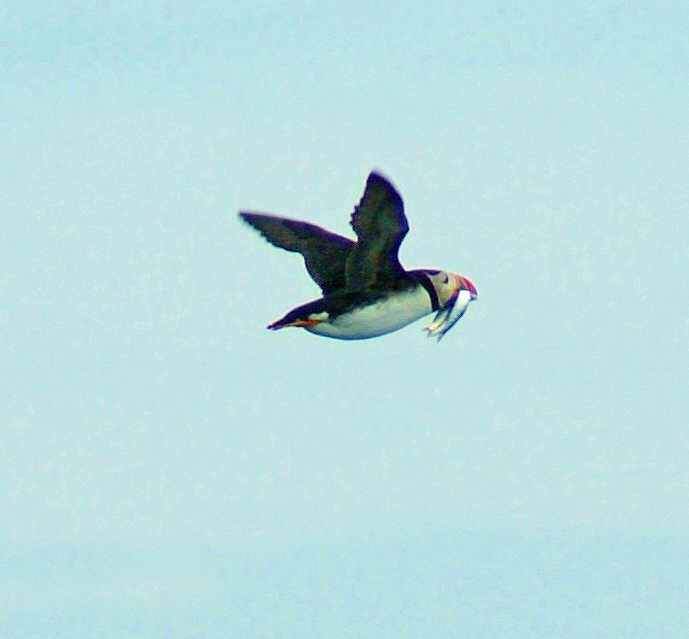
Atlantic Puffin, Maine Coast

Even little birds can give us lofty thoughts. To some, puffins simply raise questions about genetics and adaptive mutations and behaviors. But in the larger context, these little birds are but one of creation’s vast array of variations and adaptations which not only challenge imaginations and serious scientific investigations but also philosophic explanations about meaning and purpose.

Birds of all kinds, including doves, eagles, herons, ravens, ostriches, vultures, owls, hens, and sparrows, are used symbolically in scripture. The prophet Jeremiah used vultures as examples of how foreign nations would devour Israel. Job’s limited understanding and faulty perceptions about God’s justice were contrasted with God’s omniscience and wisdom when he was presented with puzzling questions about the natural world- such as how does the hawk know how to migrate or the eagle behave as it does? “Does the hawk take flight by your wisdom and spread its wings toward the south? Does the eagle soar at your command and build its nest on high? (Job 39)

Although puffins are not mentioned by name in the Bible, they are our co-inhabitants in this immense, mind-boggling, complicated universe with its strange planets, spectacular heavens, delicately balanced moving parts, and amazing creatures of limitless color combinations, shapes, forms, adaptations and complex behaviors.

Several Maine coastal islands are breeding grounds for the unique and fascinating Atlantic puffin, the only one of three puffin species to float around the North Atlantic ocean. Spending most of their lives at sea, they come to land specifically for breeding purposes. They are small, playful, monogamous bird with a life span of up to 20 years. Sporting large colorful beaks and bright orange legs which give them a clownish look, they live in colonies called a “circus” or a “puffinry”. After breeding season, the outer layers of their beaks shed, becoming smaller and duller. They eat fish, dive up to two hundred feet to catch their meal, and can carry up to ten fish at a time because of a specialized tongue enabling them to hold fish in their throat and beak. And they can swim and fly with wings that beat up to 400 beats per minute.

These astonishing birds are but one of myriads of puzzling worldly inhabitants. That thought brings us to the realization that we humans are connected to and part of something really big! So, our minds search for insight into meaning and purposes. Our spirits seek validation. We long for something beyond relationships, wealth, power, sex, or prestige for spiritual fulfillment. And puffins remind us to “Look at the birds. They don’t plant or harvest or store food in barns, for your heavenly Father feeds them. And aren’t you far more valuable to him than they are?…..Seek the Kingdom of God above all else, and live righteously, and he will give you everything you need.” (Matthew 6:26-33 (NLT2)

This small bird turns out to be but one example of God’s creativity, purposeful design, and wisdom. They are representatives of His common grace and care for all creatures great and small. And they bring us to consideration of God’s special grace to those who seek him.

Once some Pharisees warned Jesus that Herod had Jesus on his hit list. Jesus told them to tell “that fox” that he was not intimidated and would continue his healing ministry to the spiritually and physically sick. Then he said “O Jerusalem, Jerusalem, the city that kills the prophets and stones God’s messengers! How often I have wanted to gather your children together as a hen protects her chicks beneath her wings, but you wouldn’t let me.” Luke 13:24; Matthew 23:37 NLT2) Putting this into a spiritual perspective, Jesus said,… do not fear those who kill the body but cannot kill the soul. Rather fear him who can destroy both soul and body in hell. Are not two sparrows sold for a penny? And not one of them will fall to the ground apart from your Father. But even the hairs of your head are all numbered.” (Matthew 10:28-30 (ESV) Like small birds we need God’s protection, and those who reverence God and seek His redemptive help are eternally protected.

So, Christ identified the ones he will help and protect. He never imposes himself. He came “ to seek and to save the lost.” (Luke 19:10) and “… to call not those who think they are righteous, but those who know they are sinners.” He said that “healthy people don’t need a doctor-sick people do.” (Matthew 9:11-13 (NLT2) Those statements are all inclusive because there are “none righteous”; nobody is exempt; no one lives a perfectly moral life. Our imperfections of attitudes or behavior are called sin. We are all eligible for Christ’s healing when we seek God’s grace and soul provision through faith.

According to the puffins, God loves us and will “cover us with His pinions/And under His wings we may seek refuge/ His faithfulness is a shield and bulwark” (Psalm 91:4)

Quarrying: Chiseling It Out

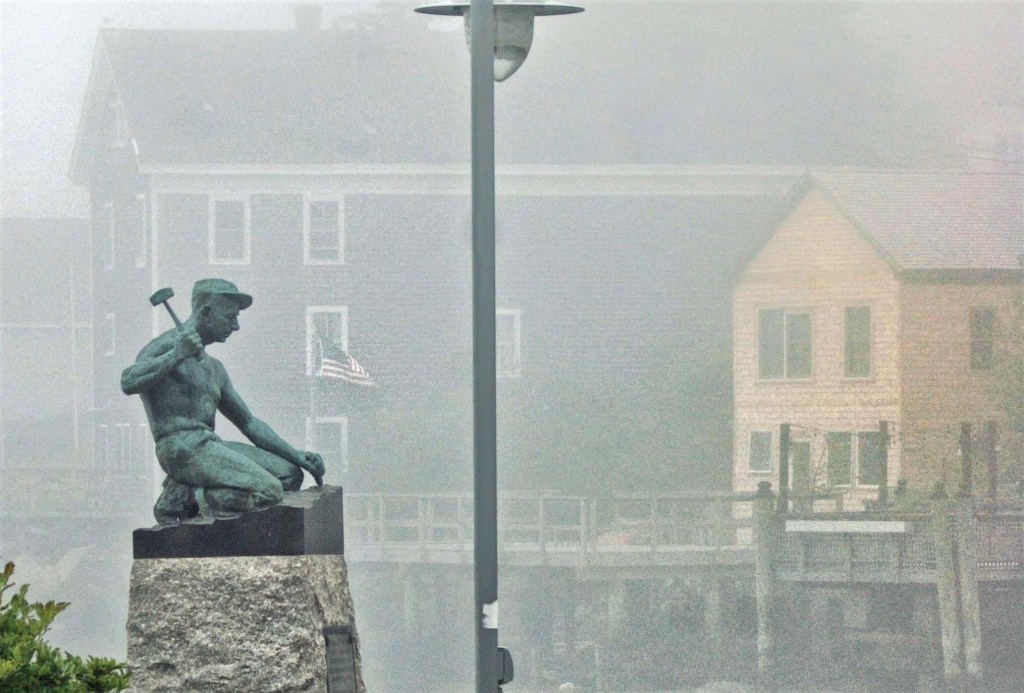
The Stone Cutter, Stonington Maine

This Stone Cutter sculpted by William Muir is situated on the public wharf at Stonington as a memorial to those who mined and sculpted granite from Maine quarries. In the early 1900’s there were as many as 152 quarries in Maine, where slate and limestone as well as granite were mined. At one point there were thirty three operative, coastal island granite quarries. Immigrants from Finland, Scotland, Sweden and Italy added their expertise to the substantial workforce cutting and shaping blocks and pavers used in constructing historical buildings, monuments, tombs, bridges and roads throughout Europe and America. Known for its beauty, strength and texture, Maine granite exhibits distinctive patterns and color varieties ranging from white to gray and pink to lavender-tinged depending on the mineral content.

Life is a bit like quarrying! We are all stone cutters searching for bedrock!

We seek security, stability, opportunity, freedom. History reveals that. The flag fluttering behind the sculpture is a reminder of resolve and dedication. American democracy is founded upon the courage and blood of patriots and upon foundational documents which have guided and cohesed its people for two and a half centuries. Whether a building, an organization, a document, or a relationship, we look within for substance, for strong, enduring, binding and anchoring foundations. We dig into the bedrock of human thought and experience. We try to find our shape as unique individuals. We want meaning and purpose. We want to be loved, so we learn how to value relationships. We search for our strengths and skills, challenge our intellects and gifts, and develop interests, trades, professions, hobbies, and test ourselves- and those around us!

During explorations of self and purpose, some will be content with the foundational values and beliefs their cultures and families have held for centuries. Many will mine and integrate the ideas, theories, revelations, experiences, and convictions of others while chipping out a world view that seems contemporary and meaningful. As we carve out values and beliefs from cultural mores, religious dogma and traditions, and secular philosophies, we become either God believers or skeptics. We discover Him or chisel Him out by ignoring or rejecting Him.

In an increasingly individualistic, humanistic society, the existence or role of God is viewed as lacking importance. People are identifying less and less with religious beliefs, and church has little relevance for many. The “none’s” are a growing entity. Christian identity often seems to be achieved by the process of exclusion. If one is not Jewish, or Muslim, or Hindu or a member of some cultural /religious entity, then one may identify as Christian.

One can not sincerely claim to be Christian with out checking out Christ. Christianity is much more than choosing a name. It may involve discerning the strength and genuineness of myriads of theories, revelations, feelings, experiences, and evidences about life and its origins, meaning, and purposes, but the place of discovery about God and Christ is Scripture.

One scriptural metaphor for God is a “rock”. As the omnipotent protector of human souls, He is strong and unmovable in His faithfulness. In Him is “no variation or shadow of turning.” He is consistently good, loving and just regardless of the time of day or season or century; His grace, His redemptive purposes, and His love became incarnate in Christ, who said that he was Truth and had come to testify to truth, (John 14:6; 18:37)

For the believer, Christ is the reference point, the “touchstone”, the standard by which one judges and recognizes God’s holiness, justice, and mercy and humanity’s need for redemption. He is alive and well, is God’s redemptive plan, and is the “cornerstone ” around whom all truth is built. Our “personal truths” change with situations and maleable ethics, but Christ is “the same yesterday, today, and forever.” (Hebrews 13:8) He is God’s wisdom to us and the solid foundation upon which to build life; a relationship with him is the Way back to God. He once told the story of a foolish man and a wise man and the consequences of their choses of the different foundations upon which they built their lives. The wise man heard and follow the teachings of Christ and survived life’s winds and floods. Tragically the foolish man did not. (Matthew 7:24)

Edward Mote’s 1834 hymn could be considered a stone cutter’s hymn because it summarizes rather beautifully these thought about solid foundations. The third verse states that: “Not earth, nor hell, my soul can move/ I rest upon unchanging love/ I trust his righteous character/ his counsel, promise, and his power.” And then the refrain: On Christ the solid rock I stand; all other ground is sinking sand.

If we seek, if we look in the right places, if we sift through the “sinking sand”, we will find the bedrock on which to build faith and eternal hope.

Chiseling It Out!

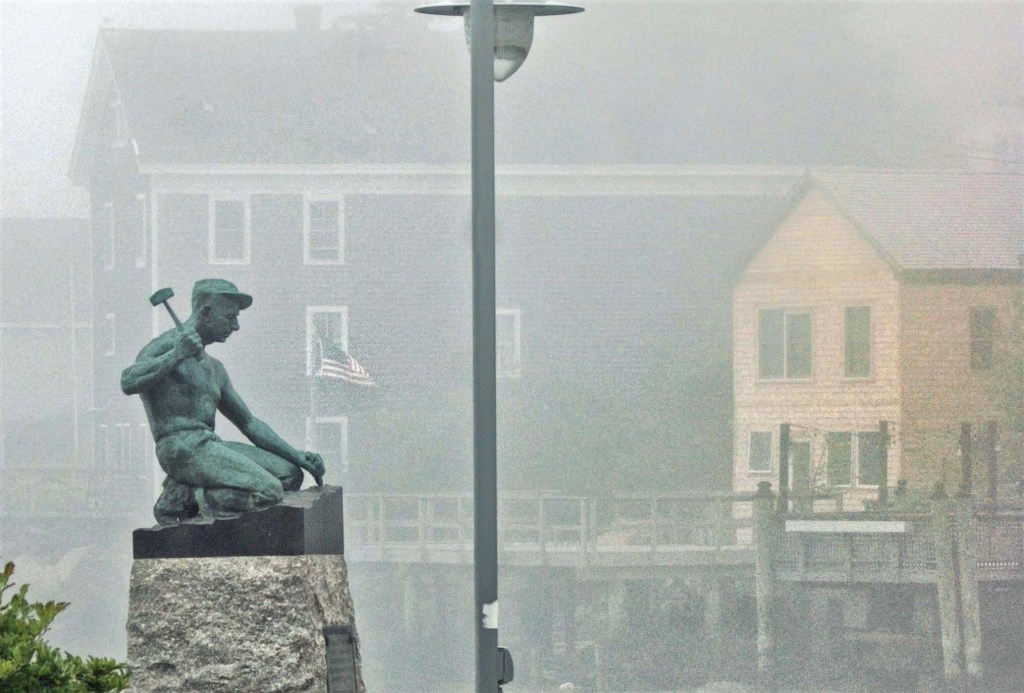
The Stone Cutter, Stonington Maine

This Stone Cutter sculpted by William Muir is situated on the public wharf at Stonington as a memorial to those who mined and sculpted granite from Maine quarries. In the early 1900’s there were as many as 152 quarries in Maine, where slate and limestone as well as granite were mined. At one point there were thirty three operative, coastal island granite quarries. Immigrants from Finland, Scotland, Sweden and Italy added their expertise to the substantial workforce cutting and shaping blocks and pavers used in constructing historical buildings, monuments, tombs, bridges and roads throughout Europe and America. Known for its beauty, strength and texture, Maine granite exhibits distinctive patterns and color varieties ranging from white to gray and pink to lavender-tinged depending on the mineral content.

Life is a bit like quarrying! We are all stone cutters searching for bedrock!

We seek security, stability, opportunity, freedom. History reveals that. The flag fluttering behind the sculpture is a reminder of resolve and dedication. American democracy is founded upon the courage and blood of patriots and upon foundational documents which have guided and cohesed its people for two and a half centuries. Whether a building, an organization, a document, or a relationship, we look within for substance, for strong, enduring, binding and anchoring foundations. We dig into the bedrock of human thought and experience. We try to find our shape as unique individuals. We want meaning and purpose. We want to be loved, so we learn how to value relationships. We search for our strengths and skills, challenge our intellects and gifts, and develop interests, trades, professions, hobbies, and test ourselves- and those around us!

During explorations of self and purpose, some will be content with the foundational values and beliefs their cultures and families have held for centuries. Many will mine and integrate the ideas, theories, revelations, experiences, and convictions of others while chipping out a world view that seems contemporary and meaningful. As we carve out values and beliefs from cultural mores, religious dogma and traditions, and secular philosophies, we become either God believers or skeptics. We discover Him or chisel Him out by ignoring or rejecting Him.

In an increasingly individualistic, humanistic society, the existence or role of God is viewed as lacking importance. People are identifying less and less with religious beliefs, and church has little relevance for many. The “none’s” are a growing entity. Christian identity often seems to be achieved by the process of exclusion. If one is not Jewish, or Muslim, or Hindu or a member of some cultural /religious entity, then one may identify as Christian.

One can not sincerely claim to be Christian with out checking out Christ. Christianity is much more than choosing a name. It may involve discerning the strength and genuineness of myriads of theories, revelations, feelings, experiences, and evidences about life and its origins, meaning, and purposes, but the place of discovery about God and Christ is Scripture.

One scriptural metaphor for God is a “rock”. As the omnipotent protector of human souls, He is strong and unmovable in His faithfulness. In Him is “no variation or shadow of turning.” He is consistently good, loving and just regardless of the time of day or season or century; His grace, His redemptive purposes, and His love became incarnate in Christ, who said that he was Truth and had come to testify to truth, (John 14:6; 18:37)

For the believer, Christ is the reference point, the “touchstone”, the standard by which one judges and recognizes God’s holiness, justice, and mercy and humanity’s need for redemption. He is alive and well, is God’s redemptive plan, and is the “cornerstone ” around whom all truth is built. Our “personal truths” change with situations and maleable ethics, but Christ is “the same yesterday, today, and forever.” (Hebrews 13:8) He is God’s wisdom to us and the solid foundation upon which to build life; a relationship with him is the Way back to God. He once told the story of a foolish man and a wise man and the consequences of their choses of the different foundations upon which they built their lives. The wise man heard and follow the teachings of Christ and survived life’s winds and floods. Tragically the foolish man did not. (Matthew 7:24)

Edward Mote’s 1834 hymn could be considered a stone cutter’s hymn because it summarizes rather beautifully these thought about solid foundations. The third verse states that: “Not earth, nor hell, my soul can move/ I rest upon unchanging love/ I trust his righteous character/ his counsel, promise, and his power.” And then the refrain: On Christ the solid rock I stand; all other ground is sinking sand.

If we seek, if we look in the right places, if we sift through the “sinking sand”, we will find the bedrock on which to build faith and eternal hope.

Flying as Eagles Fly

Eagle flying along the Taunton River, Sullivan, Maine

Bald eagles are definitely forces “to be reckoned with”. They have powerful talons which can exert ten times the pressure of an adult male human hand and can have up to seven foot wingspans enabling them to catch updrafts and soar thousands of feet in the air where their amazing visual and color acuities allow them to spot signs of small prey and fish. Their attacks may be unsuspected and swift, but their presence is formidable and commands tremendous respect.

One might expect them to have a pleasant, satisfied demeanor. Yet, even though they control the skies and hold powerful predator status among the animal kingdom, their countenance seems very intent, maybe even angry, or somewhat scary! However, they must be content because they are long-lived, mate for life, and build mega-mansion nests where they patiently but clumsily protect their eggs, feed their young until they fledge, and parent them for a few months after fledging.

The are majestic, even regal, symbols of the beauty and independence of American democracy. Furthermore, they have a spiritual allure about them. Their feathers are honored as messengers of spirits by some Native American cultures. Ancient biblical authors used the eagle’s nature as expressive metaphors for God’s powerful presence and nurturing care for His people. He destroyed the evil intent of those who pursued Israel in the Exodus and later reminded them : “You have seen what I did to the Egyptians, and how I bore you on eagles’ wings, and brought you to myself.” (Exodus 19:4).

Moses used eagle imagery to express God’s love for Israel: “Like an eagle that stirs up its nest, that flutters over its young, spreading out its wings, catching them, bearing them on its pinions, the LORD alone guided (them)…” (Deuteronomy 32:11-12) Such figurative language bespeaks the encouragement, support, provision, and patience God gave that nation. Similarly, His gracious attitude toward all humanity is dramatically evident in both His gift of those all-encompassing, guiding, moral principles of the Law which clarify the importance of loving God and others and also in His amazing, mercy filled, love gift—Jesus. Like the protective wings of an eagle, Jesus’ cross embraces the world for whom he died so that whosoever choses may know the peace and joy of God as He brings them to Himself.

Our childish night dreams of flying, of soaring high, disappear as life grows longer and a bit more serious and limiting! But strengthened by God’s presence, nourished and satisfied by His Word, and eternally protected by His grace, we can all fly like Eagles. Isaiah spoke of this spiritual strength, of the courage and enduring power found in a trusting faith which waits on God’s purposes. “Those that wait on the LORD shall renew their strength; they shall mount up with wings like eagles; they shall run and not be weary, they shall walk and not faint.” (Isaiah 40:31).

Plucking Petals…

Field of Daisies, Hancock, Maine

Many of us have carefully plucked petals from daisies hoping to find the answer we want when the last petal is removed…He loves me. He loves me not… She love me. She loves me not…They love me. They love me not…

Although formed as statements, those are really crucial questions! Despite the illogicalness of this playful mind game, we superstitiously continue trying until we receive the answer we want! That activity becomes a metaphor for our hearts which vacillate and wonder as we wade through competing proofs and uncertainties in an attempt to discern the integrity of others and how much of our emotional life should be committed to them. Love is beautiful but can be treacherous with potential for pain and despair. Because of our vulnerability we are tentative until assured.

We evaluate ideas and our deep spiritual longings similarly. We desparately want solutions to the human dilemma but face an array of confusing ideas about purpose and meaning and God.  Our distracted minds want facts, but we have fragmented information upon which to build our beliefs. Our questions are many, and so are the various, answering voices which contribute to our indecisiveness and flounderings surrounding issues of faith! We have to be discerners who sort though questions and ideas about origins and cosmic design, about the essence of humanness, about suffering and injustice, and about purpose and meaning in this brief life.

There are a plethora of faith ideas… humanism and its social mores, scientism and its theories, religious philosophies with their guilt inflicted, self effort redemptive ideas about the path to righteousness and eternal bliss. However, it is possible to to be devastatingly disappointed, disillusioned, and unfulfilled by belief systems. Inner peace comes with validation. How many daisies do we have to pick before we are secure and validated by love, hope and assurance?

Jesus’ answer makes sense. It is redemptive and restorative and defines a relationship about which there can never be any doubt. He stepped into humanity and our broken, fallen world where he lived, taught and died to reveal the truth about himself, about God, and about us… the truth that God exists and loves us and that we need His redemption. His conversation with the religious leader Nicodemus directly addressed that truth and those needs:“ For God so loved the world that he gave his one and only Son, that whoever believes in him shall not perish but have eternal life.” (John 3:16) That summation in some form or another has been recognized by  Kings, Prophets, Psalmists, the Apostles, and his followers. Even our own lives authenticate our need for forgiveness and redemption. We need God’s loving grace:

Indeed, there is not a righteous man on earth who continually does good and who never sins. (Ecclesiastes 7:20)

Every one of them has turned aside; together they have become corrupt; There is no one who does good, not even one. (Psalm 53:3)

 Though the mountains be shaken and the hills be removed, yet my unfailing love for you will not be shaken nor my covenant of peace be removed,” says the Lord, who has compassion on you. (Isaiah 54:10)

For you, O Lord, are good and forgiving, abounding in steadfast love to all who call upon you. (Psalm 86:5) 

For as high as the heavens are above the earth, so great is his steadfast love toward those who fear (revere) him…(Psalm 103:11) 

But God demonstrates his own love for us in this: While we were still sinners, Christ died for us. (Romans 5:8)

This is how God showed his love among us: He sent his one and only Son into the world that we might live through him. This is love: not that we loved God, but that he loved us and sent his Son as an atoning sacrifice for our sins. Dear friends, since God so loved us, we also ought to love one another. (1John 4:9-11)

See what great love the Father has lavished on us, that we should be called children of God! And that is what we are! (1 John 3:1)

For I am convinced that neither death nor life, neither angels nor demons, neither the present nor the future, nor any powers, 39 neither height nor depth, nor anything else in all creation, will be able to separate us from the love of God that is in Christ Jesus our Lord. (Romans 8:38-39)

Some of us as children and even occasionally as adults have sung, “Jesus loves me this I know for the Bible tell me so.” There has never been a more profound statement ever –because in him and his sacrifice for us lie unbounded love, forgiveness, redemption, meaning, and eternal hope.

Those who met and believed Jesus no longer had to search the field of faith-options. Their questions were answered by the most wonderful realization in the universe!  He loves me….

Neither do we need to insecurely pluck away at the petals, because God, who is rich in mercy will save us by His grace. There is nothing we need do except to trust. (Ephesians 2:4-9)

May you experience the love of Christ, though it is too great to understand fully. Then you will be made complete with all the fullness of life and power that comes from God. (Ephesians 3:19)  

Plucking Petals

Preview in new tab

Field of Daisies, Hancock, Maine

Many of us have carefully plucked petals from daisies hoping to find the answer we want when the last petal is removed…He loves me. He loves me not… She love me. She loves me not…They love me. They love me not…

Although formed as statements, those are really crucial questions! Despite the illogicalness of this playful mind game, we superstitiously continue trying until we receive the answer we want! That activity becomes a metaphor for our hearts which vacillate and wonder as we wade through competing proofs and uncertainties in an attempt to discern the integrity of others and how much of our emotional life should be committed to them. Love is beautiful but can be treacherous with potential for pain and despair. Because of our vulnerability we are tentative until assured.

We evaluate ideas and our deep spiritual longings similarly. We desparately want solutions to the human dilemma but face an array of confusing ideas about purpose and meaning and God.  Our distracted minds want facts, but we have fragmented information upon which to build our beliefs. Our questions are many, and so are the various, answering voices which contribute to our indecisiveness and flounderings surrounding issues of faith! We have to be discerners who sort though questions and ideas about origins and cosmic design, about the essence of humanness, about suffering and injustice, and about purpose and meaning in this brief life.

There are a plethora of faith ideas… humanism and its social mores, scientism and its theories, religious philosophies with their guilt inflicted, self effort redemptive ideas about the path to righteousness and eternal bliss. However, it is possible to to be devastatingly disappointed, disillusioned, and unfulfilled by belief systems. Inner peace comes with validation. How many daisies do we have to pick before we are secure and validated by love, hope and assurance?

Jesus’ answer makes sense. It is redemptive and restorative and defines a relationship about which there can never be any doubt. He stepped into humanity and our broken, fallen world where he lived, taught and died to reveal the truth about himself, about God, and about us… the truth that God exists and loves us and that we need His redemption. His conversation with the religious leader Nicodemus directly addressed that truth and those needs:“ For God so loved the world that he gave his one and only Son, that whoever believes in him shall not perish but have eternal life.” (John 3:16) That summation in some form or another has been recognized by  Kings, Prophets, Psalmists, the Apostles, and his followers. Even our own lives authenticate our need for forgiveness and redemption. We need God’s loving grace:

Indeed, there is not a righteous man on earth who continually does good and who never sins. (Ecclesiastes 7:20)

Every one of them has turned aside; together they have become corrupt; There is no one who does good, not even one. (Psalm 53:3)

 Though the mountains be shaken and the hills be removed, yet my unfailing love for you will not be shaken nor my covenant of peace be removed,” says the Lord, who has compassion on you. (Isaiah 54:10)

For you, O Lord, are good and forgiving, abounding in steadfast love to all who call upon you. (Psalm 86:5) 

For as high as the heavens are above the earth, so great is his steadfast love toward those who fear (revere) him…(Psalm 103:11) 

But God demonstrates his own love for us in this: While we were still sinners, Christ died for us. (Romans 5:8)

This is how God showed his love among us: He sent his one and only Son into the world that we might live through him. This is love: not that we loved God, but that he loved us and sent his Son as an atoning sacrifice for our sins. Dear friends, since God so loved us, we also ought to love one another. (1John 4:9-11)

See what great love the Father has lavished on us, that we should be called children of God! And that is what we are! (1 John 3:1)

For I am convinced that neither death nor life, neither angels nor demons, neither the present nor the future, nor any powers, 39 neither height nor depth, nor anything else in all creation, will be able to separate us from the love of God that is in Christ Jesus our Lord. (Romans 8:38-39)

Some of us as children and even occasionally as adults have sung, “Jesus loves me this I know for the Bible tell me so.” There has never been a more profound statement ever –because in him and his sacrifice for us lie unbounded love, forgiveness, redemption, meaning, and eternal hope.

Those who met and believed Jesus no longer had to search the field of faith-options. Their questions were answered by the most wonderful realization in the universe!  He loves me….

Neither do we need to insecurely pluck away at the petals, because God, who is rich in mercy will save us by His grace. There is nothing we need do except to trust. (Ephesians 2:4-9)

May you experience the love of Christ, though it is too great to understand fully. Then you will be made complete with all the fullness of life and power that comes from God. (Ephesians 3:19)  

The Old Schoolmaster…

School House, Whitneyville, Maine

Soon, it will be back to school for Maine children. Once, it was to the one or two story village schoolhouse with its one or two story backhouse and a playground where there may or may not have been a swing, but there was a flag pole. There one teacher taught all subjects for up to three to eight grades, administered healthcare from a first aid kit, and even sang patriotic songs and prayed with students who ate bagged lunches at their desks or walked home where Mom had lunch ready.

Presently, free breakfast and lunch are served at cafeterias in consolidated school districts with subject-specific teachers, high tech toilets, well equipped playgrounds, expensive sports and performing arts programs, health clinics, social workers, complicated busing systems, and top heavy administrations. Even though some changes are good and students have wider cultural exposure and broader learning experiences, our current educational desires and values have arrived with a hefty price tag which isn’t just reflected in higher taxes. School boards, administrations, and educators are deluged with mandatory paperwork, performance evaluations, burdensome curriculum demands, and even fears of violence against them.

And the children…

Schools have always reinforced traditional values of hard work, integrity, respectfulness, kindness, and community pride, as well as seeking knowledge and truth! But educational values are shifting. Enticed by state and federal monies, communities now accept governmental supervision and overreaching demands which push the agendas of politically powerful special interest groups. Humanistic teachings, manipulative ideologies, and moral molding in education tend toward indoctrination rather than intellectual exploration. Mental health issues, antisocial behavior, and suicide in the young raise legitimate questions as to whether some current educational practices contribute to emotionally healthy, happy children or promote confusion, human devaluation, loss of childhood innocence, and diminishment of patriotism and parental authority.

Although social structures and world views and cultural norms may be shifting, our sensual and spiritual needs are unchanged. If we are to be physically and emotionally healthy, we will always require shelter, nourishment, and love . However, we have elevated our desires to needs which in some cases not only push but exceed moral boundaries. There is more than a whiff of arrogance in the air. Our self absorbed, entitled attitudes and behaviors are less constrained and more raw. Resultant lack of self discipline has led to increasing levels of anxiety, depression, addictions, violence, abuse, social detachments, lack of civility, moral confusion, and obnoxious, offensive language rather than greater happiness.

Moses reminded Israel that the guiding truth and the wisdom of God’s Law are fundamental to the stability and success of a nation. “And the LORD our God commanded us to obey all these decrees and to fear him so he can continue to bless us and preserve our lives, as he has done to this day. ” (Deuteronomy 6:24 ) The Book of Proverbs addresses the fact that our souls need protective barriers: “Like a city that is broken into without walls, is a man who has no control over his spirit.” (Proverbs 25:28) In those ancient days, a city without walls was completely vulnerable to the enemy and disaster. Although humans have an innate moral intuitiveness, we are prone to relativizing and justifying behaviors. The Law as a protective, moral gold standard does not allow either but clearly defines human weaknesses and shows how much we need redemption. We fall off the moral tracks without guardrails.

The Apostle Paul explained how the Law is a schoolmaster that brings us to Christ. Because of human reluctance and inability to keep the Law, Christ came to show and give us the righteousness we lack. His perfect observance of the principles of the Law were foundational to his redemptive ministry for us. He explained, “Don’t misunderstand why I have come. I did not come to abolish the law of Moses or the writings of the prophets. No, I came to accomplish their purpose. (Matthew 5:17 (NLT2) He did what we are too broken to do. In sinlessness, he met the requirements of the Law and atoned for our inability to keep the moral law. He paid for our transgressions. (Matthew 22:37-39)

Despite our world views and associated values, our spiritual needs are universal and unchanging. No matter what our perception of God is, He and His provision for us are consistent. He is forever good and transcendent. His ways are perfectly purposed for us to share in His goodness and to live as images of His character. The Law instructs us and the school of life demonstrates to us that our spiritual need is unachievable apart from God’s gracious forgiveness and His redemptive, restorative powers released to us by the sacrifice of Christ and our repentance and faith.

The Sculptor’s Song…

Bird Sculpture, Bangor, Maine

Art is an expression of words, ideas, stories, and even music from its creator’s soul. Listening closely to this simply shaped , plump, little bird sitting on its intrically designed pedestal amidst a reflected world of clouds and trees, one hears a sweet song.

Along with His eternality, God’s imagination and creativity are the first of His attributes about which we learn. Scripture tells us that “In the beginning God created” an incredibly magnificent, wildly imaginative, intricate, beautiful universe from nothingness, from a blank palette. His only instrument-His voice! The power of His Words revealed his mind and birthed a cosmos originally filled with goodness which evidenced His magnificent glory and His love and provision for humanity.

Scripture also presents the image of God as a potter sculpting an especially important element in His creation, forming man from the dust of the earth, breathing life into him, making him a rational, relational being, and bestowing upon him godly attributes.

Created in God’s ” image”, mankind has this remarkable capability to honor or abuse God’s gifts. Whether designing, crafting, sculpting, painting, dancing, writing, performing, producing music, or drafting and constructing communities, we express our minds, feelings, ideas, and imaginations in artful wonders and words and patterns and blue prints. We may not always understand the mind or vision or motivation or feeling behind an artist’s work, but all artistry should reflect God’s character by bringing something good into the lives of others. Whether building bridges or caning chairs, Scripture instructs us to do “whatever (we) do or say” as Jesus would. (Colossians 3:17) He lived as “the radiance of the glory of God and the exact imprint of God’s nature.” (Hebrews 1:3) If creativity does indeed derive from God’s nature, it has the ultimate, divine purpose of honoring God and His creative goodness.

Whether intentionally or unintentionally, this little bird gives a nod to the ultimate Creator and Giver of all good gifts as it looks across the river toward a Church steeple pointing into the heavens. Hear the sweet doxology? “Praise God from whom all blessings flow…”

The Sculptor’s Song…

Sculpture, Bangor, Maine

Art is an expression of words, ideas, stories, and even music from its creator’s soul. Listening closely to this simply shaped , plump, little bird sitting on its intrically designed pedestal amidst a reflected world of clouds and trees, one hears a sweet song.

Along with His eternality, God’s imagination and creativity are the first of His attributes about which we learn. Scripture tells us that “In the beginning God created” an incredibly magnificent, wildly imaginative, intricate, beautiful universe from nothingness, from a blank palette. His only instrument-His voice! The power of His Words revealed his mind and birthed a cosmos originally filled with goodness which evidenced His magnificent glory and His love and provision for humanity.

Scripture also presents the image of God as a potter sculpting an especially important element in His creation, forming man from the dust of the earth, breathing life into him, making him a rational, relational being, and bestowing upon him godly attributes.

Created in God’s ” image”, mankind has this remarkable capability to honor or abuse God’s gifts. Whether designing, crafting, sculpting, painting, dancing, writing, performing, producing music, or drafting and constructing communities, we express our minds, feelings, ideas, and imaginations in artful wonders and words and patterns and blue prints. We may not always understand the mind or vision or motivation or feeling behind an artist’s work, but all artistry should reflect God’s character by bringing something good into the lives of others. Whether building bridges or caning chairs, Scripture instructs us to do “whatever (we) do or say” as Jesus would. (Colossians 3:17) He lived as “the radiance of the glory of God and the exact imprint of God’s nature.” (Hebrews 1:3) If creativity does indeed derive from God’s nature, it has the ultimate, divine purpose of honoring God and His creative goodness.

Whether intentionally or unintentionally, this little bird gives a nod to the ultimate Creator and Giver of all good gifts as it looks across the river toward a Church steeple pointing into the heavens. Hear the sweet doxology? “Praise God from whom all blessings flow…”

(Colossians 3:23;Exodus 31:1-6; 35:31-32; Ephesians 2:10; James 1:17)