Watching the rhythm of the sea, Schoodic Point, Maine
The rhythms of the sea with its shifting tides, rising waves, crashing surf, and drifting fog are mesmerizing. And as the fog lifts to expose a view stretching beyond the horizon’s curve into the heavens, both awe and calmness engulf the soul with a sense of belonging within that vastness.
“On a Clear Day You can See Forever” was a ‘60’s musical and later a film in which Barbara Streisand starred. It was a quirky but hope filled play/film about a young lady with low self esteem who learned how to value herself. A number of popular singers sang the theme song:
“On a clear day, rise and look around you, and you’ll see who you are. On a clear day, how it will astound you That the glow of your feelings outshines every star. You will follow every mountain, sea and shore, You will see from far and near a world you’ve never seen before. On a clear day, on a clear day, you can see forever, and ever, and ever more.”
We Americans spend a great deal of time and money attempting “to see who (we) are.” A few of us overinflate our importance, but most of us are clearing up or cleaning up our self perceptions. We explore our insecurities, inadequacies, “mistakes”, and powerlessness. We face self-delusions and misconceptions while gathering confidence that we are valued and gifted individuals despite our heritage, opportunities, or personal backgrounds.
However, wherever we are on that journey of self-discovery and self-affirmation, of self-fulfillment and self-expression, or of self-love, the clearest day will be when we realize that we are supremely valued sinners in need of mercy and grace, that God loves us with a magnitude of love that is beyond our comprehension despite our unholiness, and that He has provided forgiveness, redemption and hope.
Finding that faith is the day “(We) will see from far and near a world (we’ve) never seen before/On a clear day, on a clear day, (we) can see forever, and ever, and ever more.”
(John 3:16,17, John 5:24, Matthew 11:28-30, Galatians 6: 7-8, 1 Timothy 1:15-6, 1 Peter 1:8-13)
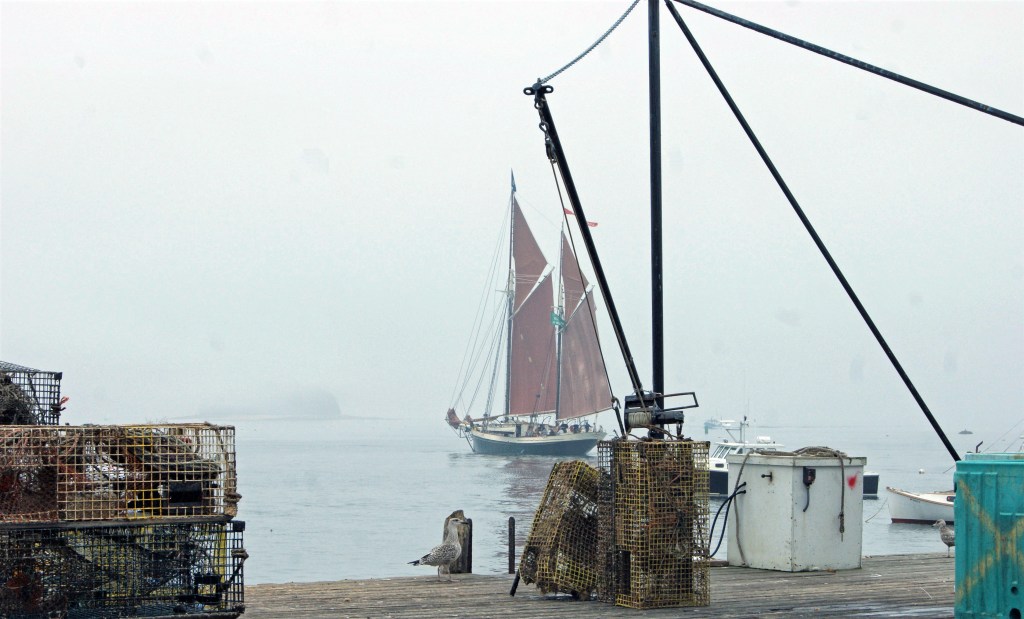
A quintessential, summer morning sail along the Maine coast includes lobster boats and pots, wharf smells and screeching gulls, lifting fog and salty breeze filling hoisting sails, and a sense of uncertainty and adventure as one heads for open seas.
In her poem “As if the Sea should part”, Emily Dickinson likened the mystery of infinity and the uncertainty of eternity to sailing into a series of unending seas…
As if the Sea should part And show a further Sea — And that — a further — and the Three But a presumption be —
Of Periods of Seas — Unvisited of Shores — Themselves the Verge of Seas to be- Eternity-is those-
Thoughts of eternity can be daunting because death is scary and the afterlife holds uncertainties. We may wonder if “eternity” is a concoction of anxious minds and mere speculation. Fortunately, history presents us with a credible witness who has sailed beyond life’s horizon and returned. Christ’s very existence, his miraculous interactions, teachings, parables, claims and most importantly his bodily resurrection from the dead draw our attention to the reality of the afterlife of which he spoke often. If Jesus is credible, we should listen to his concerns not only for the spiritual well being of mankind in this earthly life but also for a future time. He specifically expressed that to Nicodemus in some of the most quoted words in the Bible: “For God so loved the world, that he gave his only Son, that whoever believes in him should not perish but have eternal life. (John 3:16)
Standing at Lazarus’ tomb, Jesus reassured his sister, Martha, that he was ” the resurrection and the life” and proclaimed, “Whoever believes in me, though he die, yet shall he live, and everyone who lives and believes in me shall never die. Do you believe this?” (John 11:25-26) Then he miraculously raised Lazarus from the dead, thus giving all those present reason to believe that through faith their spirits could live with God forever!
Even during his incredibly brutal crucifixion, Jesus lovingly and confidently comforted the dying thief on an adjacent cross that they would be together in paradise that very day after he confessed belief in Jesus. (Luke 23:39-4)
Christ often both warned and comforted his disciples regarding future events when teaching about the Kingdom of Heaven. He spoke of angels and end times and of ultimate joy but also of eternal separation of the faithful from the faithless and the faithless from God. He illustrated final judgment with a story about dividing sheep from goats. However, on the eve of his crucifixion, he gave encouragement, reassuring them that hehad come into the world from “the Father” andwas “leaving the world and going to the Father” but would return for them.His final words uplifted them with a proclamation of his eternal presence. “Behold, I am with you always, to the end of the age.” (Matthew 24, John 16) (Matthew 7:19-23), (Matthew 13)(John 16:28)(John 14:2-3(Matthew 28:18-20)
Despite the mysteries ahead, we have reliable information and directions. With confident expectation, we can advance into that unexperienced, hazy territory with hoisted sails of faith in the One familiar with the way. We have promises not presumptions!
By trimming the sails, a good sailor skillfully pulls the wind into the canvas, dominates the prevailing, opposing and shifting gusts, and maneuvers his boat forward. He or she knows their boat’s capabilities, reads maps, sets the course, watches the skies, and catches the breeze with skill and strength . Know-how, common sense, intuitiveness, and a certain knack give a proficient sailor an advantage over nature.
Life is a bit like that! Sometimes, the breezes of good fortune carry us along. Other times, we become caught in headwinds and cross winds that oppose and impede and blast us off course or threaten to do us in. We may be blindsided or overpowered by circumstantial and personal adversity over which we have little or no control. And we frantically scramble to deal with disturbing or devastating consequences of our own missteps of commission or omission. But cursing ill winds accomplishes nothing! Navigating chaos and turmoil requires tenacity, the ability to tweak things, or even make a full course correction. Adversity and misfortune focus us, help us to define or redefine, encourage persistence or realignment of our values and goals, and often force us to ponder deep questions about the meaning of our existence or whether God is at the end of our “time.”
Questioning God’s existence or distrusting His ability and goodness are universal doubts, but persistent doubt is an intellectual and spiritual no-man’s land. “…he that doubts is like the surge of the sea driven by the wind and tossed.” (James 1:6) Is there an answer to the God question? How is one to “trim the sails” so “that we may be no longer children, tossed to and fro and carried about with every wind of doctrine, by the sleight of men, in craftiness, after the wiles of error” ? (Ephesians 4:14)
Christ made the bold, challenging statement that he is “The Truth”, that if one has seen him one has seen God, and that he is the Way to God. (John 14:6-9) So, either God can be found, or Christ was sadly delusional! One of the great promises of Scripture is that those who seek will find. The physical universe, history, the moral Law and Scripture’s revealed principles for living, and the person and teachings of Jesus Christ direct us to God and His loving intentions and ultimate purposes for mankind.
So, steady as she goes, Mate. If asked, God will fill our sails with His offers of forgiveness, redemption, enabling, and the eternal “hope” necessary for stability and direction. He will be our Helmsman, keeping us from being blown off course as we sail toward that final horizon.
O LORD, our Lord, your majestic name fills the earth! Your glory is higher than the heavens. You have taught children and infants to tell of your strength, silencing your enemies and all who oppose you. When I look at the night sky and see the work of your fingers— the moon and the stars you set in place— what are people that you should think about them, mere mortals that you should care for them? Yet you made them only a little lower than God and crowned them with glory and honor. (Psalm 8:1-9 (NLT2)
Gathering Clouds over Moosehead Lake and Mount Kineo
Although written during WW1 and revised in 1938 when WW11 was on the horizon and a great testing for America lay ahead, Irving Berlin’s “God Bless America” has always been my favorite patriotic song and musical prayer for America. As a kid, I remember sitting in front of our floor model radio and listening to Kate Smith’s clear, contralto voice give a heart felt rendering of what became her signature song:
“While the storm clouds gather far across the sea/Let us swear allegiance to a land that’s free/ Let us all be grateful for a land so fair/As we raise our voices in a solemn prayer.”
“God bless America/Land that I love/Stand beside her and guide her/Through the night with a light from above.”
“From the mountains to the prairies/To the oceans white with foam/God bless America, my home sweet home/God bless America, my home sweet home.”
In those difficult days of war and sacrifice, God was and had always been a welcomed part of our Nation’s spoken narrative. At our beginnings, many of our founding fathers were Theists, if not Christians, who recognized God as a player in the blessings bestowed on America. Our Declaration of Independence mentions God four times. Although some of out recent leaders have expressed that God is an important part of America’s collective mindset, our country is less oriented toward God today than it was in the past. In that context, President Ronald Regan’s thoughts deserve consideration: ” Freedom prospers when religion is vibrant and the rule of law under God is acknowledged.” and ” If we ever forget that we’re one nation under God, then we will be one nation gone under.”
Somehow, our understanding of “separation of Church and State” has morphed into elevating the role of the state and locking God out of authority. Human reasoning and our search for origins and purpose have narrowed our thinking and diverted us away from the possibilities of God.He has become more of an ironic symbol than a reality. “In God we trust” is imprinted on our highly trusted money. Congress opens with prayer but public prayer is illegal in schools. We pledge allegiance to a nation under God but have no concept of what that means. The slogan “For God and Country” is used by many sincere, good intentioned, and patriotic people. It has been adopted as a moto by families, organizations, universities, and even reportedly by political or military campaigns. According to some sources, the US Navy Seals confirmed the death of Osama bin Laden with the signal “For God and country, Geronimo, Geronimo, Geronimo.”
However, whether stated or inferred, phrases that invoke God have inherent problems and are open for abuse. They may convey a false sense of moral credence. They can be used to justify an idea or imply a lofty motivation to a goal which may or may not be good. They equate two unequals…the infallible with the fallible, the omniscient with the limited, the pure and holy with the flawed, the absolute with the relative.
There is a disparity between patriotism and loyalty to God although in certain contexts they might be inclusive. Seeking God’s blessing for our nation is quite distinct from claiming that our national purposes are God’s purposes. Nations have national priorities not God’s. If they seek God, it is for His blessing on what they want to do, not an inquiry into what He would want them to do! They pursue national interests and needs and borders and protection and hopefully the common good of its people. But the historical truth is that the forces for change within a nation are ideologies, politics, power, and greed.
Ultimate power, authority, and blessing come from God, not national leaders or even “the people.” God instructed Israel in a principle that guaranteed His good blessings. It is as definite and reliable and true for us today as are the laws that govern our universe. The Lord explained it to wise, rich, powerful, praying King Solomon while answering his prayer:“… I have heard your prayer …When I shut up the heavens so that there is no rain, or command the locust to devour the land, or send pestilence among my people, if my people who are called by my name humble themselves, and pray and seek my face and turn from their wicked ways, then I will hear from heaven and will forgive their sin and heal their land. Now my eyes will be open and my ears attentive to the prayer that is made in this place. (2 Chronicles 7:12-15)
May it be so- that if or when the clouds gather and God doesn’t seem to be in the land- that we will be teachable, will have learned the lessons of history, and will seek God’s wisdom so that He will continue to bless America, the land that I love!
In nature’s time, the Pond Lilies bloom on Mount Desert Island, Maine
We know plants bloom or fruit at specific times. Field daises flower, crab apples blossom, and pond lilies emerge on schedule. There are seasons to life, and at some point, we become aware that “time” for us is unpredictable and limited and that there are no extensions or redo’s. Our responses to this truth may be mixed but usually include thoughts about life’s meaning and purpose and perhaps even an urgency and the making of a “bucket list”. In that context, Diana Bell’s praise chorus deserves consideration: “In His time, in His time. He makes all things beautiful, in His time/Lord, my life to you I bring, may each song I have to sing/ be to you a lovely thing, in your time.” (Praise chorus by Diana Bell)
Those are encouraging words, but one certainly questions those ideas if one does not believe in Almighty God. Even people of faith may question them when circumstances are difficult, when they have disappointed themselves, or if they are feeling deflated or perhaps even defeated by the negativity of messy lives, lousy attitudes and offensive behaviors which may be their own or someone else’s! Yet, despite spiritual weaknesses and moral failures, Scripture proclaims that God has good news for us all, “He will bring us out of the quagmire of our folly and set us upon the Rock of steadfast love when “(we) cry out to God Most High, to God who will fulfill his purpose for (us).” (Psalm 57:2) That is the promise of the Gospel. God will redeem people and their circumstances when they sincerely seek Him and His purposes in their lives.
Christ taught that life’s “quagmires”, all the injustices, meanness, and evil in this world proceed from man’s fallen nature and that mankind desperately needs God’s redemptive intervention. (Matthew 15:19)(John 3:16) So, in “the fullness of time” Christ stepped into the human narrative for that reason. (Galatians 4:4-5) He appropriated the Old Testament Messianic prophecy which said that “The Spirit of the Sovereign LORD” was upon him, that he was “anointed to bring good news to the poor,” that he would ” comfort the brokenhearted,” and that he would proclaim the “release of captives ” and freedom of “prisoners.” Furthermore, his message to Israel was that God would “give a crown of beauty for ashes, a joyous blessing instead of mourning, festive praise instead of despair.“(Isaiah 61:1-3) (Luke 4:17-19)
Jesus’ Jewish audience had an historical perspective for Isaiah’s words. Time and again, their idolatrous and self-willed rebellions against God had tested His forbearance, “His steadfast love.” However, when they cried out in repentance and confessed their waywardness, He repeatedly intervened, raising them up from the ashes of their destructive sinfulness and powerfully restoring their mourning nation with forgiveness, joy, opportunity, goodness and renewal. But before doing His special work in their lives. He waited until they cried “out to God Most High” in a sincere desire to have Him ” fulfill his purpose for (them).”
Somewhat surprisingly, Jesus declared this transforming power was his to assert by personally claiming Isaiah’s Old Testament prophecy which foreshadowed Christ’s earthly life of compassionate help and healing and hope he gave to the hopeless, the physically, materially, socially, and spiritually defeated. Those ancient words also pictured his personal sacrifice and crucifixion-to release the world from spiritual oppression and to lift humanity from darkness into light because it had proven over time that it could not do so without divine help. New Testament correlates are the promises that “…everyone who calls upon the name of the Lord shall be saved.” (Acts 2:21) and that God works all things for good to those who love Him enough to live within His purpose of conforming to the image of Christ, the image for which He created us.(Romans 8:28)
God will always exert His sovereign influence in the matters of men. Even wise King Solomon needed a life time to discover that God waits to give redemption until people acknowledge their need. Reflecting upon the general purpose of existence and the specific meaning behind his long and priviledged life, he realized the importance of submitting to moral principles set forth by God. Recognizing God presence in His life , he said that God “had made everything beautiful in its time.” (Ecclesiastes 3:11; 12:1)
God creates beauty through faith, through the humility and trust of hearts that are teachable and transformed by mindset shifts from self-dependence to God-dependence, from self centeredness to God centeredness, from our folly filled wisdom to His Truth, from self-righteousness to Christ’s. The meaningless wastelands we have created and the difficulties and injustices we experience will be changed into something purposeful. The Psalmist reassuringly sang ”The LORD will fulfill his purpose for me; your steadfast love, O LORD, endures forever. (Psalm 138:8) And the Philippian Church was encouraged that God, who had brought salvation to them, would “bring it to completion at the day of Jesus Christ.” (Philippians 1:6) And “In His time,” this broken, fallen, groaning creation will be “set free from bondage to corruption.” (Romans 8:20-24)
“In His time” is how history’s narrative will be written. The conclusion of time will be beautiful for those who have cried out “to God most high.” And Scripture is clear that “today” is the day that one should consider these things because we are promised no other day. (Hebrews 3:13,4:7))
House on the Rocks, Grindstone, Winter Harbor, Main
If we are wise, we work, budget, don’t over extend our credit, and live within our means. But our fortunes are tied to more than the money we earn or save. The cost of living changes as the economy fluctuates, a fact we have recently experienced during the pandemic as the production and supply of goods (and microchips) became problematic.
In contrast, God’s Kingdom has a stable economy. There are no shortages or unmet needs and no fluctuations in wealth. There are no hidden costs or taxes, no pre-qualifications, and no budgetary restrictions for soul-building. There is limitless grace, bountiful mercy, and boundless love and room for whoever wills to enter.
During his Sermon on the Mount, Jesus taught how to secure and build this Kingdom life. He told a riveting, illustrative story. “Everyone then who hears these words of mine and does them will be like a wise man who built his house on the rock. And the rain fell, and the floods came, and the winds blew and beat on that house, but it did not fall, because it had been founded on the rock. And everyone who hears these words of mine and does not do them will be like a foolish man who built his house on the sand. And the rain fell, and the floods came, and the winds blew and beat against that house, and it fell, and great was the fall of it.” (Matthew 7:24-27 (ESV)
His fellow Jews would have understood the importance of listening to God, who had miraculously guided their nation when they trusted Him, and they lived by the Law given to Moses by God. The astonishing thing is that Christ had confidently elevated the content, impact, and authority of his teaching to equal that of Scripture. His words had as much power and jurisdiction as the Law of Moses. At points of controversy with other religious teachers, his teaching was to take precedent. On another occasion, he made it clear that he did not speak his own words but those of His Father. (John 14:10)
His seemingly unique ideas were actually old scriptural truths. The concept of keeping the Law had become misinterpreted to mean one worked for one’s salvation, but loving and trusting God were always foundational for receiving national or personal blessings. Centuries before Christ, the Psalmist had said that “Unless the LORD builds a house, the work of the builders is wasted.” (Psalm 127:1-5 (NLT2) And now Christ was teaching in this sermon and illustration that hard work, religious fervor, self effort, and personal merit do not gain God or the riches of His Kingdom. His blessings could be attained through “hearing,” and following Christ, who declared himself to be the Light, The Way, The Door to the Kingdom and to eternal life. It was a major paradigm shift in religious thought to believe Christ when he said, “My sheep hear my voice, and I know them, and they follow me. I give them eternal life, and they will never perish, and no one will snatch them out of my hand. (John 10:25-28)
If that is true, if Christ is the promised Redeemer, wise men will listen to this cautionary tale. “Hearing” Christ means believing and following him. His Truth restores us to God and makes us into Kingdom dwellers, into who we are meant to be . His words are key to finding full forgiveness and discovering the unlimited love, grace and mercy found in God’s eternal provision for those who choose Him. Christ paid the cost for the sins of the world so that God could open His treasure house of unlimited blessing to His people without budgetary restrictions.
One beauty of Spring in Maine is the recrudescence of nature’s music. After winter’s silence, (except for a few cawing crows, screaming Jays, screeching gulls and the occasional tweet of an Eagle or osprey) an amazing cacophony of peeping frogs and sweet bird voices bursts forth as the rest of the world is resurrected and blooms.
Do you wonder why birds sing, why the whip-o-will ushers out twilight by persistently chanting its name or the loon’s laughter echoes through the night? To whom does the Robin merrily chirp at sunrise or the white throated sparrow whistle into a fresh morning? For whom does a solitary duck softly quack as it paddles across the pond?
Bird songs are amazingly species specific, numerous, and purposeful. After weeks of separation, Emperor penguins find their mates and chicks simply by voice recognition within noisy populations of thousands of other penguins. However, thrushes sing, and cardinals trill for more than species specific reasons. There is a beautiful, old hymn that speaks the reality behind their songs: “This is my Father’s world/ And to my lis-tning ears/ All nature sings, and round me rings/ The music of the spheres…This is my Father’s world/ The birds their carols raise/The morning light, the lily white /Declare their Maker’s praise.”
The Psalmists lift their voices in similar praises: “Let every thing that hath breath praise the Lord” (Psalm 150:6) and also, “Let every created thing give praise to the LORD, for he issued his command, and they came into being. He set them in place forever and ever. His decree will never be revoked. Praise the LORD from the earth, you creatures of the ocean depths…wild animals and all livestock, small scurrying animals and birds...Let them all praise the name of the LORD. For his name is very great; his glory towers over the earthand heaven!(Psalm 148:1-13 (NLT2)
For some, this Biblical explanation of a meaningful creation is too simplistic or mythical. Therefore, God is kicked out of the narrative. But is there really a better or more complete explanation for natural order, specificity, and intention than His narrative? Genesis 1:20-31 is worth reading because it conveys the Scripture’s view about the progressive origins of the earth and its diverse life forms. It clues us in to what DNA is all about, presents life as an expression of God’s perfection, goodness, creativeness, and life giving power, and proclaims life as purposed and purposeful and as meant to be enjoyed in grateful recognition and relationship with God, who declared the earth and its life to be “good” when they fulfilled ultimate reasons for existence.
Why bird songs? Nature’s voices are created marvels and music to God’s hearing. They lift us to a wonder-filled, wonderful God: “For (God’s) invisible attributes, namely, his eternal power and divine nature, have been clearly perceived, ever since the creation of the world, in the things that have been made.” (Romans 1:20)
Could it be possible that our various voices, our languages and dialects, are meant to join this chorus of praise?
My Grandmother used to say, “A watched pot never boils.” Spring in Maine is a bit like that. The more one looks for it, the longer it takes! But when it eventually arrives, it does so with a dramatic explosion of beauty. By late May, flowering apple trees grace yards, highlight country roads, and bring new life to old fields and orchards. Their blossoms always remind me of the legendary Johnny Appleseed, an eccentric whose real name was John Chapman. He was an orchardman who planted apple orchards from West Virginia through the mid-West into Canada. His work inspired imaginative anecdotes and ballads about his sowing apple seeds throughout the countryside. As a kid, I learned a catchy little nursery rhyme ditty about him but never gave it much thought until some years later when our friends sang this little verse for a meal time blessing with their children:
“Oh, the Lord is good to me, And so I thank the Lord, For giving me the things I need; The sun and the rain and the apple seed. The Lord is good to me…”
This song is an amazingly theologically sound and powerful prayer which acknowledges God as Creator, Sovereign and Sustainer of all the earth and expresses gratitude for His goodness, His sufficiency, His personal attentiveness, and His common grace to all. In child-like simplicity, it becomes a profound worship filled Psalm of thanksgiving and praise. Like spring blossoms, it fills us with wonder!
“Beyond the Sunset” over Acadia, Grindstone Neck, Maine
Memorial Day is a day of “remembering”. Originating in the post civil war period as Decoration Day, it is now a Federal holiday designated to honor US military veterans who died while serving our country. However, the day has morphed into not only a day filled with ceremonies, parades, flags, and wreaths to remember all who died in military service but also to honor those who serve or have served. It has also become a day when families decorate graves of loved ones with flowers and meaningful mementos.
Memories may be bitter or sweet and commonly are a bitter-sweet mixture of tears and laughter as one reminisces about the special people with whom we have shared life. Perhaps that poignancy first hit home for me when my mother took my older brother and myself to a Curly O’Brien show in Howland, Maine. (Curly O’Brien was a Maine country singer who had a band with his brother called The Top Hands. He successfully stayed in the Country Music business for a quarter of a century doing radio and TV shows.) During the show hat night, there was what some might consider to be a sappy moment. To my youthful, impressionable imagination, it was quite vividly touching and dramatic. The stage darkened; the spotlight focused on a lone cowboy who movingly sang “Beyond the Sunset,” a hymn not previously known to me but one which had been popularized by singers such as Hank Williams and Pat Boone. Soliloquies were mixed into the song and began with the emotionally weighted line “Should you go first and I remain.” For example:
Should you go first and I remain, one thing I’d have you do. Walk slowly down that long, long path, for soon I’ll follow you And I’d want to know each step you take that I may walk the same For someday down that lonely road, you’ll hear me call your name
For some, all this ” beyond the sunset” business is just magical thinking. For others, it is a God-promise to those who trust Him.Although believers may sometimes dress their their confidence and ideas of heaven in excessive sentimentality or personal comforting thoughts, their hope (confidence) is based on inspired Words and Promises that will never pass away. (Matt 2:35) (Hebrews 1:1-2)(11 Timothy 3:16-17)
The Psalmist sang, “Blessed be Jehovah, the God of Israel, From everlasting even to everlasting…” (Psalm 106:48)
Isaiah prophesized to Israel, “…O God of Israel, the Savior. ..Israel is saved by the LORD with everlasting salvation; you shall not be put to shame or confounded to all eternity. (Isaiah 45:15-17) Israel understood that God is ever existent and ever present and learned that salvation depended upon repentance and belief.
Christ told many parables referencing heaven, gave prophetic glimpses of the future,(Matthew 13, 24) and addressed all humanity, “Truly, truly, I say to you, he who hears My word, and believes Him who sent Me, has eternal life, and does not come into judgment, but has passed out of death into life.(John 5:24) And prior to miraculously raising her brother from the dead,he astounded Martha by declaring, “I am the resurrection and the life. Anyone who believes in me will live, even after dying. Everyone who lives in me and believes in me will never ever die. Do you believe this, Martha?” (John 11:25 -26)
The Apostles Peter and John were there, heard, saw, believed, and confirmed their belief by enduring severe persecution because of it. They proclaimed their faith with these words of encouragement to their audiences. Listen to Peter. ” All praise to God, the Father of our Lord Jesus Christ. It is by his great mercy that we have been born again, because God raised Jesus Christ from the dead. Now we live with great expectation, and we have a priceless inheritance—an inheritance that is kept in heaven for you, pure and undefiled, beyond the reach of change and decay. And through your faith, God is protecting you by his power until you receive this salvation, which is ready to be revealed on the last day for all to see.(1 Peter 1:3-5) And John told his readers, “This is the promise which He Himself made to us: eternal life.”(1 John 2:25) Furthermore, he ended the prophetic Book of Revelation with a glimpse of heaven.“…Behold, the dwelling place of God is with man. He will dwell with them, and they will be his people, and God himself will be with them as their God. He will wipe away every tear from their eyes, and death shall be no more, neither shall there be mourning, nor crying, nor pain anymore, for the things have passed away.” (Revelation 21:3-4 (ESV)
The believer’s Memorial day is filled with more than past memories. As that long ago lone cowboy sang, there is a sweet future “When with our Savior/ Heaven’s begun,” “Earth’s tolling ended,” “…glorious dawning/When day is done,” “Oh, glad reunion/ With our dear loved ones/Who’ve gone before.”
Magical thinking! No! This confidence is based on God’s character and the trustworthy promises of One who journeyed “beyond the sunset” and then returned to give us eternal hope.









 Sweet Words from Maine