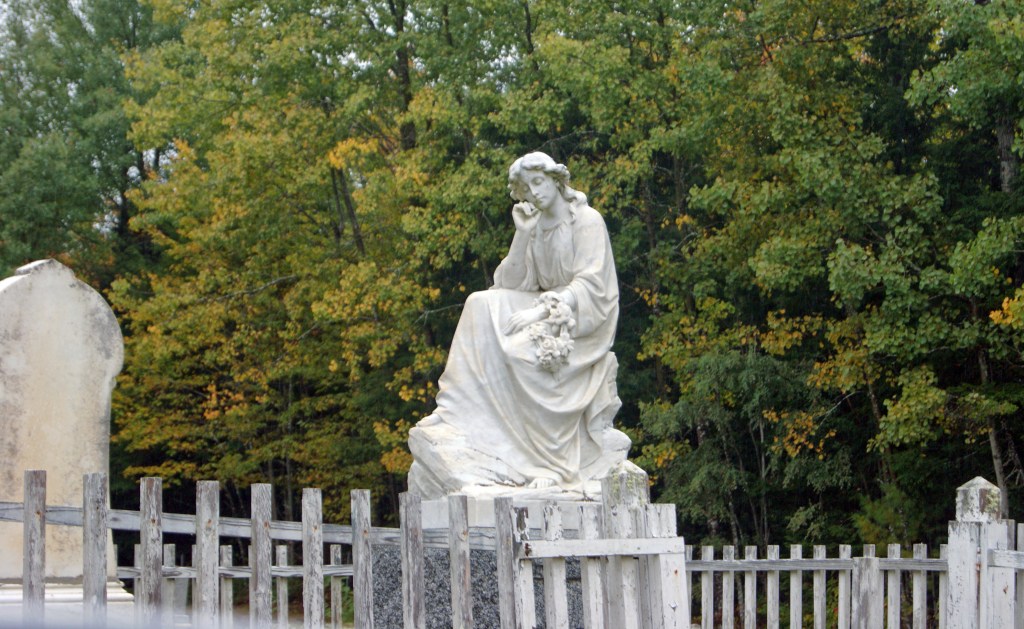
Fall colors and tombstones are reminders that “there is a season for every purpose under heaven”. Life is filled with beginnings and endings. Generations of our ancestors have struggled through their personal stories with their hopes and dreams ending up beneath some old oak or maple tree and becoming the poetry of country music. But is there a greater significance to our life spans than becoming a song, a poem, or a short story?
In a world of violence, war, racism, suffering, hunger, materialism and humanism, it is easy to question if God is uninterested in us or if the idea of God is dead. However, the Bible takes a different viewpoint! God is not dead. He remains caring, sovereign and providential despite humanity’s free will debacle. It is humanity that is dead, buried in confusion, doubt, and selfish immoral behavior, lost in trespasses and sins. Humanity is so disconnected from God that it needs spiritual resuscitation.
Faith is what relieves the tension between holy God and unholy mankind. Belief connects us with God and pleases Him. (Hebrews 11:6) That is why Jesus’ passion on the cross and his triumphant resurrection are crucial. Assuming the guilt and shame of humanity’s rebellious, willful, unrighteous nature, Christ paid the price of death and condemnation which we deserve. Instead, he gives us resurrection hope. In repentance and belief, we are forgiven and gifted an eternal relationship with God. We become alive because of Christ!
The day was promising, the forecast favorable. The sun was burning it’s way through lifting fog. All information pointed to a good sailing day. The Captain gave the order. So the sails were hoisted.
Decision making is a familiar, daily but complicated process although it may be either instantaneous or prolonged depending on urgency or need for deliberation. We assess conditions and possibilities and then move ahead with plans which we hope will lead to best outcomes. Similarly, we formulate world views based on knowledge, observations, and experience. These ideas about origins, purpose, and meaning help determine attitudes, the way forward, and outcomes.
Life’s awesome mysteries spark curiosity and a search for interlocking pieces of the cosmic puzzle. Depending upon on one’s perspective or bias, evidences may lead to different conclusions or theories about God, us, and the world we inhabit However, making deductions requires accepting concepts which are not fully substantiated by the material world or our physical senses. So, “faith” enters the world view picture.
Faith is a very personal matter; we all live with some beliefs that are difficult to fully substantiate. Whether atheist, agnostic, a follower of Islam, a Hindu, a Buddhist, a Christian, a Jew, or a disciple of some other religion, one’s religious beliefs or anti-religious beliefs are based on facts, inferences, theories, and specific writings believed to be profound or profound and sacred. From these we divide ourselves into different faith traditions and label ourselves as humanists, conservatives or liberals.
If God exists, we can only know about Him from ways He reveals Himself to us. Christianity accepts evidences from creation, history, inspired revelation, and Jesus Christ.
Creation gives clues not only to God’s existence but to His nature: “His invisible qualities- His eternal power and divine nature” (Romans 1:20)
Scripture is uniquely powerful. Through divine revelation, historical narrative, and generations of wonderful biographies of courageous men and women of faith, God’s presence, power, providence, and sovereignty are revealed. Furthermore, Scripture holds moral authority, discerns the thoughts and intentions of the heart, is the power of God for salvation, and is profitable for teaching, reproof and training in righteousness (Hebrews 4:22) (Romans 1:16) (2Timothy 3:16)
Christianity may put all its eggs in one basket but not without reason. There are consistent eye witness accounts which bring great credibility to claims of and about Christ, who is “the image of God” and in him was the “fullness of God.” (Colossians 1) His miraculous incarnation, his perfect life and teachings, his miracles, his crucifixion for humanity’s sins, his death defying resurrection, and his astounding ascension were attested to by many:
After Christ’s resurrection, the Apostle John wrote: “now there are also many other things that Jesus did. Were every one of them to be written, I suppose that the world itself could not contain the books that would be written.” (John 21:25)
Dr. Luke reported that Christ “presented himself alive (to his disciples) after his suffering by many proofs, appearing to them during forty days and speaking about the kingdom of God.” (Acts 1:3)
The Apostle Peter spoke of believers having a “living hope” because of the resurrection of Jesus Christ. (1 Peter 1:3)
And the Apostle Paul confirmed the reality of the resurrected Christ to the Corinthians in his affirmation of the wonderful truth of an amazing gospel: ”For I delivered to you as of first importance what I also received: that Christ died for our sins in accordance with the Scriptures, that he was buried, that he was raised on the third day in accordance with the Scriptures, and that he appeared to Cephas, then to the twelve. Then he appeared to more than five hundred brothers at one time, most of whom are still alive, though some have fallen asleep. Then he appeared to James, then to all the apostles. Last of all, as to one untimely born, he appeared also to me.” (1 Corinthians 15:3-8)
Faith need not be blind or devoid of logic or reason. However, it pushes beyond the boundaries of physical proof or full explanation. “Faith is the confidence that what we hope for will actually happen; it gives us assurance about things we cannot see.” (Hebrews 11:1 (NLT2) For Christians that confidence lies in a relationship with Jesus Christ. Believing faith in Christ trusts that God exists, is sovereign and of good character, that He desires to redeem us through the atoning work of Christ, and that He works providentially for our good and bestows spiritual blessings on those who choose Him. “For without faith it is impossible to please Him for He is a rewarder of those that believe Him” (Hebrews 11:6) Faith bestows righteousness and peace: “ …we have been made right in God’s sight by faith, we have peace with God because of what Jesus Christ our Lord has done for us.” (Genesis 15:6) (Romans 5:1 (NLT2)
Circumstances will unexpectedly blow in and obscure and mystify our course; the waters ahead will not always be calm or clear; the unspeakable and unexplainable will happen; fear and doubts will creep in. But faith looks at the evidences, sees beyond the seeable, trusts in a good and just God’s redemption and providence, and moves purposefully onward. Such is the mysterious earthly journey of the Christian. It is one of faith not sight. The righteous shall live by faith” because Christ made those who believe “right with God”. (Romans 1:16-17 ) (1Corinthians 1:30)
An old hymn champions the way ahead: “Standing on the promises that can not fail/ When the howling storms of doubts and fear assail/ by the living Word of God I shall prevail/Standing on the promises of God.”
As this storm blows across the Camden hills and down Penobscot Bay, rain will fall indiscriminately on those in its path, a reminder of a statement Christ made in his inaugural sermon: “God makes his sun rise on the evil and on the good, and sends rain on the just and the unjust.”(Matthew 5-7)
Without context, that thought may sound uncaring, calculating, or even presumptuous. However in its context, Jesus’ words are a snippet from a beautiful message on God’s nature and how one can live righteously with love for God and grace toward all. His comments about rain and sun refer to God’s common grace. We all benefit from the sun’s light and warmth and are refreshed and nourished by rain. Without them earth would not produce fruits.
Similarly, God is an equal opportunity God. He offers redemption to all peoples. Every one, “good” or evil, needs God’s saving mercy because we all have moral failures of thought, attitude and behaviors. Unless one chooses to be, nobody is outside the bounds of God’s redemptive grace which transforms broken, self centered natures and minds into images of God.
That begs the question of what we should be like? What is God like? Jesus taught that the Law helps explain the just and holy nature of God and His requirements for our holiness. The Moral Law is about reverencing and loving God with all one’s being; it’s about character development and about placing the interests of others before one’s own. Some perceive this moral code as being restrictive while, in truth, it’s only restrictions are the fulfillments of authentic love! When the Law’s foundational purposes are understood, God’s principles for living explain the importance of God in life, how to avoid trouble, how to respond to hurt and mistreatment without acting in vengeance or bitterness, how to forgive and not return evil with evil but with good, how to bless and to pray for enemies and not curse them, and how to live humbly in God’s image. (Matthew 5-7)
Jesus explained that the “Thou shalt not(s)” in the Law lead to healthy relationships. The moral code is not about self righteous, exemplary behavior through rule keeping. That concept leads to self congratulatory arrogance. The Law shows us who we are or are not; it humbles us before God’s holiness and shines a light on our weaknesses, on our inability to be morally pure, and on our need for forgiveness. It directs us to Christ, who as a perfect sacrifice paid the penalty for our transgressions because he loves all souls even praying for forgiveness for powerful adversaries who perpetrated the evil of murdering him.
If “God is love” and if we are to be like God, we must live the incarnational, humble,and sacrificial life of Christ, who showed the meaning of love and compassion, how to live prayerfully in obedience to God’s purposes, how to put others first, how to forgive deep hurts and to nurture or to turn around difficult relationships,
To be like God requires living the grace of sun and rain, living intentionally with integrity and charity and as a blessing to all others. God’s love is “made complete” in those those who love Him. (1John4:12)
In Psalm 19, the Psalmist compares the created heavens and sacred Scripture as unique and powerful revelations of God’s magnificence and loving care. The heavens touch the soul without sound or words; Scripture enlightens the mind and revives the soul with God’s words.
“The heavens proclaim the glory of God. The skies display his craftsmanship. Day after day they continue to speak; night after night they make him known. They speak without a sound or word; their voice is never heard. Yet their message has gone throughout the earth, and their words to all the world.
The instructions of the LORD are perfect, reviving the soul. The decrees of the LORD are trustworthy, making wise the simple. The commandments of the LORD are right, bringing joy to the heart. The commands of the LORD are clear, giving insight for living. Reverence for the LORD is pure, lasting forever. The laws of the LORD are true; each one is fair. They are more desirable than gold, even the finest gold. They are sweeter than honey, even honey dripping from the comb. They are a warning to your servant, a great reward for those who obey them. How can I know all the sins lurking in my heart? Cleanse me from these hidden faults. Keep your servant from deliberate sins! Don’t let them control me. Then I will be free of guilt and innocent of great sin. May the words of my mouth and the meditation of my heart be pleasing to you, O LORD, my rock and my redeemer.” (Portions of Psalm 19:1-14 (NLT2)
Our songster was humbled by an awesome view of God’s glory, by His “eternal power and divine nature”, and by self revelation through God’s “instructions”, “decrees”, and “commandments” which give “insight into living”. Creation and Scripture make us aware of God’s character, His magnificent grace, and His loving soul-care. The Psalmist had discovered the joy of living an obedient, repentant life within God’s purposes and guidance. He understood that God’s sovereign principles for living are perfect and just.
Fortunately, creation and Scripture have never stopped speaking. They continue to minister to us. It is a matter of whether we see God’s “grace” in them and listen to what they say to us.
“O LORD, our Lord, how majestic is your name in all the earth! You have set your glory above the heavens…When I look at your heavens, the work of your fingers, the moon and the stars, which you have set in place, what is man that you are mindful of him, and the son of man that you care for him?” (Psalm 8:1-4)
“ Your word, O Lord, is eternal; it stands firm in the heavens…Your word is a lamp to my feet and a light for my path.” (Psalm 119:89, 105)
Someone has said that “A ship is safe in harbor, but that is not where it is meant to be…” Sometimes safety is prudent, and “sticking close to home” is wise when we are unable to fully define the course ahead. However, timidity can be diminishing. Our personal world will not expand until we push into the wider world of potential, opportunity, adventure, and dreams. Knowing that the passage may be rough at times, we just have to suck it up, move out of our comfort zone, and face whatever challenges lie ahead.
Not long ago, I was asked what advice I would now give my 20-year old self if I could. After some thought, I believe some of the wisest guidance I would have given myself as a still naive and unsure young man who was taking substantial steps to leave the home harbor would have been to carefully plan my life against the background of Psalm 15 and Proverbs 3:5-9:
“O LORD, who shall sojourn in your tent? Who shall dwell on your holy hill? He who walks blamelessly and does what is right and speaks truth in his heart;who does not slander with his tongue and does no evil to his neighbor, nor takes up a reproach against his friend; in whose eyes a vile person is despised, but who honors those who fear the LORD; who swears to his own hurt and does not change; who does not put out his money at interest and does not take a bribe against the innocent. He who does these things shall never be moved,” (Psalm 15:1-5)
“Trust in the LORD with all your heart; do not depend on your own understanding. Seek his will in all you do, and he will show you which path to take. Don’t be impressed with your own wisdom. Instead, fear the LORD and turn away from evil. Then you will have healing for your body and strength for your bones. Honor the LORD with your wealth and with the best part of everything you produce.”(Proverbs 3:5-9)
Those verses are profound. Although one can’t lead a perfect life (which is the reason God forgives and redeems us through Christ) one can live a devoted life. Freedom from hurt or suffering is never guaranteed. However, there is a promise that if one seeks God and heeds His wisdom there will be healing and strength and direction within one’s given circumstances.
Regardless of age, any man or woman can be reassured that their soul will always find safe harbor when they go with God in their boat! And one day while looking back on distant shores, they will be able to give this prayer of gratitude, “You (have made) known to me the path of life; in your presence there is fullness of joy; at your right hand are pleasures forevermore.” (Psalm 16:11)
This photograph suggests there is merit in the adage “History repeats itself.” However, even though the old painting on the wall and the current photo of the man in the window are similar, they are not replicas. In this case, there are not only different men, different flags, and different boats, but technology has intervened. An iPhone has not only changed a quiet, thought filled meal but also the world! History may be instructive, but there is no redo.
Actually George Santayana’s statement was that “Those who cannot remember the past are condemned to repeat it.” When we think and behave in familiar ways, we end up with similar outcomes. Resentment or insecurity may evolve into anger, depression, abuse, or even violence. Lack of loving affirmation may turn into negative attention seeking behaviors. Unforgiveness leads to sadness and disrupted relationships, but we are clumsy about seeking it, and worse still, we don’t forgive. We want to be kinder, gentler, happier, and people of integrity, but our coping skills are faulty. We have some concept of right from wrong and struggle with guilt about our lousy attitudes, bad and aggressive behaviors, and poor, selfish, destructive, hurtful choices. So, we actually desire transformation and struggle to be our “ best selves”. This is problematic if we do not recognize or know how to break negative behavior cycles.
We seek out mentors, therapists, and accountability groups and discover that if we are willing to do the work we can learn new values and thought processes. We are not necessarily doomed to repetitive thinking and behaviors. However, our greatest obstacle to wholeness is our self centered, fallen nature- a spiritual condition which self-love or self effort can not change. The Psalmist points us to the surprising and powerful source of help: I lift up my eyes to the hills. From where does my help come? My help comes from the LORD, who made heaven and earth.(Psalm 121:1-2) The Apostle Peter framed it this way: “And the God of grace who called you to His eternal glory in Christ, after you have suffered a little while will himself restore you and make you strong.” (1Peter 5:10)
We may have our own personal stories of mentors, benefactors, heroes and redemption, but there is only one soul Redeemer. What God did for us through Christ is unique. It can never be and never needs to be repeated. Jesus’ life and death in a shadowy, backward time and place are brilliant mega events in history. His death on the cross for the sins of the world is a one time historically unique event of cosmic consequences: ‘…for this he did once for all, when he offered up himself.” (Hebrews 7:27) He died so we could be new creations with new natures spiritually alive to God, who enables us to combat our destructive, unholy ways and to be conformed to the glorious image meant for us. Jesus stepped into a gloomy picture, intervened with an old rugged cross, and has changed and brightened the future and image of all creation forever.
“Things” change; we change, but not God or His redemptive plan for all creation. Realizing the enormity of what Christ lovingly did for us is impactful and transformative. Healed, cleansed, forgiven, and restored souls and minds become less self centered and more God-centered. The past has been taken care of and never needs to be repeated. The believer moves forward with the prayer of all Christendom:“ Thy kingdom come, Thy will be done on earth as it is in heaven” for “Yours is the kingdom and power and glory forever. Amen.”
Great Blue Heron fishing at twilight, Sullivan, Maine
Sitting on the river’s edge at dusk watching and listening to heron fish and squawk, I wonder what messages they are conveying to each other. Creature communications are complex, but the idea that God speaks to us is vastly more intriguing and mysterious.
In the Bible narrative, God made His purposes known in visions and dreams, thunderings and prophetic words, tablets of stone and object lessons. A detached hand wrote on a wall; lots were cast; warriors succeeded or failed; a donkey spoke; a voice from heaven was heard; a still small voice whispered to Elijah; a whirlwind of questions and revelations inundated Job.
In this age of logic, reason, scientific methods, and intellectual arrogance, we are embarrassed by the miraculous. Some scoff at the idea of God -let alone that He reaches out to us and that we can not only engage Him with trusting hearts and praise-filled voices but also with with laments, doubts, requests, and intercessions. That God speaks to us, let alone in unorthodox and indirect ways, easily provokes skepticism. Some God-believers are deists who accept God as existing but an uninterested or uninvolved player in current life. “Rational” minds want proofs and evidences and limit themselves to human possibilities.
Scripture also indicates that God speaks through the beauty, wonders, and mysteries of nature as well as through life circumstances that often include suffering which C. S. Lewis described as God’s megaphone. Job’s life is one example. In the midst of great emotional and physical distress, Job took issue with God and His justice. God in turn overwhelmed him with considerations about the origins, uniqueness, and immense diversity of the natural world and its created beings. He posed questions: “Where were you when I laid the foundations of the earth? Tell me, if you know so much. Who determined its dimensions and stretched out the surveying line? What supports its foundations, and who laid its cornerstone?…Do you know the ordinances of the heavens? Can you establish their rule on the earth” ( Job 38:4-6; 33)
Job had no answers. He was humbled. God’s purposes were too great for him to fully comprehend. However, he saw God’s transcendence, His eternality, His omniscience, His mighty power, and His sovereignty. He attained a deeper understanding of God’s nature through nature and that man’s puny wisdom is conceit and folly and that creation speaks so loudly that we ” have no excuse for not knowing God.” (Romans 1:17-23)
Although nature is revelatory, sacred scripture continues to be God’s divinely practical and powerfulwisdom. It is “able to make you wise for salvation through faith in Christ Jesus. All Scripture is breathed out by God and profitable for teaching, for reproof, for correction, and for training in righteousness, (2 Timothy 3:15-16)“For the word of God is living and active, sharper than any two-edged sword, piercing to the division of soul and of spirit, of joints and of marrow, and discerning the thoughts and intentions of the heart.” (Hebrews 4:12)
Addressing the people of Athens, the Apostle Paul said that “In (God) we live and move and have our being.” If we do not recognize that, we have either tuned Him out, or we are not understanding the language He speaks. We may choose not to listen, but maybe His voice has been muted by lack of religious training or by the loud and appealing voices of culture. Maybe rituals, traditions, and liturgy which do not translate into transformed living have resulted in inattention, disinterest, boredom. Maybe distorted, contrived, burdensome restrictions about what a believer should or should not do have killed interest. And maybe the hypocrisy of those who confess to love Christ but do not love their neighbor has deadened truth. Authenticity is immensely important to validate faith.
Redirecting focus away from tradition, ritual, legalism, and people and centering on the person of Christ is essential for Christian faith. He vividly, perfectly, and unmistakably personifies God’s love and “radiates God’s glory.” God speaks most powerfully and clearly to us through his life, and teachings. “Fix your eyes upon Jesus, the author and perfected of our faith.” (Hebrews 12:2)
Jesus made a crucial statement and an amazing promise as he talked to those who would not recognize him as divine. “My sheep listen to my voice; I know them, and they follow me. I give them eternal life, and they will never perish. No one can snatch them away from me,for my Father has given them to me, and he is more powerful than anyone else. No one can snatch them from the Father’s hand. (John 10:25-29 (NLT2)
We may be distracted or ignore God. We may seek Him in the wrong places, hear distorted ideas, or not understand what He is telling us. Just listen to Jesus. Standing before Pilate and his accusers, he stated his purpose in coming into this world was “to testify to truth.” (John 18:38) If that is so, it is imperative that we give him an audience!
In order to communicate intimately with anyone, one must know something about who they are. God knows us and has given us ways to hear Him. Three of those are creation, Scripture, and Jesus. For those who seek Him, God said, “Call unto me, and I will answer you and show you great and mighty things that you don’t know.” (Jeremiah 33:3)
And just maybe, a squawking heron will speak with flashes of wonder, grace, and beauty!
We long for that elusive state of inner calmness, of being untroubled…Yet, our imperfect natures and this chaotic world guarantee we will never be free from situations, relationships, and circumstances which are distressing. Frustration, disappointment, and angst are part of the human experience. So, we are restless souls who spend considerable effort to make life enjoyable, to minimize stress, anxiety, and depression.
“Serenity making” is a lucrative business. We take massages and spa holidays, read self- help books, meditate, listen to music, and seek therapy. We go on “relaxing” vacations, exercise, take social media breaks, and practice mindfulness. We enrich pharmaceutical companies and experiment with illicit and legal mind altering drugs for temporary relief from stress. But even then, we are still restless, dissatisfied, unfulfilled. What we value and do may be good but still is lacking. Generosity, charity, service, compassion, independence, endurance, and hard work are noble qualities and efforts, but they do not guarantee contentment. Self-realization, chasing personal desires, and exerting our rights are motivators to justify our existence but in the end are hollow endeavors.
Where we look for meaning and purpose is the biggest factor to inner peace. If life is without a grander purpose, then we are condemned to futilely circle around and around on this lonely planet as puny, pathetic, empty individuals without hope or lasting legacy.
Scripture gives us an alternate view point, one that is wildly grand, poetic, and imaginative yet appeals to intellect and soul because it is both rational and intuitive. Life is indeed about us but with a twist. It is about creative intent, about who we are intended to be and why we have a distorted view of ourselves.
Scripture tells us that God exists and is good and that He created us with the wonderful intent that we would experience His goodness and possess His just and loving nature. However, because of doubt and ambition, humanity lost its innocence and has been restlessly searching for restoration ever since Eden. Sinful willfulness separates us from God’s holy, just character and interferes with the realization that the most glorious and fulfilling way to be our “best selves” is living in God’s image.
There is no way we can gin up goodness enough to save ourselves. However, in astonishing compassion and love, God responds to our rebellious hearts with a merciful redemption offer. “It is not by works of righteousness that we have done but by His mercy He saves us.” (Titus 3:5-7) By God’s grace we can be restored to a relationship with our Creator because He loves and purposes to preserve His creation through Christ.
Christ knew the joy of his Father’s love and presence and vowed to share them with us: “Peace I leave with you; my peace I give to you. Not as the world gives do I give to you. Let not your hearts be troubled, neither let them be afraid.” (John 14:27)
Christ became our path to God when he paid the penalty of our rebellious spirits and assumed the condemnation for our sins as he suffered the indignity and horrors of the cross. Because of his righteousness we may be redeemed. He has provided us with what the world cannot: forgiveness, freedom from fear of condemnation and death, his righteousness, God’s providential care, a heavenly inheritance, and a new spirit blessed with joy, peace and hope.
Our part is believing with a faith that is more than intellectual but substantive enough to trust and follow. Confidence in God’s love, power, sovereignty, and providence was why African American slaves could sing “peace like a river floods my soul”. Horatio Spafford, who upon learning of the tragic loss of his four daughters at sea,, immediately wrote the hymn “It is Well with My Soul. ” In it, he expressed this extraordinary peace which courageously weathers storms that threaten to undo us : “When peace like a river attendeth my way, when sorrow like sea billows roll, whatever my lot, thou hast taught me to say, it is well with my soul…”
If we search Scripture and accept the purposes of Christ’s death on our behalf, then we can not doubt God’s loving intentions. We are meant to be under His care. What greater rest could there be than in the peace “of” God—a peace which is not self-generated but is sourced in God’s nature, His presence with us, and His powerful providential care? Such faith defies understanding but brings comfort and rest to the burdened and weary. (Matthew 11:29)(Philippians 4:7)
God is our refuge and strength, a very present help in trouble. Therefore we will not fear though the earth gives way, though the mountains be moved into the heart of the sea, though its waters roar and foam, though the mountains tremble at its swelling…
The nations rage, the kingdoms totter; he utters his voice, the earth melts. The LORD of hosts is with us; the God of Jacob is our fortress…
“Be still, and know that I am God. I will be exalted among the nations, I will be exalted in the earth!” The LORD of hosts is with us; the God of Jacob is our fortress.
This delicate, beautiful, isolated plant shines brightly in an unlikely environment. Somehow it has managed to grow and blossom mostly unnoticed in unfriendly, non nourishing, stark surroundings. Some people are like that. Despite adversity, lack of opportunity, and restrictive circumstances, they shine. They seize the day and “bloom where they are planted.” But that is not always an easy task.
Sometimes we are stuck and have to play the hand we are dealt. Not everyone does equally well in similar circumstance. Some people can handle wealth or power or success. Others become greedy, arrogant, and oppressive. Some people arise above adversity and injustices and make the most of their circumstances while others are defeated.
Victor Frankl, an Austrian Psychiatrist who survived the Nazi concentration camps said that “the last of human freedoms is to choose one’s attitude in any given set of circumstances, to choose one’s own way…” That may be true. Life frequently does not give us choices except the choice of how we respond. How can we not respond with anger, envy, prolonged grief, or depression when pressed by suffering, loss, hardships, or injustice? The manner with which we deal with life is crucial.
Whether recognized or not, we are all on that journey of discovery. Frankl believed that the search for meaning was a major motivator for how we deal with life. If so where do we look? There are only two places. Either existence is all about us and our self-realization, or there is some greater, grander reason for being.
We obviously find self value in the goodness and purpose of service, or in the comfort and love of friendships, or in the self expression or beauty of art, or other positive experiences. Sometimes our search turns to materialism, or addictions and obsessions or even immoral and criminal behaviors. Whatever our experience, there is always a gnawing discontent, a sense that there is something more.
Both King Solomon and Dylan Thomas hit us with the futility of out passions, goals, pleasures, work, and wealth. The book of Ecclesiastes stuns us with the fact that “all is vanity”. Dylan Thomas’ poem captured the thought that whether “old”, “wise”, “good”, “wild” or “grave” we will not “…go gentle into the good night” but “rage against the dying of the light.” We struggle against the fact that life has been vacuous. We want our lives to have value. And they can! King Solomon pointed out that life is to be lived in light of the overarching facts of creation. We are creatures with a purpose—to be images of God’s character- to know Him, to honor Him, and to enjoy Him.
When the Israelites were taken into Babylonian captivity, there response to subjugation and exile was grief and depression and withdrawal: “Beside the rivers of Babylon, we sat and wept as we thought of Jerusalem. We put away our harps, hanging them on the branches of poplar trees. ..But how can we sing the songs of the LORD while in a pagan land?” (Psalm 137:1-4 (NLT2)
But that was not God’s intentfor them: “For thus says the LORD: …I will visit you, and I will fulfill to you my promise and bring you back to this place. For I know the plans I have for you, declares the LORD, plans for welfare and not for evil, to give you a future and a hope.” (Jeremiah 29:10-11 (ESV)
Despite the terrible consequences of their idolatry and immoral ways, God loved them, had not deserted them. He wanted them to remember His promise of restoration, to patiently trust, to not give up, and to flourish even in captivity: He told these captives to “Build homes, and plan to stay. Plant gardens, and eat the food they produce. Marry and have children. Then find spouses for them so that you may have many grandchildren. Multiply! Do not dwindle away! And work for the peace and prosperity of the city where I sent you into exile. Pray to the LORD for it, for its welfare will determine your welfare.” (Jeremiah 29:4-7 (NLT2)
That is a prototype for how we can live. Their God-directed duty was to grow and blossom, to enjoy life, to contribute to their community, to endure in faith, and to have confidence that God that would redeem them as He said He would.
When life is tough and with no relief in sight, hopelessness and despair are natural responses unless one is assured of God’s loving providential wisdom and care. He assures us through Christ. He rescues our spirits through faith in Christ, who has defanged death, freed us from the condemnation of sin, gives joy as we love God and others, and shows us the way to eternal hope. The Apostle Paul lived that life. He suffered persecution, deprivation, sickness, and ultimately death because of his faith. Yet, his letters to the New Testament churches ring with joy and love and contentment because he was centered in his faith and believed God’s way was sufficient: “My grace is sufficient for you, for my power is made perfect in weakness.” (2 Corinthians 12:9
By God’s grace and power, we can be content to be who we are meant to be whatever our skill, potential, or circumstance. Focusing our eyes on Jesus’ teachings and sacrifice for us and trusting in God’s steadfast love and good purposes for us, we can joyfully “bloom where we are planted” as children of God.