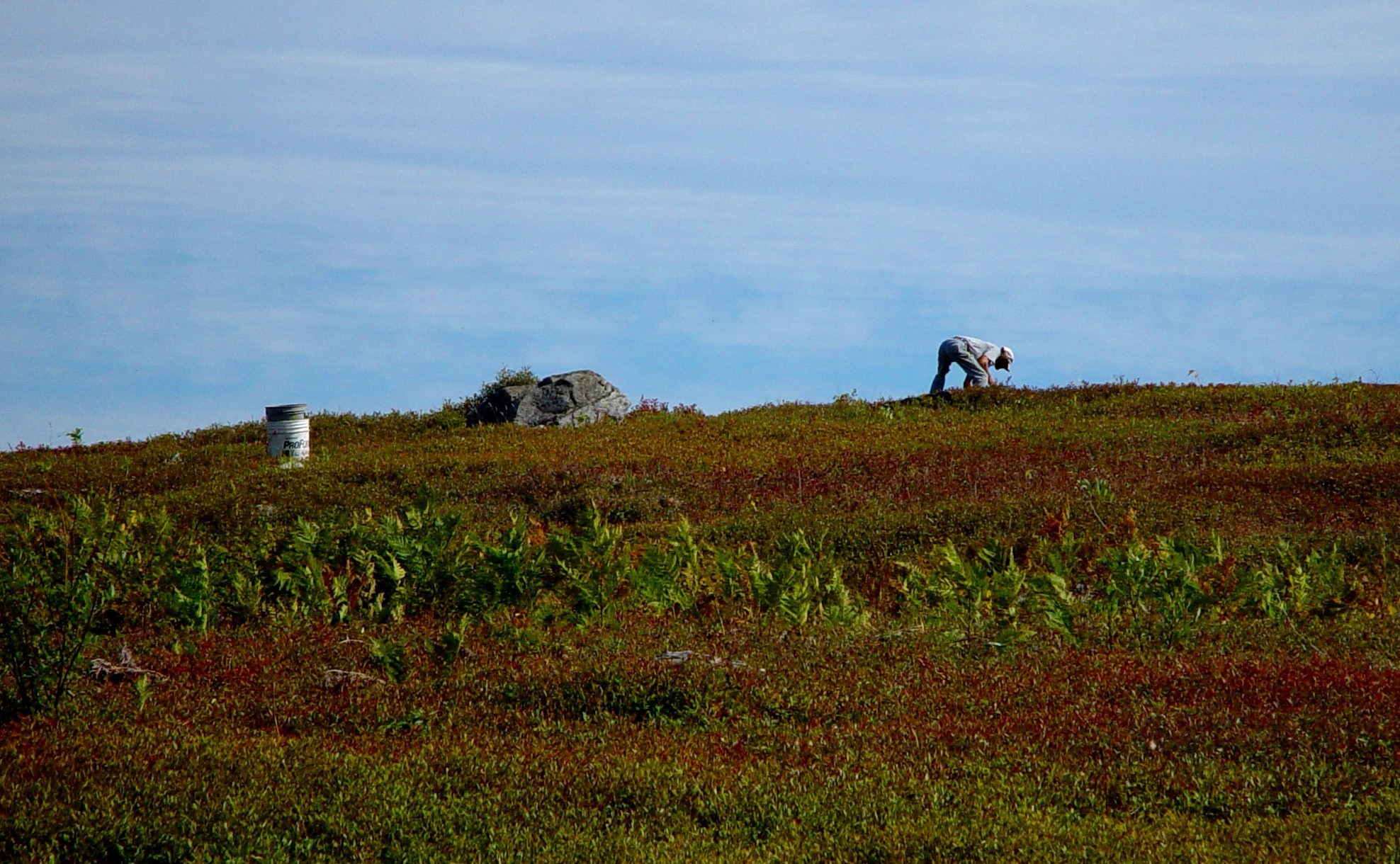
Raking Blueberries, Whitneyville, MaineWorking late, taking advantage of seasonal blueberry harvesting, this fellow is laboring a “second job.” Whether to provide for his children’s school clothes, to have a financial cushion for the upcoming winter’s utility bills, or to buy something special he wants, he is “redeeming the time.” That is an odd phrase because we cannot buy back or relive one short, fragmented, unpredictable second and its outcomes, but that phrase encourages us to take advantage of opportunities as they present themselves.
We understand failing to seize the moment: forgetting to take a photo of a precious memory or occasion, missing a good investment, speaking hastily and unkindly, living selfishly, not spending time with loved ones now gone, and regretting distant, dysfunctional, or broken relationships. Those impressionable times…good or bad…cannot be retrieved. However, sometimes second changes are possible e.g. we may recover lost health, wealth, or reputation, or restore old, valued relationships.
Scripture teaches that God patiently uses time for working out His purposes-that “There is a time for every purpose under heaven,” and that “in the fullness of time” God reveals Himself and acts in certain ways – times in which He draws us to Himself and invites us to understand and participate in His purposes for our good. Although much New Testament teaching is directed toward believers in Christ, it has general application on how to live aware, selfless, intentional lives guarded by values that promote healthy, peace filled living and loving relationships. It encourages a positive mindset which concentrates on the true, honest, just, pure, virtuous, lovely, and praiseworthy (Philippians 4:8). Created to be like God, we have the ability to love, know, reflect, and enjoy God’s goodness. To our detriment we have veered from and have distorted those purposes. Living in a materialistic, sexualized culture which idolizes self, we tend to focus on our wants, desires, and plans. Self-actualization and self-aggrandizement push God aside. That universally fallen, broken nature needs redemption.
Because of our redemptive need, God, in the fullness of time, graciously and mercifully continued His redemptive purposes for humanity by sending his son to redeem us, to restore back the glory we lost in Eden, to entirely clear our sin-debt and give us a righteous standing before God (a standing unachievable by our own efforts) if we choose to believe, and to eventually fulfill all His purposes in Christ (Galatians 4:4) (Ephesians 1:10) (2Corinthians 5:21). Jesus spoke about squandering time and encouraged us to look beyond ourselves and to seek the kingdom of God which he opened to us through his caring, compassionate, selfless life and his immensely loving sacrifice for us on the cross.
So, if we carefully consider life’s unpredictability and our vulnerability and if it is true that God brings us His Kingdom through Christ, “redeeming the time” is critical. There could be no better day to consider Jesus because there may be no other day to listen to him about meaning and eternal life.
Mountains Tops

Although they lack the towering, ragged grandeur of the Rockies and the Alps, the mountains of Acadia National Park are impressive and beautiful in a more refined way.
There is something satisfying, even elating, about achieving a mountain top after a strenuous climb. On the heights, one enjoys an otherwise unappreciated perspective of distant mountains, valleys, and wide ocean vistas. From the top, one better understands the landscape.
Mountain top experiences in scripture were often where one attained a more expansive view of God. They were where God revealed Himself and His purposes to humanity.
After surviving the deadly deluge in an ark, Noah landed safely on Mount Ararat where God renewed His promised blessing to humanity. God revealed Himself as a faithful redeemer to Abraham on Mount Mariah. The Moral Law, which shows us the best possible way to live, came to us on Mount Sinai. From Mount Pisgah, Moses saw the promised future of Israel. Mount Carmel was the site where Elijah proved that God is the only True and powerful Sovereign. Mount Zion was the site of the temple and the presence of God.
Christ gave his first recorded and beautifully comprehensive and instructive sermon on the “Mount.” Peter, John and James saw his eternal glory revealed on the Mount of Transfiguration. And in the garden of Gethsemane on the Mount of Olives, Jesus agonized in prayer as he faced not only torture and execution but the crushing penalty of humanity’s sins. There he showed us how to submit to the Father’s will. Tradition speaks of Calvary as being a mountain where God in immeasurable love, mercy, and grace opened Himself in a new way to us as Christ waged a great battle to achieve redemption for all who would accept it.
If we choose to climb these mountains, we will see God afresh, and our lives will be transformed as we ponder the vast landscape of His ongoing, faithful love and redemptive purposes for us.
Coexistence in a Swampy World
Coexistence
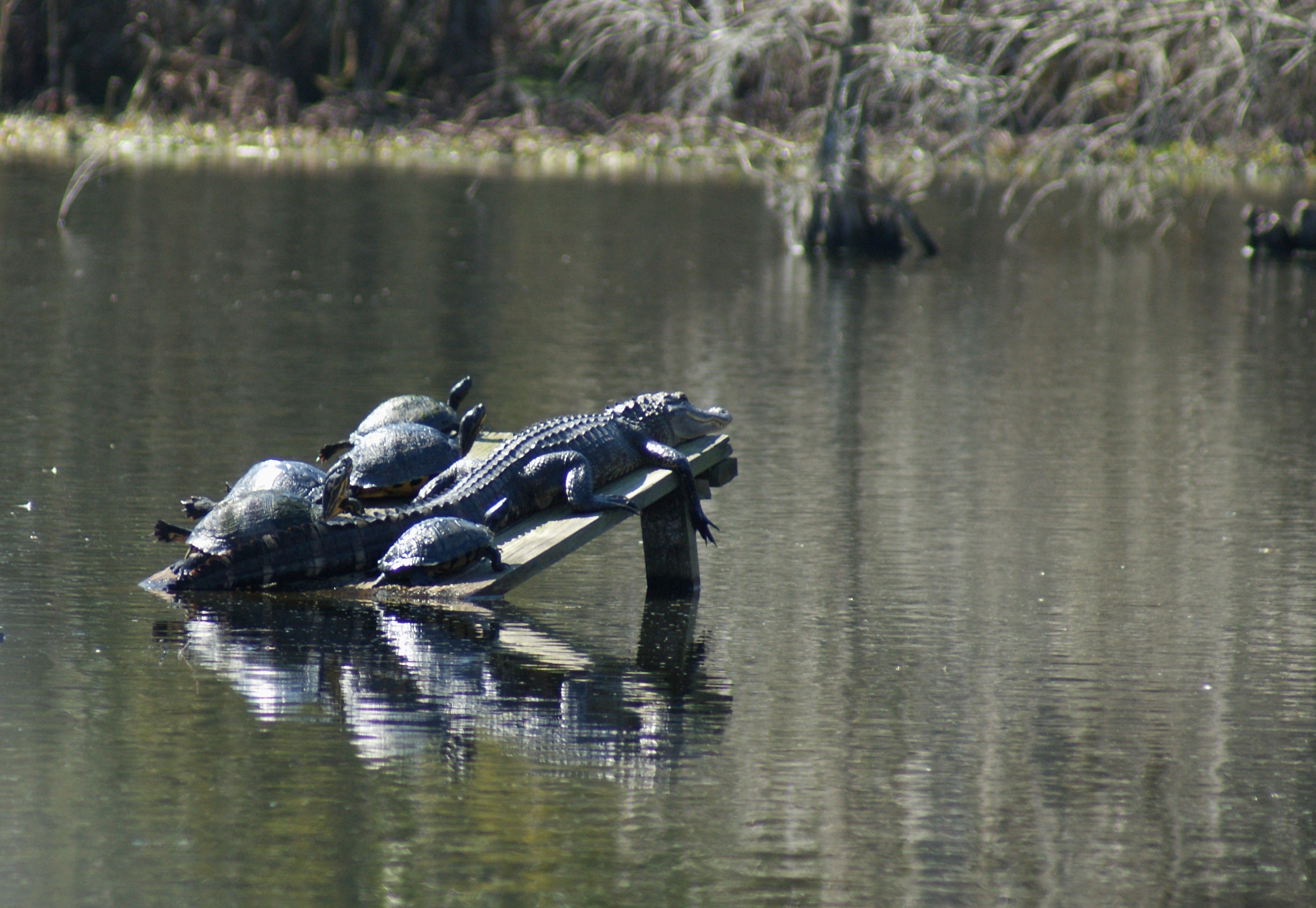
Although definitely not a Maine photo this one is shared because it generated some shareable thoughts.
This swampy microcosm was spotted on a South Carolinian plantation while we were visiting family. Drawn to the smug almost gleeful countenance of the alligator and the naive inquisitiveness of the turtles, I immediately thought of Lewis Carroll’s poem in which the “Walrus and the Carpenter” lured some happy little oysters on a walk and then ate them and of Mary Howitt’s poem about the flattering spider who enticed a little fly into its web. But turtle shells are not very digestible and alligators’ hard exoskeleton-like skin would not be good for nibbling; so everybody appeared safe!
These dissimilar creatures were residing on the same real estate but in separate worlds, perhaps much like the preceding generations of blacks and whites who had lived on this planation before them. Although together, they were separate and isolated by hard social and economic realities and terribly hurtful, inhumane practices and prejudices and all those customs, beliefs, and values which define different social groups.
Being stiff necked and hard shelled does not allow for fruitful interaction or resolution of differences. They distance people from each other. We know that because we experience both subtle and blatant divisive influences, attitudes and behaviors today. Conflicting visions of the common good, powerful special interest group, shifting moral standards, economic policies, government overreach, and political and religious arrogance contribute to discontent, lack of civility, and the drive toward self-centeredness, entitlement, and individualism. We redefine and recalibrate truth to be situational and to mean what we want it to be; and we become delusional forgetting that truth is based on reality.
Because of our inherent differences and life experiences, we will not always share the same values or draw similar conclusions or find space for compromise. Seeking truth together requires graces we frequently lack: listening, understanding, patience, honesty, valuing others, and selflessness. That is hard work for self-assertive, self-protective fallible minds and broken spirits which require healing and transformation. But Jesus said that there is Truth.
In fact, Jesus said that he is Truth revealed. He told Pilate that he came into the world to bear witness to the truth which one would know if they listened to him (John 18:37). As we look at him, the very nature of God becomes visible. If we listen to him, the voice of God speaks. If we seek him, truth will be revealed. And if we follow him, we will begin to experience life the way it was meant to be. We will see ourselves for who we are and how much God loves us; we will find forgiveness, redemption, and peace. We will be empowered to be more, to be our “best selves,” and to discover what we have wanted all along including the promise that the best is yet to come.
As relational creatures we want to live in fellowship and peace but have flawed ideas of how to share the same place. Our imperfect human natures prevent attaining the ideal, but that does not negate the solution. If we were to look, seek, ask, and follow, we could be more than the alligator and the turtles. We could learn how to live better with each other in love and gratitude to God and with as much love for our neighbor as we have for ourselves.
Heads UP!

At first, I thought these ducks were “nodding off,” but they were paddling their way through the early morning mist fishing with their heads down.
Interestingly, there were no apparent “lookouts” to warn of predators. Their vulnerability reminded me of the Bible story of Gideon, who watched his potential army recruits quench their thirst in a river. Some dipped their faces into the stream. Others drank from their hands so that they could pay attention to their surroundings and not be ambushed. He chose his army from the observant and aware and sent the others home.
We live in an era when we need to be constantly cognizant of potential harm and to be alert for enemies that plot to destroy our bodies and our spirits. Are we thoughtful and protective against these sometimes subtle assailants as well as our personal weaknesses? What is going to catch us unaware?
Once when speaking about “last times,” Jesus gave his disciples clues for recognizing when that time will approach. (Read Luke 21). He also gave them (and therefore us) crucial advice for contemporary living. He told them not to be caught sitting complacently without knowing God and His redemption:
“…Stand and look up, for your salvation is near!…Heaven and earth will disappear, but my words will never disappear…Watch out! Don’t let your hearts be dulled by carousing and drunkenness, and by the worries of this life. Don’t let that day catch you unaware like a trap…..Keep alert at all times. And pray that you might be strong enough to escape these coming horrors and stand before the Son of Man.” (Luke 21)
We all know that our earthly lives are time limited. We will experience a last time. We may work our way through this life with heads down never seeking the source of life and the Promiser of everlasting life, never looking to the heavens from whence comes our help, and oblivious to or denying what is ahead,
But…
if his words are true, there is every reason to check out Jesus and what he has to offer.
The Wait…

There are moments and even seasons when we have no choice but to “wait it out.” Sometimes, we are powerless over our challenges. Solutions elude us, and we become overwhelmed, anxious, and depressed especially if the situation or change is irrevocable.
Scripture speaks of waiting and then waiting some more for the Lord’s intervention in our dilemmas. In Psalm 46, the Psalmist reminds us that even in the most horrific circumstances “God is our refuge and strength, that He is an ever present help in trouble,”and that He calls for us to consider His wondrous acts and mighty power while looking for Him within our calamaties.
When we do, we will hear God’s gentle words penetrate the pain, the loss, the tragedy, the angst, “Be still and know that I am God.” That stillness is an invitation to trust Him, to believe that He is good all the time, that He is compassionate and faithful and keeps His promises to us.
Be quiet in your spirit. Listen as He speaks through His word, through the example and teachings and the person of Christ, through our meditations and prayers, through the wisdom of others and as He reveals His goodness within our circumstances.
God is always near. He will minister to us as we wait…He will undergird us with His everlasting arms, will carry us through deep waters, and will walk with us through fiery trials.
Identifying a Good Tree

Some can tell the nature of this tree by its shape, bark, and leaves. Appearances can be deceptive, but all questions and doubts dissipate when this it produces apples. In Maine that occurs in August and is followed by apple picking and delicious pies in September.
Like a tree, a person’s true nature may be revealed over time. Christ once said “a tree is known by its fruit; no good tree bears bad fruit, nor does a bad tree bear good fruit…” and “what comes out of person is what defiles him.” (Matt 12:33) (Mark 7:20-23) in other words, human behaviors and attitudes and speech are the means by which character is revealed.
Although the old adage that actions speak louder than words is true, how we use words provides windows into who we really are. Jesus also said, “ I tell you, on the day of judgment people will give account for every careless word they speak, for by your words you will be justified, and by your words you will be condemned.” (Matthew 12:35-36) That our words justify or condemn us is startlingly personal and should give us pause to consider how speech reflects inner character. What we believe and how we confess it in action and word is important to God. And to us!
One of the good fruits of faith should be lovely speech which does not intentionally offend, hurt, or diminish another, which offers truth with love, and which proceeds from the good treasure of a repentant, humble heart reflecting the presence of Christ.
“For out of the abundance of the heart the mouth speaks.” (Matthew 12:34)
Freedom Rings
“Down in the valley where the river meets the sea…”
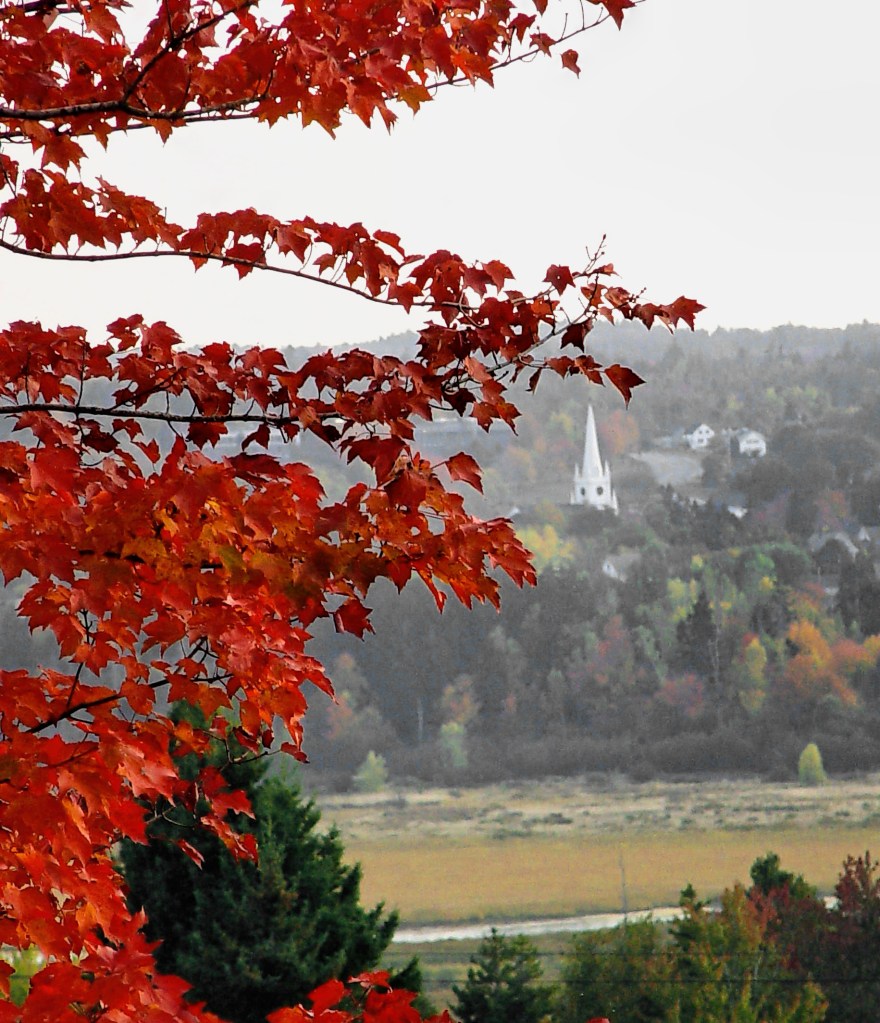
Nestled in the picturesque Machias valley lies this historic New England village. The Church in this photo played a role in a Revolutionary War naval battle during which local patriots captured a British ship, the Margaretta, took it up Middle River, (foreground) and scuttled it.
New England villages are steeped with the history and ambiance of our nation’s social and religious beginnings. There are village greens, old court houses, cemeteries, and taverns. Magnificent church spires point to the heavens while holding crosses and weather-vanes high above their towns. Belfry clocks keep the village on schedule, clanging bells invite or even summon one to worship, and carillons chime beautiful, old hymns that echo through the town. They remind one of quickly advancing hours and worship opportunities while their steeples tell how the winds are blowing, point to the One from whom all good things come, and proclaim God’s Good News of redemption.
The first battles of the Revolutionary War were fought in New England villages. Our incontrovertible, dearly held God-given rights and freedom of worship were purchased with the bloody sacrifice of brave men and women. But are we truly free? Despite our political and religious freedoms, things we seek or fear become our masters: goals, habits, desires, needs, addictions, relationships, money, professions, ideas, positions and prestige, and our anxieties, and neuroses. We may have Freedom from tyranny of others, but do we have Freedom from tyranny of self? Who will save us from ourselves?
The message symbolized by crosses on village church spires is that Christ’s sacrifice on the cross has won our spiritual freedom. Believers are loved, forgiven, restored and free to live as they ought because of Christ. Scripture tell us: “It is for freedom that Christ has set us free.” (Galatians 5:1) He made a covenant freeing us from the power of our sinful natures, pardoned us from the condemnation of our unholiness, undid the tyranny of death, and guaranteed life eternal if we but agree that we need him and will trust him.
American song writers have produced some wonderful patriotic hymns which sadly are seldom heard any more. “My Country Tis of Thee” was written in 1831 and beautifully delivers the powerful message of why we know the blessings of freedom. Listen to stanzas one and four. Ironically they are sung to the tune of “God Save the King.”
My country tis of thee,
Sweet land of liberty,
Of thee I sing.
Land where my fathers died!
Land of the Pilgrim’s pride!
From every mountain side,
Let freedom ring!
Our father’s God to, Thee,
Author of liberty,
To Thee we sing.
Long may our land be bright
With freedom’s holy light;
Protect us by Thy might,
Great God, our King!
.
Beauty or Burnout?

If we do not believe in God or do not perceive Him as Someone who is interested in our lives, we miss His voice speaking to us through creation’s beauty. Also, at times, our psychic and physical energies have been so overwhelmed and dissipated with the busyness and preoccupations of hectic days that we experience mini “burnouts.” These not only diminish the fleeting moments of creation’s magnificence but also sap the joy from our entire days.
Minor “burnout” may respond to a reprioritizing pep talk, a good night’s rest, or an energizing vacation. However, we are all susceptible to serious burnout when the things we strive for and the ways we conduct our lives disappoint and seem futile. The prophet Isaiah had special advice for those who have reached “flame out” status because of failed expectations. He had been reassured by God that he was God’s servant and would be used to bring God glory. Because he focused on results and not God, he saw no evidence that God was fulfilling His promise. He felt powerless and saw no benefit from his efforts. “But my work seems so useless! I have spent my strength for nothing and to no purpose.” (Isaiah 49:4)
At that point, Isaiah make an important, conscious decision to trust God to do what He had said He would do. His submission statement should be posted on all our desks or walls, “… Yet, I leave it all in the LORD’s hand; I will trust God for my reward.” (Isaiah 49:4) He listened as he heard God reiterate, “I will make you a light to the Gentiles, and you will bring my salvation to the ends of the earth.” The key to that incredibly big promise and huge responsibility for this little-known prophet was that God said. “I will make you…” Therein lay the power. God could and would do it. He needed to trust God, not himself, to do so.
Remember Christ’s difficult, extensive, and exhausting work and how sadly disastrous the end seemed. Even though he had poured his energy and his heart into people while doing God’s will, he was murdered. Praise God for the resurrection, but when he left this world, he would have been considered a failure by most standards. He had only a meager group of followers. Yet Jesus knew that his suffering for the purposes of God would result in joy—both his and ours! Believers are encouraged to look to him as “the founder and perfecter of our faith, who for the joy that was set before him endured the cross, despising the shame, and is seated at the right hand of the throne of God.(Hebrews 12:2) What greater affirmation could there be?
Ultimate purposes and hope may be difficult to define if God is not in the mix of one’s life. Trusting God makes all the difference because the joy of the Lord is the believer’s strength. When the Psalmist was in deep despair, he remembered the benefits of his faith: God’s mercy, forgiveness, unfailing love, and eternal hope. His descriptive summation was that God gave “full redemption” (Psalm 130).
The Apostle Paul had learned the truth about full redemption as he dealt with physical problems and treacherous situations: “…for I have learned how to be content with whatever I have. I know how to live on almost nothing or with everything. I have learned the secret of living in every situation, whether it is with a full stomach or empty, with plenty or little. For I can do everything through Christ, who gives me strength. (Philippians 4:10-13)
Seeing life through the lens that God is present, powerful, good, loves creation and its creatures, and has good purposes for us will bring a sense of gratitude and hope and a fuller realization and appreciation for both the constant and the fleeting beauty around us. Oh, the wonder of it all!
Navigating the journey

Navigating life is like navigating the Stonington thoroughfare. It requires certain skills, awareness of potential hazards, and alertness to the dynamics of the moment as we weave our way through life’s challenges. Although our lives hold the possibility for much happiness and joy, these can be siderailed by complicated relationships, misplaced priorities, personal weaknesses, the demands of family and careers, unexpected disasters and disappointments, and unanticipated oppositions. Injustices, scammers, mistakes, betrayals, failures, and the transitions required of aging all exact their price and can decrease one’s sense of enjoyment.
Whether under pressure or riding a high, we are not immune to the injustices, the hurt, the wrong, and the depravity around us. At some point, we are going to search for meaning, purpose, and explanations and wonder if humanity is redeemable.
But God has not given us up! And Christ gives us a solid hope. He died to make us right with God by making redemption possible for every human soul through repentance and belief. Furthermore, God has promised a day when He will make paths straight. “Every valley shall be exalted, and every mountain and hill shall be made low; and the crooked shall be made straight, and the rough places plain” (Isaiah 40:4)
Until that time when wrongs will be made right and justice will reign, God has promised guidance to the good ways, to the best possible life. When we “Trust in the Lord with all our heart and lean not on our own understanding (and) in all our ways submit to him, he will make our paths straight (Proverbs 3:5-6).” His Word is “a light” for our paths (Psalm 119:105). “(He) instructs you in the way of wisdom and leads you along straight paths (Proverbs 4:11). “Watch the path of your feet/And all your ways will be established. Do not turn to the right nor to the left; Turn your foot from evil (Proverbs 4:26-27)”
He not only has instructed us how to live with love for Him and our neighbor but has shown us the way through Jesus. The New Testament authors summed it up by telling us to “walk as Jesus did.”(1John 2:6, Ephesians5:2)
The journey may be difficult and even hazardous, but the “Captain of our salvation” steadfastly and lovingly takes us through to the other side of our difficulties into a glorious life with Him. (Hebrews 2:10). In the beautiful metaphor of walking, he even walks with us through the valley of the shadow of death into what Pilgrim in Pilgrim’s Progress called the Celestial City.”
Tied in knots?
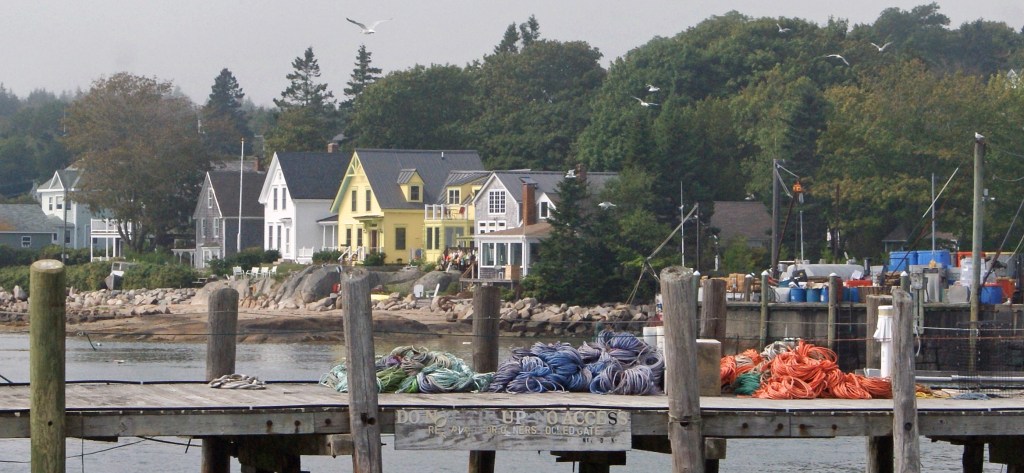
Lying on this Stonington wharf, these colorful, braided ropes are reminders of things which hold us tightly. King Solomon used braided cords as a metaphor for strong relationships. The Message paraphrases his wisdom: “With a friend you can face the worst. Can you round up a third? A three-stranded rope isn’t easily snapped.” (Ecclesiastes 4:12 (MSG)
Just as intertwined rope strands increase strength and durability, bonds of love, shared values, and mutual support join to make strong marriages, cohesive families, and successful cooperative efforts. We are more stable and able when joined in community where we share ideas, customs, rituals, and learned values but are free to communicate differences.
However, not all bonds are good. Toxic relationships, inherited disorders, unfortunate personality traits, difficult circumstances, chronic disabilities, and devastating addictions are restrictive. They control us, hold us back, and are often the source of shame.
Scripture speaks of being enslaved by sinful attitudes, behaviors and beliefs. Christ said that he was Truth and “the Truth will make you free.” His atoning work releases the power of forgiveness, takes away shame, grants freedom from condemnation, provides comfort in difficulties, gives meaning and purpose, enables overcoming, and ensures hope even in death if we choose to believe.
Many of us are familiar with the beautiful, hope-filled, and much beloved hymn “Amazing Grace,” which was written by slave owner John Newton after his conversion. Another version (Amazing Grace -My Chains are Gone). expands the concept of how free and amazing God’s grace is when it comes to bondage of the soul. Although better heard than read, one refrain is:
My chains are gone, I’ve been set free/ My God, my Savior has ransomed me/And like a flood His mercy reigns/
Unending love, amazing grace
No entrapped mind or soul is so tightly bound that Jesus cannot intervene and loose the bonds. “If the Son (Jesus) sets you free, you are will be free indeed.” (John 8:36 (ESV).
 Sweet Words from Maine
